Introduction
Telehealth counseling has become a cornerstone of modern mental‑health service delivery, allowing clients to connect with licensed therapists from any location with a stable internet connection. This flexibility eliminates travel, reduces missed appointments, and expands reach to rural and underserved communities where provider shortages are acute. By delivering evidence‑based therapies—such as CBT, ACT, and medication management—via secure video, phone, or messaging, telehealth preserves clinical effectiveness while offering greater privacy and reduced stigma. Accessibility is essential: timely, affordable care can prevent worsening symptoms and improve overall well‑being, especially for those facing transportation, mobility, or scheduling constraints. Julia Flynn Counseling embraces this paradigm, committing to personalized care that meets each client where they are—both literally and emotionally. The practice integrates teletherapy into its service model, ensuring that every individual receives compassionate, client‑centered treatment regardless of geography or circumstance.
Geographic Reach and Rural Access
Geographic Reach and Rural Access – Key Summary
| Key Point | Statistics / Evidence | Platforms / Examples |
|---|---|---|
| Eliminates travel barriers | 48 % of Catholic Charities NH counseling sessions were online in early 2023; 39 % of U.S. adults used telehealth in 2022 | Cerebral, Mindful Care, Talkspace (serve all 50 states) |
| Expands service to underserved areas | Rural NH clients cite lack of long drives as primary benefit; telehealth bridges gaps where local providers are scarce | State licensure compacts enable cross‑border care |
| Comparable effectiveness | Video‑based teletherapy as effective as face‑to‑face for anxiety, depression, PTSD, youth interventions | Research shows similar symptom reduction and high satisfaction |
| Increased access & reduced stigma | 57 % of adults with depression or anxiety chose virtual care in 2022 | Telepsychology delivers secure video, phone, messaging |
| Higher engagement in rural pop. | Platforms report reduced wait times and higher engagement for rural patients | 89 % of psychologists used telehealth (67 % hybrid) in 2023 |
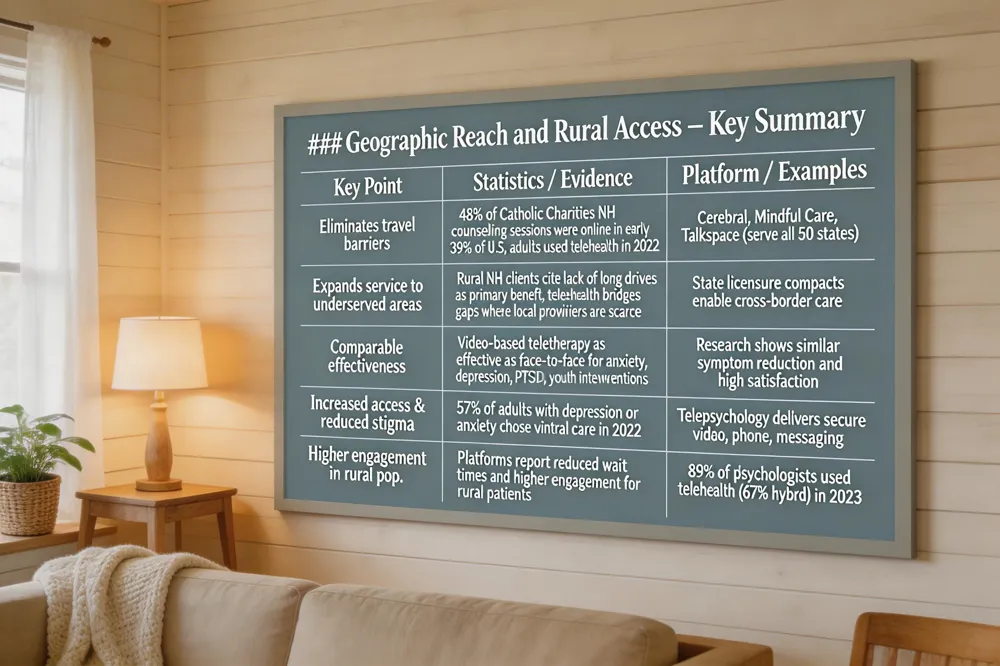 Teletherapy eliminates travel barriers by letting clients attend sessions from any location with a stable internet connection, removing the time, cost, and logistical challenges of commuting to a clinic. Catholic Charities NH reported that 48% of counseling sessions in early 2023 were conducted online, and clients in rural New Hampshire cite the ability to receive care without long drives as a primary benefit. By expanding service delivery to remote and underserved areas, telehealth bridges gaps where local providers are scarce. Platforms such as Cerebral, Mindful Care, and Talkspace serve all 50 states, giving patients in isolated communities access to evidence‑based therapies like CBT and medication management. State licensure and cross‑border care are facilitated through inter‑jurisdictional compacts and regulatory flexibility; clinicians can legally treat clients in other states when licensed appropriately, widening the therapist pool for rural patients.
Online vs in‑person therapy research: Studies consistently show video‑based teletherapy is as effective as face‑to‑face treatment for anxiety, depression, PTSD, and youth interventions, with comparable symptom reduction and high satisfaction rates.
Telehealth in psychology: Telepsychology uses secure video, phone, or messaging to deliver mental‑health services, offering synchronous and asynchronous options that maintain therapeutic outcomes while increasing convenience.
Online therapy statistics: In 2023, 89% of psychologists used telehealth (67% hybrid) and platforms report reduced wait times and higher engagement, especially in rural populations.
Impact on mental health: Telehealth expands access and reduces stigma, and supports continuity of care during emergencies, delivering outcomes on par with traditional care for many conditions.
Scholarly articles: Research highlights comparable effectiveness, high client satisfaction, and challenges such as technology access and rapport building.
Mental health statistics: By 2022, 39% of U.S. adults used telehealth, with 57% of those with depression or anxiety opting for virtual care, underscoring its role in reaching underserved areas.
Convenient Scheduling and Flexibility
Convenient Scheduling and Flexibility – Highlights
| Benefit | Example | Impact |
|---|---|---|
| Flexible appointment times | Evenings, weekends, after‑school hours offered by providers | Reduces missed sessions; lower cancellation rates |
| Same‑day / next‑day appointments | Cerebral & Mindful Care can schedule within 24 hrs | Critical for acute distress; faster care initiation |
| Reduced travel time & cost | Clients attend from any stable internet location | Saves money, improves work/family balance |
| Hybrid model adoption | 89 % of psychologists used telehealth (67 % hybrid) by 2023 | Maintains convenience without compromising outcomes |
| Comparable outcomes | Studies show similar recovery rates for depression, anxiety, OCD, PTSD | Convenience does not sacrifice clinical effectiveness |
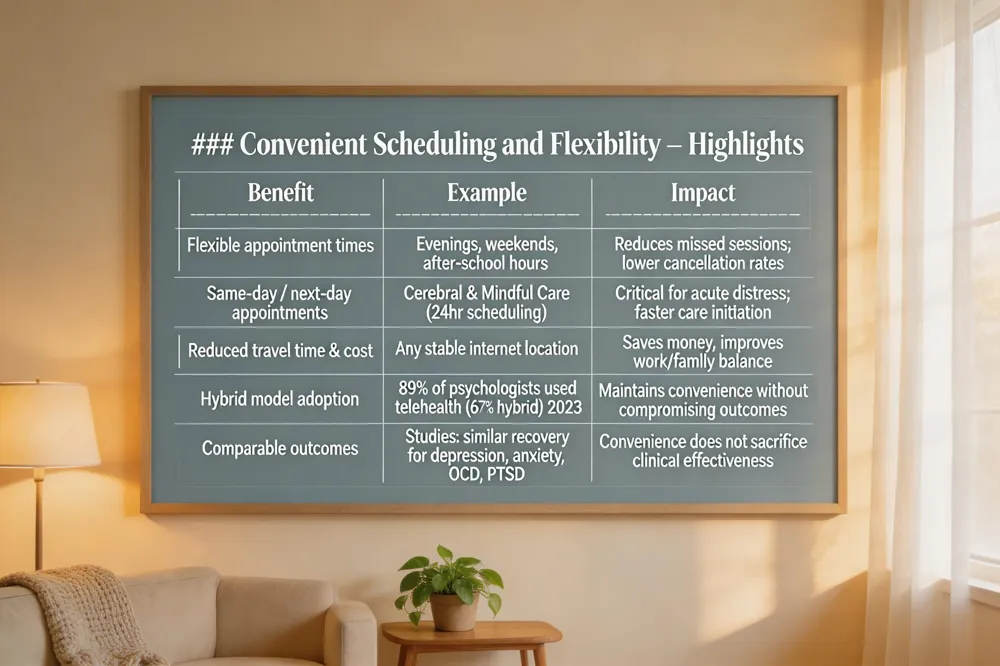 Teletherapy’s scheduling flexibility is a core advantage for clients and clinicians alike. Providers can offer flexible appointment times—including evenings, weekends, and after‑school hours—so therapy fits into busy lives without sacrificing work or family responsibilities. In New Hampshire, Catholic Charities NH reported a noticeable drop in missed sessions after moving 48 % of its counseling to an online format, demonstrating how virtual access reduces cancellations and no‑shows. Platforms such as Cerebral and Mindful Care even provide same‑day or next‑day appointments, allowing people to start care within 24 hours of reaching out, a critical benefit for those experiencing acute distress.
What are 4 examples of how telehealth is used to help others? Telehealth delivers behavioral‑health counseling via video calls for anxiety, depression, and substance‑use concerns; it supports medication management through remote prescription reviews; it enables chronic‑illness monitoring with digital vitals transmitted to clinicians; and it offers virtual physical or occupational therapy sessions with real‑time therapist feedback.
What are the benefits of telehealth therapy? Eliminating travel saves time and money, expands access to rural and underserved populations, shortens wait lists, and offers privacy that lessens stigma. Research shows video‑based therapy is as effective as in‑person care.
Online therapy statistics By 2023, 89 % of psychologists used telehealth (67 % in a hybrid model), and early‑career clinicians report the highest hybrid use. Studies reveal comparable recovery rates for depression, anxiety, OCD, and PTSD when care shifts online, confirming that convenience does not compromise outcomes.
Affordability and Insurance Coverage
Affordability and Insurance Coverage – Core Points
| Feature | Details | Example Platforms |
|---|---|---|
| Sliding‑scale fees | $40‑$70 per session for low‑income or uninsured clients | Catholic Charities NH, Open Path |
| Lower overhead → lower fees | No physical office reduces costs | Cerebral $175/video visit, $795/3‑month bundle |
| Insurance parity | Most major plans reimburse telehealth at parity with in‑person visits | Accepts Aetna, Cigna, UnitedHealthcare, Blue Cross Blue Shield, Medicare, Medicaid |
| Medicaid acceptance | States cover virtual services through Medicaid | Mindfully (OH), Zencare (IL) |
| Medication management integration | Secure video visits for prescribing, often copay‑free when insured | Cerebral, Doctor On Demand, Telehealth services |
| Cash‑pay options for uninsured | Flat‑fee virtual appointments and prescriptions | GoodRx Care, PlushCare, Hers |
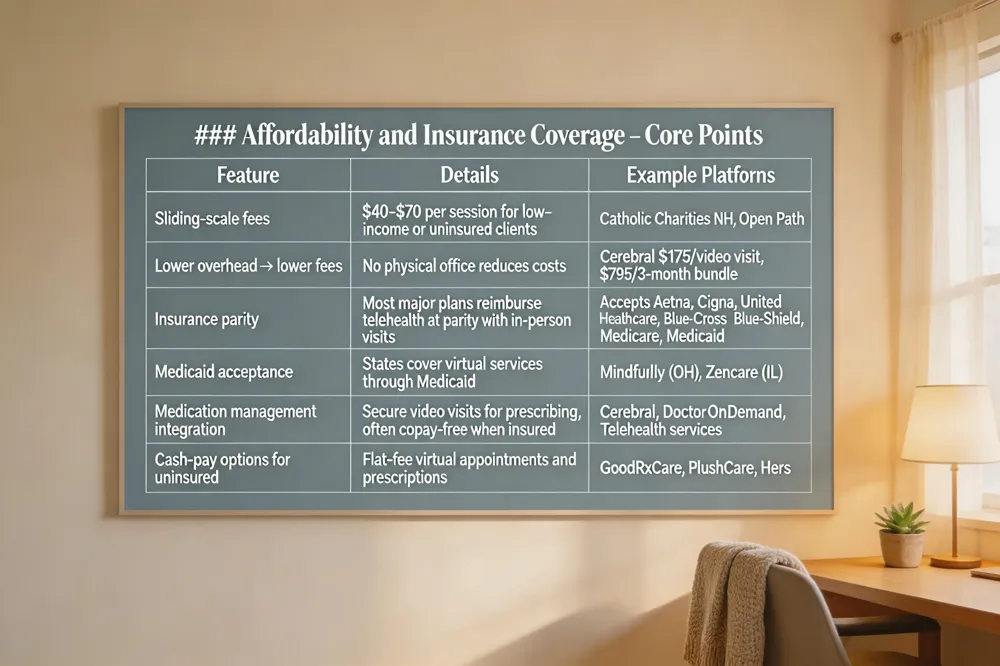 Teletherapy dramatically lowers the cost of mental‑health care while expanding access. Sliding‑scale fees, as used by Catholic Charities NH and Open Path, let uninsured or low‑income clients pay as little as $40‑$70 per session, far below the typical $80‑$200 market rate. Because therapists no longer need a physical office, overhead drops, and those savings are passed on to patients through lower session fees or transparent pricing plans such as Cerebral’s $175 per video visit or $795 for a three‑month bundle.
Most major insurance plans now reimburse telehealth at parity with in‑person visits, and many states cover virtual services through Medicaid. Platforms like Mindfully (Ohio) and Zencare (Illinois) accept Medicaid, offering free or low‑cost video sessions that follow evidence‑based protocols. This insurance parity eliminates out‑of‑pocket expenses for both the initial assessment and ongoing medication management.
Medication management is seamlessly integrated into telehealth. Licensed prescribers can evaluate symptoms via secure video, issue prescriptions, and coordinate with therapists for combined treatment—Cerebral, Doctor On Demand, and Telehealth services all accept Aetna, Cigna, UnitedHealthcare, Blue Cross Blue Shield, Medicare, and Medicaid. Clients can receive same‑day or next‑day appointments, track progress through digital dashboards, and have prescriptions filled at their preferred pharmacy, often with no copay when covered by insurance.
Online mental health medication with insurance – Yes. Secure video visits allow prescribers to diagnose, prescribe, and monitor medication, and most insurers cover the evaluation and drug costs.
Online mental health services that take Medicaid – Many states provide fully Medicaid‑covered tele‑therapy (e.g., Mindfully in Ohio, Zencare in Illinois).
Cerebral online therapy – Nationwide platform offering evidence‑based therapy and medication management, accepting most insurance and cash‑pay options.
Telehealth policy and procedure for mental health – Clinics follow HIPAA‑compliant, secure video platforms, obtain informed consent, verify licensure, and bill using CMS telehealth codes without geographic restrictions.
Online mental health medication without insurance – Services like GoodRx Care, PlushCare, and Hers provide flat‑fee virtual appointments and prescriptions for patients without insurance.
Privacy, Stigma Reduction, and Ethical Safeguards
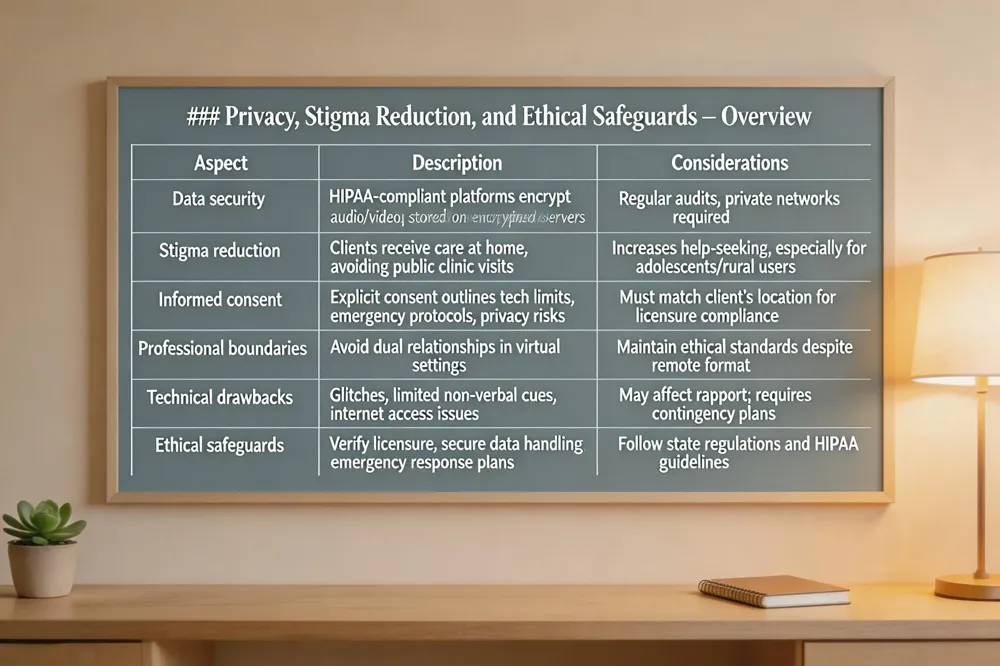
Privacy, Stigma Reduction, and Ethical Safeguards – Overview
| Aspect | Description | Considerations |
|---|---|---|
| Data security | HIPAA‑compliant platforms encrypt audio/video; recordings stored on encrypted servers | Regular audits, private networks required |
| Stigma reduction | Clients receive care at home, avoiding public clinic visits | Increases help‑seeking, especially for adolescents/rural users |
| Informed consent | Explicit consent outlines tech limits, emergency protocols, privacy risks | Must match client’s location for licensure compliance |
| Professional boundaries | Avoid dual relationships in virtual settings | Maintain ethical standards despite remote format |
| Technical drawbacks | Glitches, limited non‑verbal cues, internet access issues | May affect rapport; requires contingency plans |
| Ethical safeguards | Verify licensure, secure data handling, emergency response plans | Follow state regulations and HIPAA guidelines |
 Confidentiality and Data Security
Secure, HIPAA‑compliant video platforms encrypt audio and video streams, protecting client records from hacking or accidental exposure. Therapists must verify that both provider and client use private, password‑protected networks and that any session recordings are stored on encrypted servers. Regular security audits and clear data‑retention policies further safeguard client information.
Reducing Public Stigma
Teletherapy allows clients to receive care from the privacy of their own home, eliminating the visible act of entering a mental‑health clinic. This anonymity lowers the fear of being seen by acquaintances and encourages help‑seeking, especially among adolescents and rural populations where stigma is strongest. By normalizing digital mental‑health access, platforms help shift public perception toward acceptance.
Ethical Considerations for Online Practice
Ethical issues with online therapy – Clinicians must obtain explicit informed consent that outlines technology limits, emergency protocols, and data‑privacy risks. Licensure must match the client’s location to avoid jurisdictional violations. Professional boundaries remain essential; therapists should avoid dual relationships that may arise in virtual settings.
Mindful care – A compassionate, evidence‑based approach integrates psychotherapy, counseling, and medication management while emphasizing present‑moment awareness. This holistic model supports anxiety reduction, emotional regulation, and lasting well‑being.
Disadvantages of online therapy – Technical glitches, reduced non‑verbal cue detection, and privacy concerns can impede treatment. Clients without reliable internet or a private space may face barriers.
Telehealth pros and cons – While telehealth expands access, offers flexible scheduling, and delivers outcomes comparable to in‑person care, it also demands robust security, equitable insurance coverage, and adherence to state licensing requirements.
Clinical Effectiveness and Evidence‑Based Outcomes
Clinical Effectiveness and Evidence‑Based Outcomes – Summary
| Study Finding | Condition(s) | Outcome |
|---|---|---|
| Video‑based teletherapy equal to face‑to‑face | Anxiety, depression, PTSD, youth interventions | Comparable symptom reduction, high satisfaction |
| Systematic review (60+ studies) | Various mental‑health disorders | No significant differences in symptom improvement or quality‑of‑life |
| Modalities supported | CBT, medication management, group sessions, asynchronous messaging | Therapeutic alliance and client satisfaction similar to in‑person |
| Strong evidence for | Depression, generalized anxiety, PTSD, bipolar, ADHD, substance‑use | Effective treatment outcomes across conditions |
| Adolescents & rural patients | Home setting increases openness; eliminates travel barriers | Improves engagement and reduces stigma |
| Cost‑effectiveness | Sliding‑scale and insurance coverage broaden access | Teletherapy is a financially viable alternative |
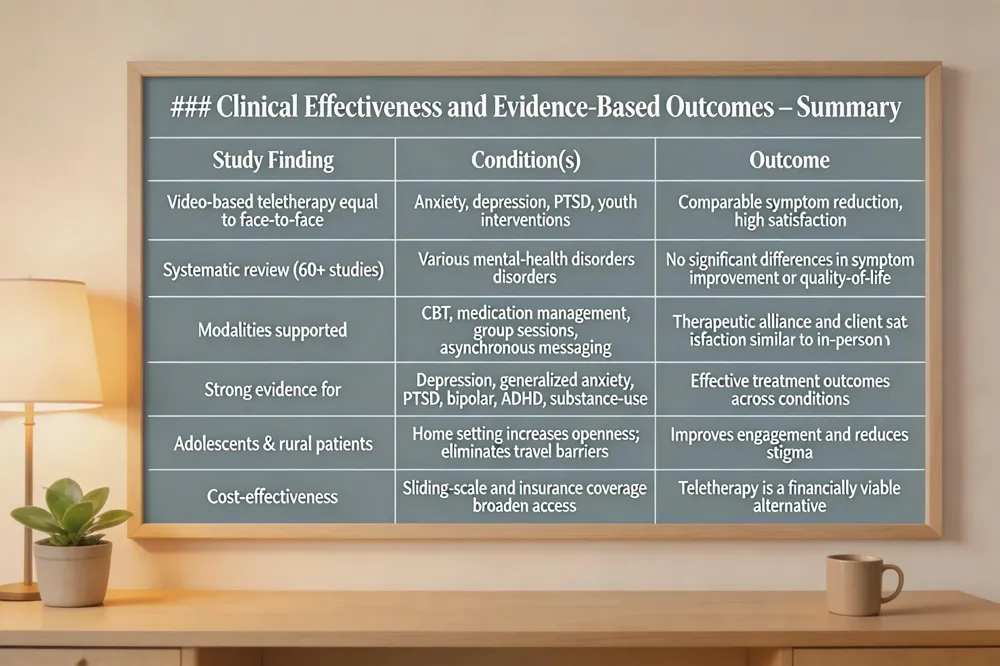 Numerous studies confirm that teletherapy delivers outcomes on par with traditional face‑to‑face care. Video‑based telemental health has been shown to reduce depressive symptoms, anxiety, PTSD and other disorders as effectively as in‑person sessions (Walden University; CMAJ; JAMA Network Open). A systematic review of 60+ studies reported no significant differences in symptom improvement or quality‑of‑life scores between virtual and office‑based treatment, supporting the clinical validity of platforms such as Cerebral, Talkspace, and Catholic Charities NH. Teletherapy works well across modalities—cognitive‑behavioral therapy, medication management, group sessions, and even asynchronous messaging—delivering comparable therapeutic alliance and client satisfaction. Specific conditions with strong evidence include depression, generalized anxiety, PTSD, bipolar disorder, ADHD, and substance‑use disorders. For adolescents, the familiar home setting can increase openness, while for rural populations it eliminates travel barriers and reduces stigma. Insurance coverage and sliding‑scale options further broaden access, making teletherapy a cost‑effective, evidence‑based alternative for diverse client needs.Is telemental health effective? Yes—research consistently shows telehealth yields symptom reductions and quality‑of‑life gains equivalent to in‑person care. Is telehealth therapy effective? Yes—clinical trials and real‑world data demonstrate comparable outcomes and therapeutic alliances. Online therapy statistics? By 2023, 89 % of psychologists used telehealth (67 % hybrid), and platforms report rapid appointment scheduling and high satisfaction. What is online therapy? It is mental‑health treatment delivered via secure video, phone, or messaging, allowing flexible, private, and evidence‑based care. Telehealth in psychology? Telepsychology uses HIPAA‑compliant video or chat to provide therapy, achieving results similar to office visits for anxiety, depression, PTSD, and more. Telehealth impact on mental health? It expands access, reduces travel costs, shortens wait times, and maintains continuity during emergencies, while offering creative digital interventions that enhance engagement.
Specialized Applications and Emerging Platforms
Specialized Applications and Emerging Platforms – Key Examples
| Application | Description | Platform Example |
|---|---|---|
| Telepsychiatry | Psychiatric evaluation, medication management, therapy via secure video/audio | Nationwide telehealth platforms (e.g., Cerebral) |
| Behavioral‑health counseling | Video calls for anxiety, depression, substance‑use | Cerebral, Talkspace |
| Remote medication management | Prescription reviews, dose adjustments via video | Doctor On Demand, Cerebral |
| Chronic‑illness monitoring | Digital vitals transmitted to clinicians for ongoing care | Integrated health‑tech solutions |
| Virtual OT/PT sessions | Real‑time therapist feedback on exercises | Emerging platforms with motion‑tracking |
| Same‑day access | Immediate appointments within 24 hrs for acute distress | Cerebral, Mindful Care |
| Evidence‑based protocols | Structured CBT, DBT, medication plans delivered remotely | Platforms with digital dashboards |
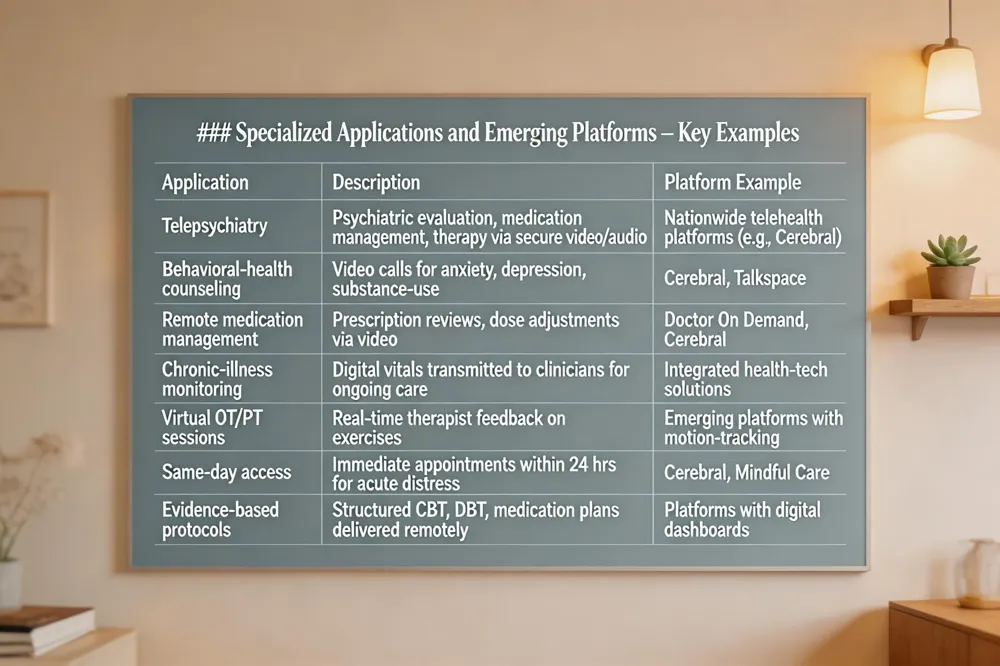 Telehealth in psychiatry, known as telepsychiatry, delivers psychiatric evaluation, medication management, and therapy through secure video or audio‑only technology. By removing the need for an in‑person visit, it expands access to specialty mental‑health care for rural residents, those with transportation challenges, and busy professionals. Research confirms that telepsychiatry provides diagnostic accuracy, treatment outcomes, and patient satisfaction comparable to face‑to‑face care, while reducing stigma and time away from work. Clinicians must be licensed in the patient’s state, and many practices blend virtual visits with occasional office appointments to create a flexible hybrid model.
Cerebral is a nationwide telehealth platform that combines evidence‑based therapy with medication management for adults and teens. Users can select from over 600 licensed clinicians, schedule same‑day or next‑day appointments, and track progress through a secure digital portal. The service accepts most major insurance plans and offers cash‑pay options; 75 % of clients report reduced anxiety or depression within 12 weeks. Therapy is delivered via video, phone, or messaging, providing confidential, convenient care from home while integrating psychiatric prescribing for a coordinated treatment approach.
Four concrete examples of how telehealth helps others include: (1) video‑based behavioral‑health counseling for anxiety, depression, or substance‑use disorders; (2) remote medication management allowing prescription reviews and dose adjustments; (3) chronic‑illness monitoring using digital tools that transmit vital signs to clinicians; and (4) virtual occupational or physical therapy sessions that guide clients through exercises in real time. These applications illustrate telehealth’s capacity to deliver personalized, evidence‑based care across diverse health needs.
Policy, Future Trends, and Continuing Access
Policy, Future Trends, and Continuing Access – Outlook
| Policy/Trend | Implication | Date/Status |
|---|---|---|
| Medicare reimbursement | Audio‑only & video mental‑health visits reimbursed through Dec 31, 2027 | Ongoing until end of 2027 |
| Rural‑facility requirement shift | Most non‑behavioral‑health telehealth will need rural‑facility setting only after 2028 | Future change in 2028 |
| In‑person visit mandate | First telehealth session requires in‑person visit within 6 months; thereafter at least once every 12 months | Ensures personal contact while preserving virtual care |
| State licensure compacts | Enables cross‑state practice, expanding therapist pool for rural patients | Currently active across many states |
| Continued parity laws | Insurance parity for telehealth sustains access and affordability | Expected to remain in effect |
| Emerging hybrid models | Blend of virtual and occasional office visits for flexibility | Growing adoption among clinicians |
| Emergency continuity | Telehealth maintains care during disasters, pandemics, and other emergencies | Proven critical during COVID‑19 |
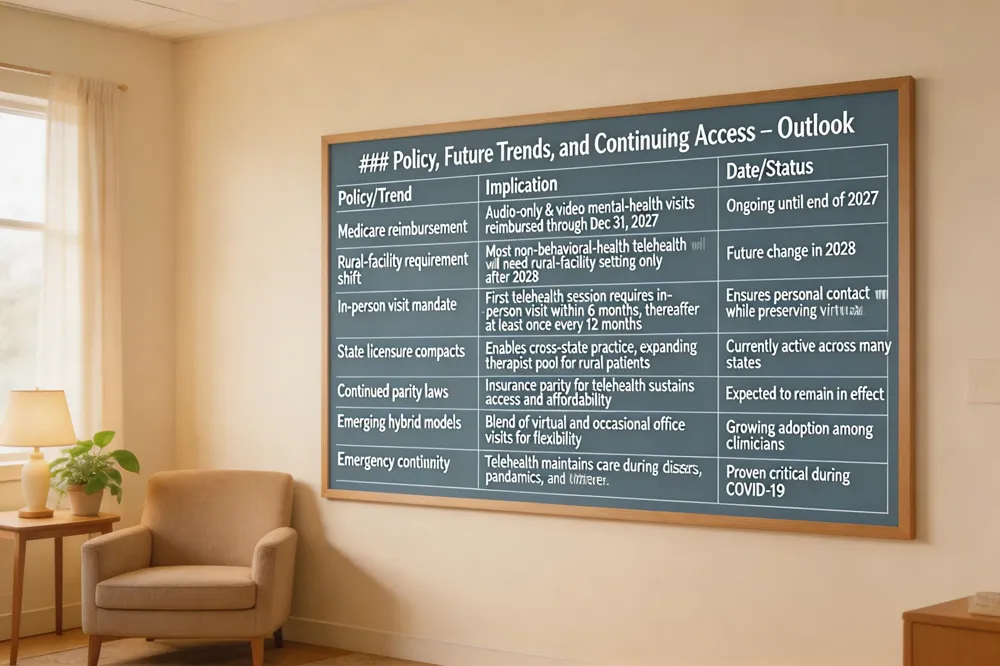 Telehealth is not disappearing in 2026. Medicare will continue to reimburse both audio‑only and video mental‑health visits through December 31, 2027, and only in 2028 will most non‑behavioral‑health telehealth require a rural‑facility setting. For counseling, an in‑person visit is mandated within six months before the first telehealth session and at least once every 12 months, ensuring ongoing personal contact while preserving virtual convenience.
Telepsychology employs secure video, phone, email or chat to deliver evidence‑based care. Synchronous video and phone sessions, as well as asynchronous messaging, have been shown to produce outcomes comparable to face‑to‑face therapy for anxiety, depression, PTSD and adjustment disorders. Clients benefit from flexible scheduling, reduced travel, and the ability to receive treatment in a familiar, private space.
The impact on mental‑health access is profound: rural and underserved populations can now connect with licensed providers across state lines, wait times shrink, and missed appointments decline. Telehealth also lowers costs by eliminating transportation and childcare expenses, and it supports continuity of care during emergencies. Overall, telehealth expands accessibility, enhances engagement, and remains a vital component of the mental‑health system.
Conclusion
Telehealth removes geographic and logistical hurdles, expands the therapist pool, offers flexible scheduling, reduces travel‑related costs, provides a private home setting that eases stigma, and maintains continuity of care during emergencies. At Julia Flynn Counseling we combine these accessibility advantages with evidence‑based modalities such as CBT, DBT, and trauma‑focused therapies, all delivered through secure, HIPAA‑compliant video platforms. Our clinicians are licensed, trained in telehealth best practices, and committed to delivering the same high‑quality outcomes you would expect in‑person. If you’re ready to experience mental‑health support that fits your life, explore our teletherapy options today—schedule a free introductory session, ask about insurance coverage, and discover how convenient, compassionate care can be right from the comfort of your own space.