Introduction
Understanding a client’s preferred learning style—visual, auditory, or kinesthetic—helps therapists deliver information in a way that reduces cognitive load and boosts retention. Research shows that aligning instruction with sensory modality improves comprehension, while multimodal approaches that blend images, spoken explanations, and hands‑on activities enhance neuroplasticity and treatment outcomes. Evidence‑based therapies such as CBT, ACT, and ABA can be personalized by incorporating visual charts, audio recordings, or movement‑based exercises, maintaining fidelity while meeting individual preferences. This client‑centered, multimodal delivery supports engagement, fosters self‑advocacy, and ultimately leads to more effective mental‑health care for diverse populations and promotes long‑term recovery and wellbeing today.
Understanding Learning Styles in Therapy
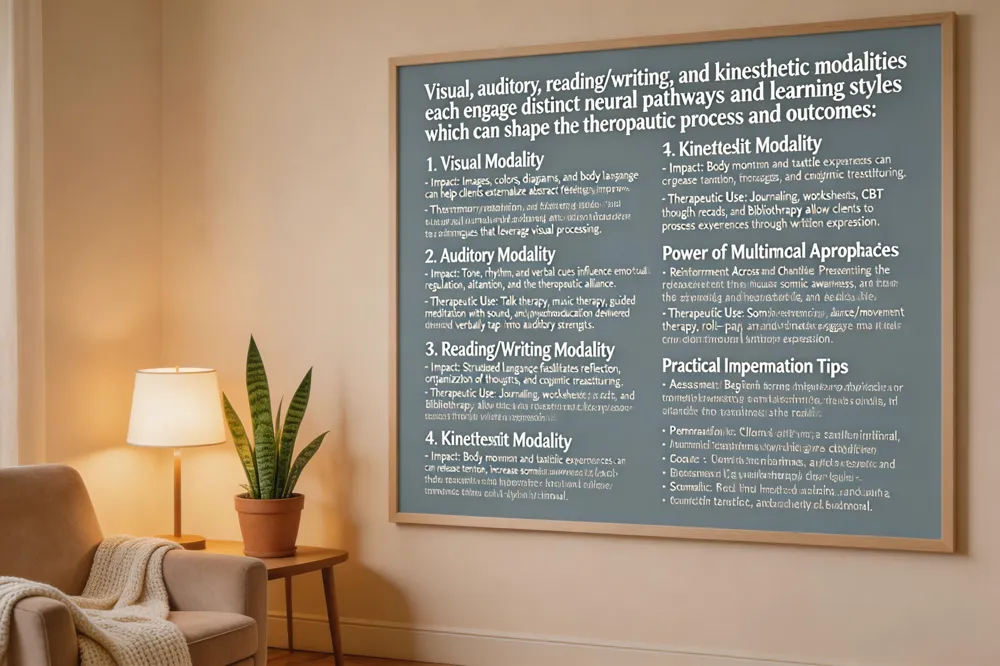 Learning styles refer to preferred ways individuals process information and are most commonly grouped into visual, auditory, reading/writing, and kinesthetic modalities ( VARK ). In therapeutic settings, visual learners benefit from diagrams, charts, and video models; auditory learners respond to spoken explanations, storytelling, and recordings; reading/writing learners prefer handouts and journaling; and kinesthetic learners thrive on hands‑on activities, role‑play, and movement‑based exercises. Neuroscience shows that sensory processing strengths are rooted in distinct neural networks, and aligning interventions with a client’s dominant modality reduces cognitive load and enhances retention. Moreover, the brain’s plasticity allows structured practice to strengthen non‑preferred pathways, supporting flexibility across styles. Multimodal teaching—integrating visual, auditory, and kinesthetic elements—leverages multiple neural pathways, reinforcing learning and promoting neuroplastic change. Institutions such as NC State University have documented that multimodal approaches yield superior outcomes compared with single‑modality methods, making them a cornerstone of evidence‑based, personalized mental‑health care.
Adapting Sessions for Teens: Best Therapeutic Approaches
 What is the best type of therapy for teens?
Cognitive‑Behavioral Therapy (CBT) remains the most widely supported approach for adolescents, teaching them to identify and reframe negative thoughts, develop coping skills, and manage anxiety or depression. For teens experiencing intense emotions, self‑harm, or borderline traits, Dialectical Behavior Therapy (DBT) adds structured skills training in emotion regulation and interpersonal effectiveness. Interpersonal Therapy (IPT) and Acceptance and Commitment Therapy (ACT) are also evidence‑based options when relationship issues, identity concerns, or experiential avoidance predominate. Creative modalities—art, play, or music therapy—along with family‑focused counseling, can reinforce these core treatments by fostering emotional expression and strengthening support networks.
What is the best type of therapy for teens?
Cognitive‑Behavioral Therapy (CBT) remains the most widely supported approach for adolescents, teaching them to identify and reframe negative thoughts, develop coping skills, and manage anxiety or depression. For teens experiencing intense emotions, self‑harm, or borderline traits, Dialectical Behavior Therapy (DBT) adds structured skills training in emotion regulation and interpersonal effectiveness. Interpersonal Therapy (IPT) and Acceptance and Commitment Therapy (ACT) are also evidence‑based options when relationship issues, identity concerns, or experiential avoidance predominate. Creative modalities—art, play, or music therapy—along with family‑focused counseling, can reinforce these core treatments by fostering emotional expression and strengthening support networks.
Evidence‑based adolescent intervention for group therapy Group therapy that draws on CBT, DBT, IPT, or ACT yields the strongest outcomes. Effective groups blend skill‑building (e.g., emotion‑regulation drills, problem‑solving worksheets) with a therapeutic alliance that encourages peer support and cultural safety. Structured turn‑taking, mentalization exercises, and occasional parent check‑ins help maintain cohesion and track progress, ensuring that gains persist after discharge.
Evidence‑based interventions for adolescents Beyond individual CBT/DBT, multi‑component programs such as Multi‑Systemic Therapy (MST), Family‑Based Treatment (FBT), and school‑based Social‑Emotional Learning (SEL) curricula address disruptive behavior, substance‑use risk, and broader resilience. Integrating these family‑oriented and community‑wide strategies creates a comprehensive, evidence‑driven toolkit for supporting teen mental health.
Matching Learning Styles to Therapeutic Techniques
 Therapists who recognize the three primary learning style categories—visual, auditory, and kinesthetic— can tailor sessions to match a client’s natural processing strengths. Visual learners benefit from charts, mind‑maps, color‑coded handouts, and video modeling; auditory learners respond best to spoken explanations, storytelling, recorded reflections, and role‑play dialogues; kinesthetic learners thrive when therapy includes hands‑on activities, movement‑based grounding exercises, or tactile tools.
How to adapt lessons for different learning styles? Begin by asking open‑ended questions or using a brief questionnaire to identify whether a client prefers to see, hear, or do information. Match explanations, metaphors, and exercises accordingly: provide diagrams and written summaries for visual learners, emphasize discussion and audio recordings for auditory learners, and incorporate role‑plays, movement, or manipulatives for kinesthetic learners. Rotate these approaches within a session, check in regularly, and adjust based on feedback.
How can you adapt and connect with people’s different learning styles? Observe natural habits—note‑taking, verbal processing, or use of objects—and align communication. Use visual aids for those who “see,” spoken language and storytelling for those who “hear,” and hands‑on, interactive tasks for those who “feel.” Cycling through modalities ensures all preferences are addressed.
What are the top 3 most common learning styles? The most frequently encountered styles are visual, auditory, and kinesthetic, each guiding specific therapeutic adaptations that enhance engagement, comprehension, and retention.
Comprehensive Assessment and Personalized Care Plans
 Understanding the four core categories of mental‑health services—cognitive, behavioral, humanistic, and integrative/holistic—helps clients see how therapy can be matched to their needs. The 5 C’s of therapy—Clarity, Connection, Coping, Control, and Compassion—guide sessions toward clear insight, supportive relationships, healthy stress management, personal agency, and self‑kindness.
Red flags for therapists include dismissive listening, boundary violations, unethical conduct, or any discriminatory remarks; noticing these signals may mean it’s time to seek a new provider.
Effective instructional strategies for clinicians involve being present in the therapeutic space, offering timely, constructive feedback, tailoring support to each client’s strengths, modeling continuous learning, encouraging reflective practice, fostering peer coaching, and cultivating a growth‑mindset culture.
Evidence‑based therapy practices that clinicians regularly draw upon are CBT, DBT, ACT, MI, Exposure Therapy, IPT, Family Therapy, and EMDR, alongside specialized programs such as Trauma‑Focused CBT and Multisystemic Therapy.
For youth, proven programs include the Incredible® CBT series, Youth Problem‑Solving, PBIS, Family Check‑Up, MST, Functional Family Therapy, and school‑based CBT interventions, all of which have demonstrated strong outcomes in U.S. settings.
Multimodal and Flexible Delivery in Modern Practice
 Modern mental‑health practice increasingly relies on multimodal delivery to meet diverse client needs. Modifying Presentation adaptations—such as simplifying language, adding visuals, or using creative activities—have been shown to boost client engagement and increase the extensiveness of evidence‑based technique delivery (B = 0.28, p = .002). In contrast, Extending adaptations that repeat or slow content can reduce overall technique use (B = ‑0.30, p = .003), suggesting clinicians should balance reinforcement with fidelity. Telehealth platforms expand these possibilities; video calls allow therapists to share slides, audio recordings, and interactive worksheets, supporting all learners. Is EMDR ok for teens? Yes—EMDR is an evidence‑based trauma treatment that, when tailored to a teen’s developmental level, is safe and effective. How do you adapt training approaches to various learning environments? Begin with an assessment, then blend demonstrations, verbal explanations, and hands‑on activities, using digital tools for settings and physical role‑play for in‑person sessions, and follow up with resources and feedback loops.
Community Resources and Access in Georgia
 Georgia’s Department of Behavioral Health and Developmental Disabilities (DBHDD) operates a statewide network of mental‑health centers, crisis hotlines (Georgia Crisis & Access Line 1‑800‑442‑8877, 988 Suicide & Crisis Lifeline), and comprehensive services—including psychiatric evaluation, medication management, individual and group counseling, case management, peer support, and psychosocial rehabilitation. Specialized programs address co‑occurring substance‑use disorders, housing, older‑adult, deaf, and developmental‑disability needs.
In Gwinnett County, free resources include NAMI Gwinnett support groups and online classes, DBHDD’s no‑cost counseling and peer support, the County’s Community Services Board (low‑cost individual/family therapy), and youth services at the Gwinnett Youth Services Center and Gwinnett Crisis Center.
Atlanta residents can access free care through the Fulton County Department of Behavioral Health (sliding‑scale therapy, peer support, psychiatric assessment), the City of Atlanta Behavioral Health, NAMI Northside, and culturally specific agencies such as Raksha and Ser Familia.
Medicaid‑eligible telehealth options are expanding; platforms like BetterHelp, Talkspace, Amwell, Teladoc, and state portals (e.g., Georgia’s MyWellness) partner with Medicaid to provide virtual counseling, psychiatry, and intensive outpatient programs at low or no cost. Verify plan details with your Medicaid provider before beginning services.
Local Personalized Care Near Conyers and Covington
 Julia Flynn Counseling delivers personalized, evidence‑based mental‑health care in both Conyers and Covington, GA. In each location the clinic offers CBT, ACT, DBT and trauma‑informed therapies crafting a treatment plan that matches the client’s goals, learning style and cultural background. Sessions are available in person and via secure video, with flexible hours and most major insurance accepted. Therapy is regularly reviewed and adjusted to ensure progress. Nearby alternatives include LifeStance Health in Conyers, which provides multidisciplinary services with medication management, and Geode Health, a telehealth‑focused practice. In Covington, Resilience Behavioral Health and Georgia Counseling offer similarly individualized, evidence‑based programs for adults and teens. All providers are state‑licensed, ensuring confidential, compassionate care. Therapists also assess learning preferences—visual, auditory, or kinesthetic to tailor interventions, boosting engagement and skill retention for clients throughout therapy daily.
Conclusion
Aligning therapy with a client’s preferred learning style—visual, auditory, or kinesthetic—reduces cognitive load, boosts comprehension, and strengthens therapeutic alliance, leading to higher engagement and better symptom improvement. When these adaptations are built on evidence‑based practices such as CBT, ACT, or ABA, the treatment remains clinically rigorous while meeting each individual’s unique needs. This personalized, data‑driven approach also supports neuroplastic growth, promotes flexibility across modalities, and encourages self‑advocacy. If you’re ready to experience a tailored, evidence‑in plan, please reach out to Julia Flynn Counseling to schedule a consultation and explore how we can support your mental‑health journey and lasting change.