Why Safe, Authentic Therapy Matters
LGBTQ+ individuals in the United States face mental‑health disparities that are roughly twice as high as those of heterosexual and cisgender peers, with depression, anxiety, substance‑use disorders, and suicidal ideation markedly elevated (NAMI, Trevor Project). Minority stress theory explains that chronic stigma, discrimination, and the need to conceal one’s identity create a toxic stress environment that fuels these disparities. Research consistently shows that affirming therapeutic approaches—such as using correct pronouns, gender‑neutral intake forms, and trauma‑informed, LGBTQ‑affirmative techniques—significantly reduce anxiety, depression, and suicide risk (APA, Trevor Project). Creating a safe, authentic therapeutic space not only validates clients’ identities but also fosters resilience, self‑acceptance, and better overall mental‑health outcomes.
Understanding LGBTQ+ Mental‑Health Disparities
Key Mental‑Health Disparities & Drivers
| Disparity | Relative Prevalence vs. Heterosexual/Cisgender Peers | Primary Contributing Factors |
|---|---|---|
| Depression | ~2× higher odds | Minority stress (stigma, discrimination, concealment) |
| Anxiety | ~2× higher odds | Chronic social pressure, internalized homophobia |
| Substance‑use disorders | ~2× higher odds | Coping with minority stress, trauma exposure |
| Suicidal ideation | ~2× higher odds | Elevated distress, lack of affirming support |
| Trans adult mental‑health conditions | ~4× higher odds | Trans‑specific discrimination, barriers to care, historic conversion therapy trauma |
 LGBTQ+ individuals in the United States face markedly higher mental‑health burdens than their heterosexual, cisgender peers. National Alliance on Mental Illness data show they are twice as likely to experience depression, anxiety, substance‑use disorders, and suicidal ideation, while transgender adults are nearly four times as likely to meet criteria for a mental‑health condition. Minority stress theory explains that chronic social pressures—stigma, discrimination, and the need to conceal one’s identity—create persistent physiological and psychological stress that amplifies these risks. Historically, many LGBTQ+ people were forced into conversion therapy or reparative therapy, a discredited practice that attempts to change sexual orientation or gender identity and has been repeatedly linked to heightened suicide risk and long‑term trauma. Recognizing these disparities and the harmful legacy of conversion therapy underscores the urgent need for affirming, culturally competent therapeutic environments that validate each client’s authentic identity and actively counteract minority stress.
Core Principles of Affirmative Therapy
Core Principles of LGBTQ+‑Affirmative Therapy
| Principle | Description | Therapeutic Integration |
|---|---|---|
| Validation of Identity | Actively affirm client’s sexual and gender identity using correct name/pronouns | Consistent pronoun use, intake forms that capture identity |
| Address Minority Stressors | Explicitly explore stigma, discrimination, internalized homophobia | Psychoeducation, CBT restructuring of stress‑related cognitions |
| Safe, Welcoming Space | Create a physically and emotionally safe therapeutic environment | Inclusive décor, gender‑neutral language, telehealth options |
| Strengthen Resilience | Empower clients to develop coping skills and self‑acceptance | ACT, DBT skills training, trauma‑informed approaches |
| Collaborative Goal‑Setting | Align treatment goals with client’s authentic life aspirations | Narrative therapy, client‑centered planning |
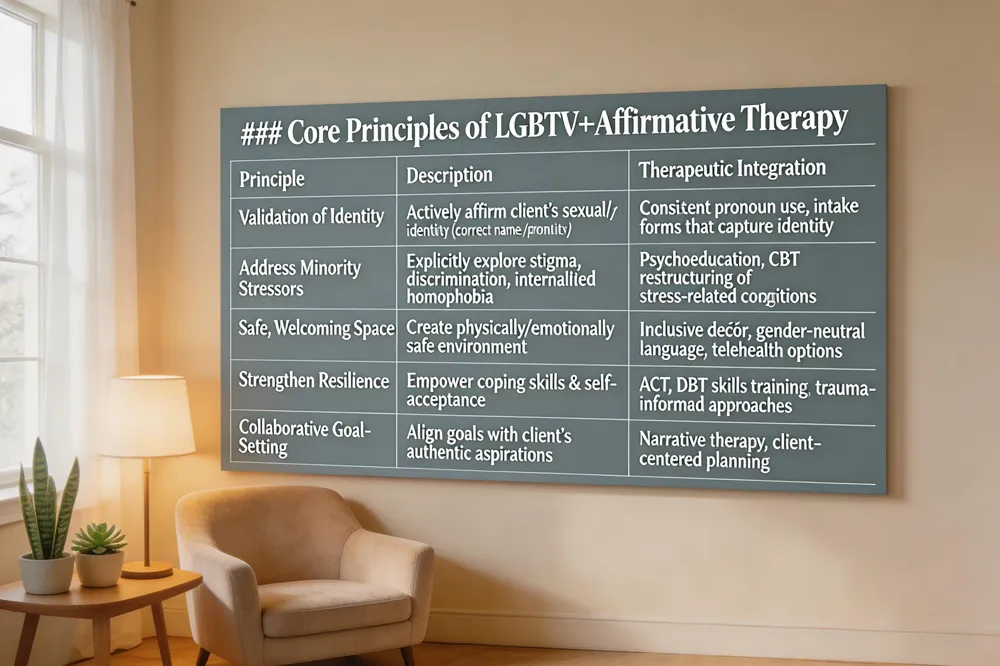 Affirmative therapy actively validates LGBTQ+ clients’ sexual and gender identities while explicitly addressing the minority‑stressors—such as stigma, discrimination, and internalized homophobia that contribute to anxiety, depression, and other mental‑health concerns. By creating a safe, welcoming therapeutic space and using the client’s preferred pronouns and terminology, the therapist models acceptance and helps the client develop a positive self‑schema. The approach can be woven into evidence‑based modalities like cognitive‑behavioral therapy, dialectical‑behavioral therapy, acceptance and commitment therapy, or trauma‑informed interventions, targeting mechanisms such as hypervigilance, shame, and emotion‑dysregulation. Research shows LGBTQ‑affirmative psychotherapy reduces depressive and anxiety symptoms, improves coping, and lowers suicide risk across diverse sexual and gender‑minority populations. Ultimately, the goal is to empower clients to live authentically, strengthen resilience, and foster overall well‑being.
Creating an Inclusive Therapeutic Environment
Elements of an Inclusive Therapeutic Environment
| Component | Implementation | Expected Impact |
|---|---|---|
| Physical Symbols | Rainbow flag, gender‑neutral signage, inclusive artwork | Signals safety, reduces minority‑stress arousal |
| Intake Practices | Forms that ask for chosen name, pronouns, gender identity | Improves accuracy, models respect |
| Pronoun Use | Therapist asks and consistently uses client’s pronouns | Lowers misgendering threat, builds trust |
| Telehealth Accessibility | Secure video platforms, virtual waiting rooms with inclusive language | Extends affirming care to rural/isolated clients |
| Staff Training | Ongoing cultural‑competency workshops | Ensures consistent affirming practice across the team |
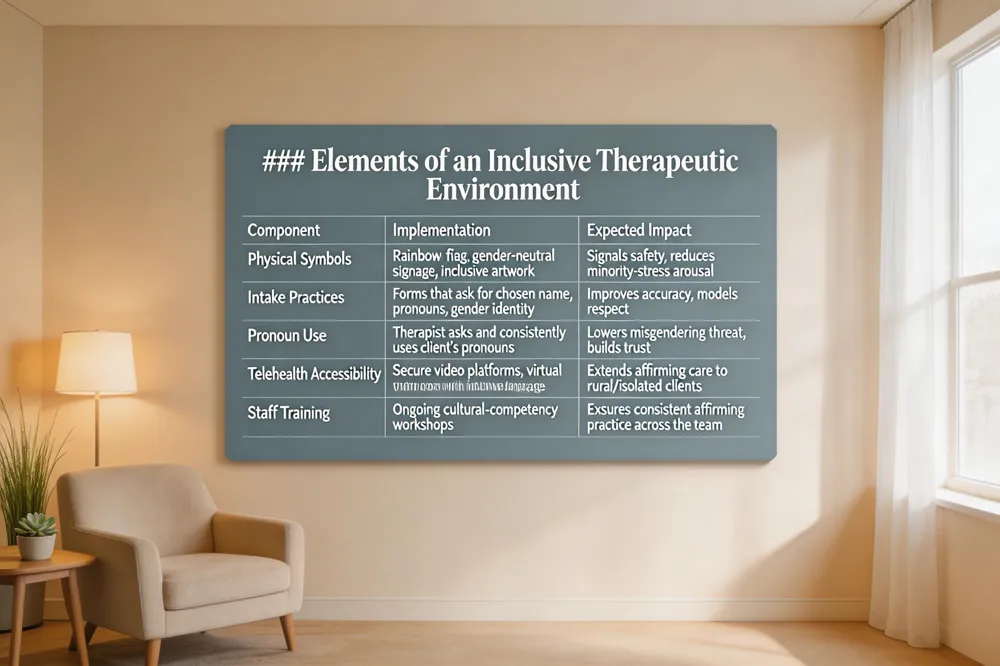 Therapeutic spaces that are LGBTQ+‑friendly signal safety through both physical cues and clinical practices. Visible symbols—rainbow flags, gender‑neutral signage, inclusive intake forms, and gender‑neutral restrooms—communicate that the office welcomes diverse identities. Therapists consistently ask for and use each client’s chosen name and pronouns, modeling respect and reducing the threat of misgendering. This simple affirmation lowers minority‑stress arousal and fosters trust, allowing clients to explore identity, relationships, and trauma without fear of judgment. Flexible telehealth options extend these affirming conditions to clients who cannot attend in‑person sessions, especially in rural areas or where local providers lack LGBTQ+ expertise. Secure video platforms, virtual waiting rooms with inclusive language, and digital intake that capture pronouns ensure continuity of care. Together, inclusive décor, pronoun affirmation, and accessible telehealth create a non‑judgmental, trauma‑informed environment that supports self‑acceptance, reduces anxiety and depression, and promotes overall mental‑well‑being for LGBTQ+ individuals.
Professional Pathways and Ethical Foundations
Professional Pathways & Ethical Foundations
| Step | Requirement | Notes |
|---|---|---|
| Academic Credential | Master's or Doctoral degree in counseling, social work, MAFT, or psychology | Must include clinical practicum |
| Supervised Hours | State‑mandated supervised clinical hours (varies by license) | Typically 3,000–4,000 hrs |
| Licensure | Obtain LCSW, LMFT, LPC, etc. | Pass state exam, maintain continuing education |
| Specialized Training | LGBTQ+ affirmative‑therapy coursework, trauma‑informed CBT, ACT, etc. | Certifications such as LGBTQ+ Affirmative Care Specialist |
| Ethical Standards | ACA Code of Ethics (dignity, diversity, confidentiality, competence) | Guides culturally sensitive practice |
| Ongoing Development | CE courses, AFFIRM series, Queer & Trans Therapists of Color Network workshops | Earn CE credits, digital badges, mentorship |
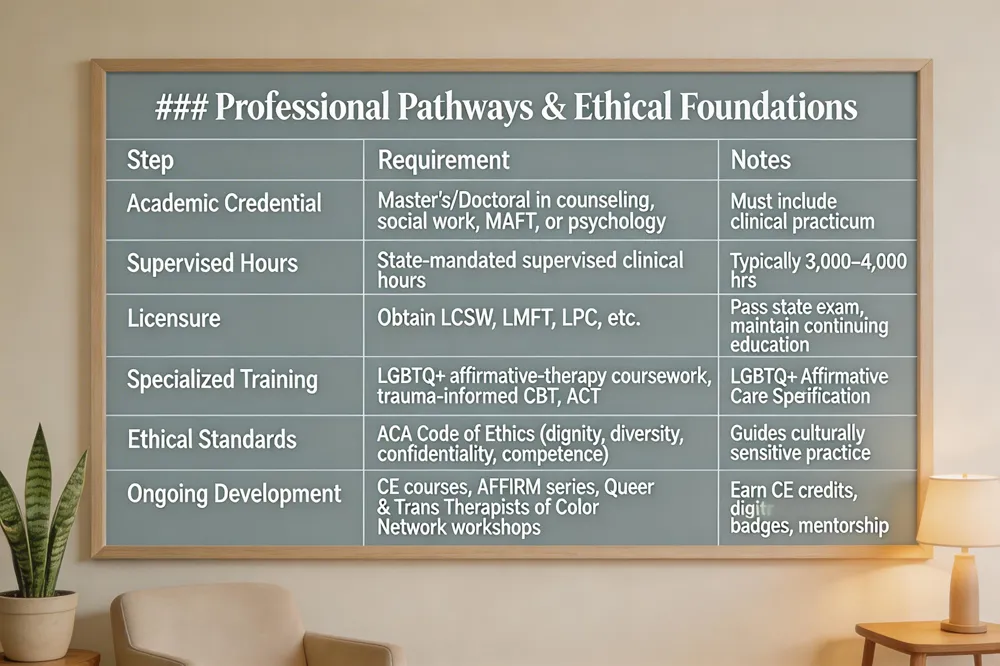 To become an LGBTQ+ therapist, earn a master’s or doctoral degree in counseling, social work, marriage‑and‑family therapy, or psychology, complete state‑required supervised hours, obtain licensure (LCSW, LMFT, LPC, etc.) and pursue specialized affirmative‑therapy training—e.g., trauma‑informed CBT, ACT, or the LGBTQ+ Affirmative Care Specialist credential. The ACA Code of Ethics sets standards for dignity, diversity, social justice, confidentiality, and competence, guiding counselors to practice ethically and culturally sensitive. Training opportunities include the AFFIRM series, Queer & Trans Therapists of Color Network workshops, and university CE courses offering CE credits, digital badges, and mentorship. Qualified LGBTQ+ therapists hold a current license, have completed affirmative‑therapy education, engage in ongoing cultural‑competency development, and consistently use correct pronouns and inclusive language. Cultural competence means understanding and respecting clients’ diverse identities, while cultural awareness involves actively recognizing those identities throughout therapy to foster trust and effective treatment.
Resources and Support Networks for LGBTQ+ Clients
Resources & Support Networks for LGBTQ+ Clients
| Resource Type | Examples | Access Details |
|---|---|---|
| Crisis Hotlines | The Trevor Project (1‑866‑488‑7386), Crisis Text Line (741741), Trans Lifeline (1‑877‑565‑8860) | 24/7, free, confidential |
| Free Online Therapy | Trevor Project counseling, 7 Cups peer‑support, Open Path Collective (low‑cost), iPrevail self‑help | Websites or apps, often no insurance needed |
| Support Groups (Adults) | TrevorSpace, LGBTribe, PFLAG virtual chapters, Meetup.com Zoom/Discord groups | Moderated, community‑based, online or hybrid |
| Scholarly Articles | PubMed, PsycINFO, Google Scholar searches (“minority stress”, “affirmative therapy”) | Access via institutional libraries or open‑access journals |
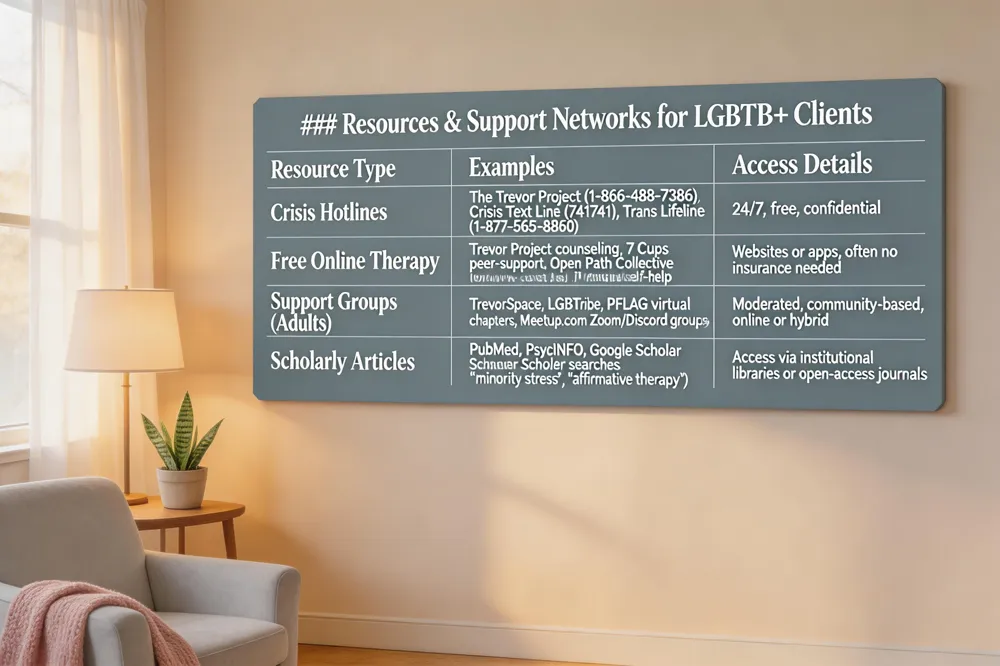 Safe, affirming resources are essential for LGBTQ+ mental‑health well‑being.
Free online LGBTQ+ therapy resources – The Trevor Project offers a 24/7 crisis hotline (1‑866‑488‑7386) and free counseling for youth, while platforms like 7 Cups provide peer‑support chat. Open Path Collective connects users to low‑cost or pro‑bono LGBTQ+‑affirming therapists, and iPrevail delivers free self‑help tools.
LGBTQ+ support groups for adults online – TrevorSpace, LGBTribe, and PFLAG’s virtual chapters host moderated chat rooms and video meetings where adults can share experiences, reduce isolation, and access resources. Meetup.com lists region‑specific Zoom or Discord groups.
LGBTQ+ mental‑health hotlines – In addition to The Trevor Project's hotline, the Crisis Text Line (741741) and Trans Lifeline (1‑877‑565‑8860) provide free, confidential support. The national 988 Suicide & Lifeline routes LGBTQ+ callers to trained counselors.
LGBTQ+ mental‑health scholarly articles – Search PubMed, PsycINFO, or Google Scholar with keywords such as “minority stress” and “affirmative therapy.” Recent systematic reviews (2024 Clinical Psychology Review, 2021 integrated literature review) offer comprehensive reference lists for evidence‑based practice.
Practical Strategies for Safe Healing
Practical Strategies for Safe Healing
| Strategy | Description | Evidence / Framework |
|---|---|---|
| Polyvagal‑Informed Regulation | Use Safe and Sound Protocol (SSP) to engage ventral vagal pathway, lowering arousal | Polyvagal Theory, reduces anxiety/depression |
| Inclusive Language | Consistently use correct pronouns, gender‑neutral terms, avoid assumptions | Improves therapeutic alliance, reduces minority stress |
| 5 C’s Framework | Clarity, Connection, Coping, Control, Compassion – guide session structure | Enhances resilience, self‑care, client agency |
| Bias Awareness Training | Clinician self‑reflection on implicit biases, ongoing education | Prevents misinterpretation, improves cultural competence |
| Family & Community Engagement | Involve supportive family members, connect to community resources | Strengthens social support, reduces isolation |
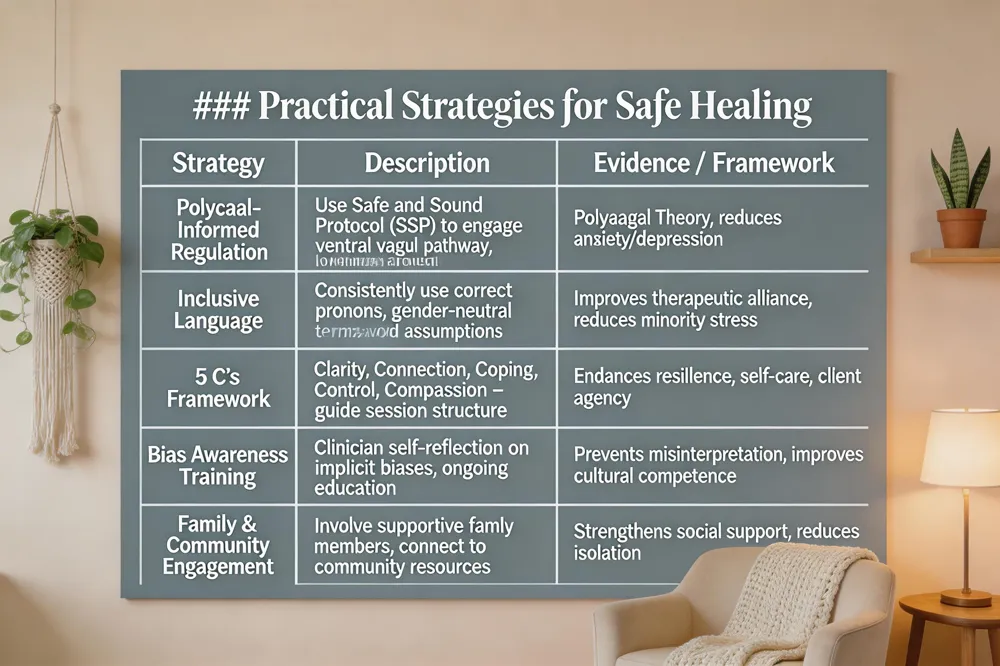 Polyvagal theory shows how the nervous system gauges safety; when the ventral vagal pathway is active, clients feel connected and can process emotions. The Safe and Sound Protocol (SSP), an auditory intervention rooted in this theory, helps regulate autonomic tone, lowering anxiety and depression in LGBTQ+ clients. Inclusive language—using correct pronouns, gender‑neutral terms, and avoiding assumptions—paired with bias awareness creates a climate where clients feel respected. The 5 C’s framework (Clarity, Connection, Coping, Control, Compassion) guides clinicians to foster communication, relationships, coping skills, client agency, and self‑care.
Strategies for creating inclusive environments: promote respectful language, model inclusive behavior, display affirming symbols, tailor learning, engage families, provide staff training, encourage peer interaction, and address bias.
Impact of lacking cultural competency: without it, clinicians misinterpret experiences, erode trust, deliver ineffective interventions, increase dropout risk, and reinforce stigma, worsening disparities.
The 5 C’s of mental health: Clarity, Connection, Coping, Control, Compassion—pillars of resilience and well‑being.
Moving Forward with Authentic, Healing Care
Therapists must view training as a lifelong commitment, regularly updating their knowledge of evolving LGBTQ+ terminology, minority‑stress research, and trauma‑informed interventions such as the Safe and Sound Protocol. Cultivating cultural humility—honoring each client’s intersecting identities and reflecting on personal biases—creates a foundation for authentic connection. Leveraging community resources like The Trevor Project’s crisis line, local LGBTQ+ directories, and peer‑support groups expands safe networks and reinforces evidence‑based practices endorsed by the APA and AMA. In every session, clinicians should explicitly ask for preferred names and pronouns, display affirming symbols, and co‑create treatment plans that honor the client’s narrative. By weaving ongoing education, community collaboration, and intentional validation into care, therapists ensure every LGBTQ+ client feels seen, heard, and truly safe.