Why Personalization Matters in Modern Therapy
Precision mental‑health care is reshaping how clinicians match treatment to each client. Digital tools—questionnaires, mobile apps, and wearables—collect real‑time data that feed algorithms, enabling therapists to predict which modality (e.g., CBT, DBT, EMDR, ACT) will most likely reduce symptoms for a given individual. Research shows that data‑driven, tailored approaches outperform clinical intuition, yielding higher remission rates, better adherence, and fewer drop‑outs. Core principles of individualized treatment planning include a thorough assessment of the client’s diagnosis, cultural background, personal goals, and preferred communication style; collaborative goal‑setting that integrates client strengths and values; ongoing outcome monitoring to adjust interventions as needed; and ethical integration of evidence‑based techniques—whether a single modality or an eclectic blend—while maintaining therapist competence and cultural humility. By centering the client’s unique story and leveraging precision tools, modern therapy delivers more effective, engaging, and sustainable healing.
The 5 C’s of Therapy – Building a Safe and Empowering Space
 Therapy thrives when five core pillars—Comfort, Competence, Confidence, Control, and Communication—are deliberately cultivated. Comfort means designing a predictable, judgment‑free setting that respects a client’s physical, sensory, and emotional needs, from a calm office to a virtual platform that feels safe. Competence involves setting realistic expectations and creating success opportunities so clients see progress and feel purposeful. Confidence builds trust both in the therapist and in the client’s own ability to confront challenges, reinforcing self‑efficacy. Control empowers clients by offering genuine choice over therapeutic goals, techniques, and pacing, which nurtures autonomy. Communication guarantees authentic, reliable expression; therapists listen actively and provide clear feedback, strengthening the therapeutic alliance. Together, these C’s establish a supportive framework where clients feel secure, capable, and motivated to engage in lasting change.
Navigating Legal Boundaries: California’s Two‑Year Rule
 California law and the state’s professional ethics rules forbid any sexual contact or sexual behavior between a therapist and a current client at all times. In addition, they prohibit any sexual contact with a former client for a period of two years after the therapeutic relationship has ended. This “two‑year rule” applies to all licensed mental‑health providers—including psychologists, clinical social workers, marriage and family therapists, and licensed professional counselors—and covers touching intimate parts, sexual intercourse, and any other inappropriate sexual communication. Violating the rule is both illegal under the Business and Professions Code and a breach of professional conduct, subject to disciplinary action by the licensing boards. The prohibition is intended to protect clients from exploitation and to preserve the therapeutic boundaries necessary for effective treatment.
Evidence‑Based Choices for Depression and Anxiety
 Evidence‑based therapies such as Cognitive‑Behavioral Therapy (CBT), Acceptance and Commitment Therapy (ACT), and Interpersonal Therapy (IPT) are the recommended choices for depression and anxiety.
Cognitive‑Behavioral Therapy (CBT) helps clients identify and restructure negative thought patterns while building practical coping skills.
Acceptance and Commitment Therapy (ACT) uses mindfulness and values‑based actions to reduce experiential avoidance and increase psychological flexibility.
Interpersonal Therapy (IPT) focuses on improving relationship dynamics that often exacerbate mood symptoms.
At Julia Flynn Counseling, therapists tailor the modality to each person’s preferences, co‑occurring concerns, and life context, ensuring a personalized treatment plan rather than a one‑size‑fits‑all approach.
Complementary techniques—guided mindfulness, relaxation training, or brief psychodynamic work—may be integrated when appropriate.
The best fit is determined collaboratively, balancing empirical effectiveness with the client’s unique goals and circumstances.
A Comprehensive List of Evidence‑Based Therapy Modalities
 Therapists draw from a growing toolbox of evidence‑based modalities to match each client’s unique needs.
CBT and its trauma‑focused variants – Cognitive‑Behavioral Therapy (CBT) is a structured, present‑focused approach proven effective for anxiety, depression, and mood disorders. Specialized CBT adaptations such as Prolonged Exposure, Cognitive Processing Therapy, and Trauma‑Focused CBT extend its reach to PTSD and complex trauma.
DBT, ACT, and EMDR – Dialectical Behavior Therapy (DBT) blends CBT skills with mindfulness to improve emotion regulation and interpersonal effectiveness, especially for borderline personality disorder and chronic suicidality. Acceptance and Commitment Therapy (ACT) promotes psychological flexibility through mindfulness and values‑based action, showing benefits for anxiety, depression, substance misuse, and chronic pain. Eye Movement Desensitization and Reprocessing (EMDR) is an evidence‑based, trauma‑focused modality that helps reprocess distressing memories and is a first‑line treatment for PTSD.
IPT, MBSR, and psychodynamic work – Interpersonal Therapy (IPT) targets depressive symptoms by improving relationship patterns, while Mindfulness‑Based Stress Reduction (MBSR) reduces anxiety and stress through meditation and body awareness. Psychodynamic therapy explores unconscious processes and early relationships, offering insight that can reshape long‑standing emotional patterns.
Family, couples, and systemic approaches – Family and couples therapies address relational dynamics, helping adolescents and adults resolve conflict, improve communication, and foster healthier attachment patterns.
List evidence‑based therapy modalities. Evidence‑based modalities include Cognitive‑Behavioral Therapy (CBT) and its specific variants such as Prolonged Exposure, Cognitive Processing Therapy, and Trauma‑Focused CBT. Dialectical Behavior Therapy (DBT) and Acceptance and Commitment Therapy (ACT) are also widely supported by research for a range of disorders. Eye Movement Desensitization and Reprocessing (EMDR) has strong evidence for treating post‑traumatic stress disorder, while Interpersonal Therapy (IPT) and Mindfulness‑Based Stress Reduction (MBSR) are effective for depression and anxiety. Psychodynamic Therapy, Motivational Interviewing , Schema Therapy, and Family or Couples Therapy each have robust data supporting their use in adult and adolescent mental‑health treatment. These modalities collectively represent the core evidence‑based approaches that clinicians draw upon to personalize care.
Personalized Therapy: Why It Works Better
 Research consistently shows that individualized treatment outperforms a one‑size‑fits‑all model. Studies of psychotherapy, addiction, and chronic‑illness care report higher symptom reduction, lower relapse rates, and greater patient satisfaction when interventions are tailored to each person’s unique profile. Aligning therapy with genetics, cultural background, and lifestyle enhances relevance; for example, Culturally Adapted CBT respects language and values, while precision‑mental‑health tools integrate wearable data and psychometric feedback to match modalities such as CBT, DBT, or EMDR to the client’s specific needs. Measurement‑based care and routine outcome monitoring enable clinicians to adjust techniques in real time, ensuring that the most effective strategies are applied throughout treatment. This dynamic, data‑informed approach supports higher engagement, faster progress, and sustained gains, making personalized therapy a more effective and efficient pathway to lasting mental‑health improvement.
Four Major Types of Therapy – A Quick Overview
 The four major types of therapy are Cognitive‑Behavioral Therapy, Psychodynamic (including psychoanalytic) Therapy, Humanistic/Existential Therapy, and Systemic/Family Therapy. Cognitive‑Behavioral Therapy (CBT) blends cognitive restructuring with behavioral interventions to modify unhelpful thoughts and actions, and it is evidence‑based for anxiety, depression, and mood disorders. Psychodynamic therapy explores unconscious processes, early relational patterns, and how past experiences shape current behavior, fostering insight and long‑standing emotional change. Humanistic and Existential therapy center on personal growth, self‑actualization, and meaning‑making, using a client‑centered relationship to encourage authentic self‑exploration. Systemic and Family therapy examine the dynamics within families or larger social systems, addressing how relational patterns influence mental health and promoting healthier interaction styles. Each approach offers a distinct framework for understanding and treating mental‑health concerns, allowing clinicians to match interventions to a client’s presenting problem, cultural background, and treatment goals. Therapists often combine elements from these models, creating integrative plans that respect a client’s preferences while maintaining evidence‑based rigor, which enhances significantly engagement and outcomes.
Special Considerations: EMDR Suitability, CBT vs DBT, Diagnoses, and CBT Personalization
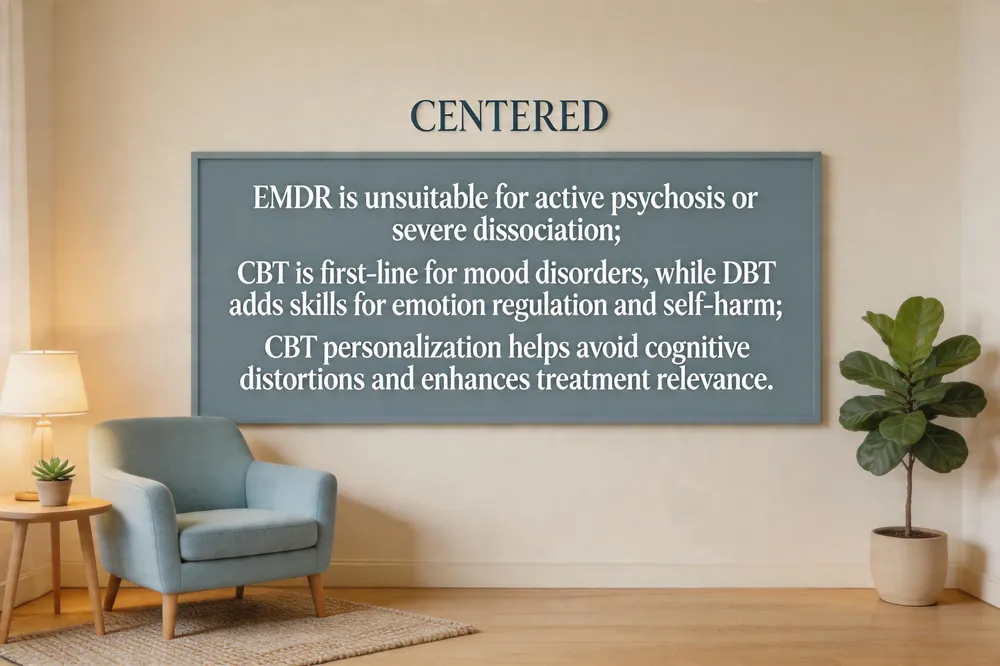 People with active psychosis—such as uncontrolled schizophrenia or manic episodes—are generally not good candidates for EMDR because intense focus on traumatic memories can destabilize them. Severe dissociative disorders, including dissociative identity disorder, also make EMDR problematic, as bilateral stimulation may trigger dissociation. Uncontrolled medical conditions that could be aggravated by rapid eye movements—such as certain neurologic or cardiac issues—should be stabilized first. For CBT versus DBT, CBT is the first‑line treatment for depression, anxiety, and other mood concerns, teaching clients to identify and re‑frame unhelpful thoughts with logical, evidence‑based techniques. DBT adds skills for emotion regulation, distress tolerance, interpersonal effectiveness, and mindfulness, suitable for emotional swings, self‑harm, or borderline traits. Licensed psychologists (Ph.D. or Psy.D.) can assess and diagnose mental‑health disorders using criteria and testing, though they cannot prescribe medication. In CBT, “personalizing” can appear as a cognitive distortion: client assumes unrelated events are caused by them, such as believing a colleague’s bad mood is a result of their actions.
Putting It All Together – Your Path to a Tailored Therapy Experience
Choosing the right therapeutic modality begins with a clear picture of your goals, current symptoms, cultural background, and preferred communication style. Key decision points include identifying the primary presenting issue (e.g., anxiety, trauma, relationship distress), weighing evidence‑based options such as CBT, DBT, ACT, EMDR, or expressive therapies, and considering practical factors like session format, cost, and therapist expertise.
We encourage you to engage in a collaborative assessment: bring questions, share your story, and explore how different approaches might fit your unique needs. A shared decision‑making process strengthens the therapeutic alliance and ensures that treatment remains flexible as you progress.
Julia Flynn Counseling embodies this personalized, evidence‑based philosophy. Our clinicians conduct thorough, client‑centered assessments, match you with modalities that align with your goals—whether it’s CBT for anxiety, EMDR for trauma, ACT for values‑driven change, or art‑based therapies for non‑verbal expression—and continuously monitor outcomes to fine‑tune the plan. By integrating data‑driven tools, cultural humility, and ongoing feedback, we create a tailored therapy experience that honors your individuality while drawing on the strongest scientific evidence.