Understanding the Path to Healing
Grief counseling matters because it offers a safe, space where individuals can process intense emotions, reduce risk of complicated grief, and improve overall mental health. Evidence‑based support combines cognitive‑behavioral strategies, acceptance‑commitment techniques, narrative meaning‑making, and mindfulness practices, often delivered in individual, group, or telehealth formats. Early, culturally‑sensitive intervention fosters coping skills, restores functioning, and promotes lasting resilience. It connects clients to peer groups, families, and resources, building social support networks.
What Is Grief Therapy?
Quick Reference: Grief Therapy Overview
| Aspect | Details |
|---|---|
| Definition | Specialized, evidence‑based counseling focused on bereavement and the emotional, mental, and physical reactions to loss. |
| Key Techniques | Cognitive‑Behavioral Therapy (CBT), Narrative reconstruction, Mindfulness, Acceptance & Commitment Therapy (ACT). |
| Primary Goals | Process painful feelings, integrate the loss, develop healthier coping skills, rebuild purpose and connection. |
| Differentiators | Targets grief‑specific symptoms (intense sadness, guilt, anger, complicated grief) rather than a broad range of concerns; provides a safe space to honor the deceased. |
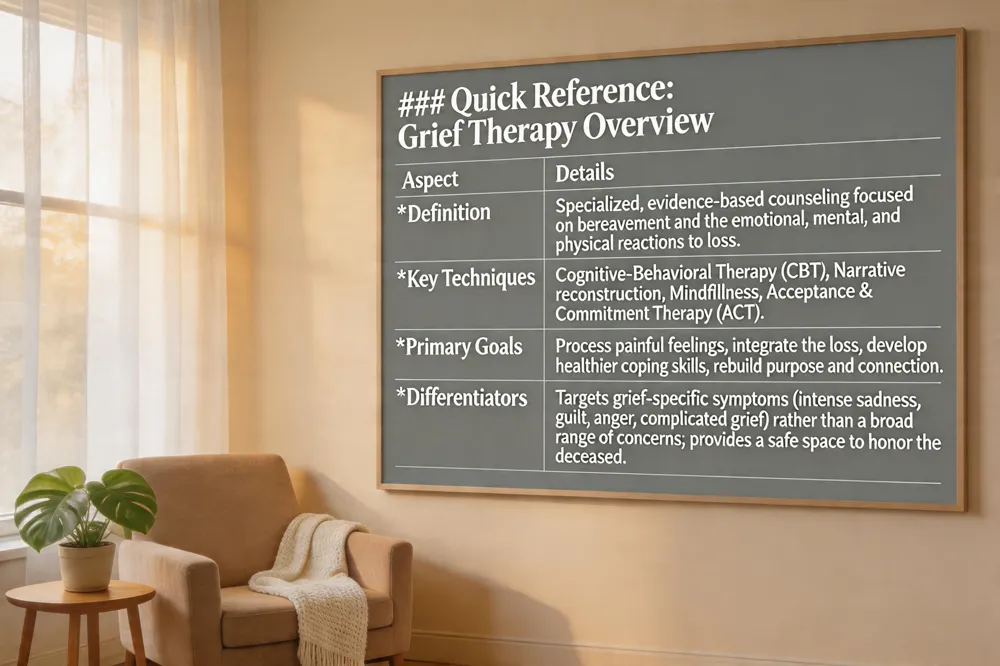 Grief therapy is a specialized, evidence‑based form of counseling that helps individuals process the emotional, mental, and physical reactions to loss—most often the death of a loved one. It uses techniques such as Cognitive‑Behavioral Therapy, narrative reconstruction, mindfulness, and Acceptance and Commitment Therapy to guide clients through painful feelings, integrate the loss, and develop healthier coping skills. Unlike general talk therapy, which addresses a broad range of concerns, grief therapy focuses specifically on bereavement and targets symptoms like intense sadness, guilt, anger, or complicated grief that interfere with daily functioning. The therapist creates a safe, non‑judgmental space for clients to honor the deceased, express grief, and gradually rebuild purpose and connection.
What is grief therapy?
Grief therapy is a specialized counseling that helps individuals process the emotional, mental, and physical reactions to loss, especially the death of a loved one. It uses evidence‑based techniques—such as cognitive‑behavioral strategies, narrative work, and mindfulness—to guide clients through painful feelings, integrate the loss into their lives, and develop healthier coping skills. Unlike general talk therapy, grief therapy focuses specifically on bereavement, addressing symptoms like intense sadness, anger, guilt, or complicated grief that interfere with daily functioning. The therapist creates a safe, non‑judgmental space for clients to express their grief, honor the deceased, and gradually rebuild a sense of purpose and connection. Ultimately, grief therapy aims to help people move forward while still carrying the memory of their loved one in a balanced, supportive way.
Can you share a helpful quote about dealing with grief and loss?
"Grief is not a disorder, a disease, or a sign of weakness. It is an emotional, spiritual and physical necessity, the price you pay for love." – Earl Grollman. This acknowledges that sorrow is a natural response to love, not a flaw. When you allow yourself to feel the pain, it gradually becomes more manageable. Over time the intensity eases, and the memories of your loved one can become a source of warmth rather than ache. In therapy, we can explore these feelings safely and find coping tools that honor both the loss and the life that continues.
The Ripple Effects of an Unexpected Death
Ripple Effects of an Unexpected Death
| Domain | Typical Reactions |
|---|---|
| Psychological | Shock, disbelief, numbness, intrusive “what‑if” thoughts, guilt, anxiety, anger, profound sadness, yearning. |
| Physical | Fatigue, sleep disturbances, appetite changes, headaches, stomachaches, somatic tension. |
| Cognitive | Difficulty concentrating, intrusive memories, disrupted decision‑making, intrusive rumination. |
| Long‑term Risks | Depressive episodes, prolonged/complicated grief, altered emotion‑regulation brain circuits. |
 An unexpected death shatters a person’s sense of safety, producing an immediate wave of shock, disbelief, and a feeling that life is unreal. The sudden loss often triggers intense numbness, intrusive “what‑if” thoughts, and powerful guilt for unfinished business. These emotions quickly spill into anxiety, anger, and physical symptoms such as fatigue, sleep disturbances, appetite changes, headaches, or stomachaches. Because the loss was abrupt, the grieving process can be delayed, leaving the individual disconnected from feelings and others while struggling to accept reality.
Psychologically, bereavement typically includes profound sadness, yearning, and emptiness, accompanied by secondary symptoms like irritability, guilt, and heightened stress. Cognitive impacts may involve difficulty concentrating, intrusive memories, and disrupted decision‑making. In some cases, the turmoil evolves into depressive episodes or prolonged/complicated grief, where sorrow remains pervasive and interferes with daily functioning for months or years. Neuroscience shows grief can alter brain circuits for emotion regulation, making the experience mentally and physiologically overwhelming.
Evidence‑based interventions—such as CBT, ACT, Complicated Grief Therapy, and mindfulness practices—help normalize responses, teach coping skills, and promote meaning‑making. Early contact with services like the SAMHSA 24/7 helpline (1‑800‑662‑HELP) can connect individuals to licensed grief counselors, offering safe spaces for emotional processing, coping‑strategy development, and prevention of complicated grief.
Treating Complicated Grief: Proven Techniques
Proven Techniques for Complicated Grief
| Technique | Core Components | Typical Duration | Evidence of Effectiveness |
|---|---|---|---|
| Complicated Grief Therapy (CGT) | Attachment‑based work, exposure (narrating death story), cognitive restructuring, meaning‑reconstruction, goal‑setting. | 16 sessions (structured) | Reduces prolonged grief symptoms, improves functioning (multiple RCTs). |
| Cognitive‑Behavioral Therapy (CBT) | Psycho‑education, exposure, cognitive restructuring, behavioral activation. | 8‑12 sessions | Decreases depressive and anxiety symptoms in bereaved adults. |
| Meaning‑in‑Loss (MIL) Therapy | Narrative writing, loss‑reauthoring, purpose‑finding exercises. | 6‑10 sessions | Enhances meaning‑making, lowers grief intensity. |
| Acceptance & Commitment Therapy (ACT) | Mindfulness, values‑guided action, experiential avoidance reduction. | 8‑12 sessions | Improves psychological flexibility, reduces avoidance. |
| Interpersonal Therapy (IPT) | Focus on relational support, grief communication, social reintegration. | 12‑16 sessions | Improves social functioning, reduces isolation. |
 Complicated Grief Therapy (CGT) follows a structured 16‑session protocol that blends attachment‑based principles with interpersonal and cognitive‑behavioral strategies. Early sessions build a therapeutic alliance and provide psychoeducation about grief. The middle phase introduces prolonged‑exposure work—repeatedly narrating the death story and gradually confronting loss‑related reminders—to lessen avoidance. Cognitive‑behavioral techniques help clients identify and reframe guilt‑laden or "what‑if" thoughts, while meaning‑reconstruction exercises support rebuilding purpose. Later sessions focus on restoring social connections, setting new personal goals, and planning for termination.
Evidence‑based interventions for grief and loss include CGT, Cognitive‑Behavioral Therapy (CBT) that uses psychoeducation, exposure, cognitive restructuring, and behavioral activation, and Meaning‑in‑Loss (MIL) therapy that rebuilds a coherent loss narrative. Acceptance and Commitment Therapy (ACT) promotes mindfulness and values‑guided action, while Interpersonal Therapy (IPT) enhances relational support. For families and children, the Family Bereavement Program (FBP) offers parallel caregiver‑child groups that teach coping skills and improve communication. These approaches have consistently reduced symptoms of prolonged grief, depression, and anxiety, fostering emotional regulation and post‑traumatic growth.
Inside a Grief Counseling Session
Typical Flow of a Grief Counseling Session
| Phase | Sample Questions / Topics | Therapist Focus |
|---|---|---|
| Opening / Fact‑Finding | “How did you learn about the death?” “What was the day like?” | Gather loss details, establish rapport. |
| Emotional Exploration | “What emotions have been most intense?” “Any recurring thoughts or dreams?” | Identify primary grief emotions, assess avoidance. |
| Functional Check‑In | “How are you sleeping/eating?” “Any physical symptoms?” | Monitor somatic impact, safety. |
| Secondary Losses & Meaning | “What other losses are you experiencing?” “How does your cultural background affect mourning?” | Explore broader impact, cultural/spiritual context. |
| Coping & Future Planning | “What rituals could help you heal?” “What goals do you see for yourself?” | Introduce coping tools, set collaborative goals. |
| Closing | Summarize session, assign between home work (e.g., journaling). | Reinforce progress, ensure safety plan. |
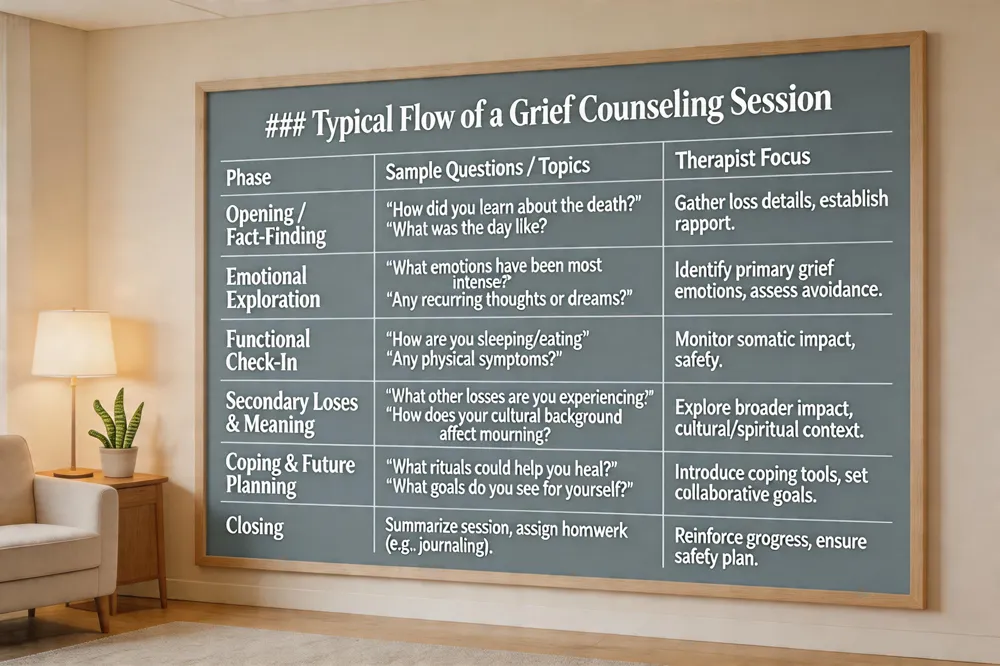 Grief counselors start by gathering the basic facts of the loss and the client’s relationship to the deceased. Typical opening questions include “How did you learn about the death?” and “What were the details of that day?” They then explore emotional reactions—“What emotions have been most intense for you?”—and probe for intrusive memories or avoidance (“Have you noticed any recurring thoughts or dreams about the loss?”). Practical queries about daily functioning—“Are you eating and sleeping okay?”—help gauge coping, while prompts about secondary losses, cultural or spiritual influences, and meaning‑making (“What secondary losses are you experiencing?” “How does your cultural background affect your mourning?”) deepen the assessment. Finally, therapists ask about coping strategies and future plans, encouraging rituals or new purpose (“What rituals could help you heal?” “How do you envision integrating this loss into a new sense of purpose?”)
Neimeyer’s meaning‑reconstruction approach builds on this foundation. It uses structured storytelling and expressive writing to help clients re‑author their loss narrative, turning pain into a coherent life story. Relational re‑attachment techniques maintain a continuing bond with the deceased while fostering new supportive connections. Creative interventions—legacy projects, guided imagery, symbolic rituals—promote post‑traumatic growth and a renewed sense of purpose. Throughout, the therapist provides a safe, collaborative space for rebuilding personal meaning, fostering adaptive coping and resilience.
Practical Tools: PDFs, Worksheets, and Coping Strategies
Practical Tools – PDFs & Worksheets Overview
| Resource Type | Core Contents | Typical Use | Example |
|---|---|---|---|
| Coping Strategies PDF | Permission to grieve, communication tips, self‑care basics, grounding exercises. | Daily reference, symptom tracking. | “10 Grounding Techniques for Grief”. |
| Emotion‑Tracking Worksheet | Feelings wheel, intensity rating, triggers, coping response column. | Monitor emotional fluctuations, identify patterns. | “Grief Roller Coaster Tracker”. |
| Narrative Writing Sheet | Prompt for loss story, timeline, meaning‑making questions. | Promote narrative integration, meaning‑reconstruction. | “My Loss Narrative Template”. |
| Goal‑Setting Worksheet | SMART goals, action steps, timeline, progress check. | Encourage re‑engagement with life activities. | “Re‑Building Purpose Planner”. |
| Holiday & Trigger Planner | Anticipated triggers, coping plan, support contacts. | Prepare for high‑risk periods (anniversaries, holidays). | “Grief Trigger Management Calendar”. |
 When you look for a grief‑focused PDF, the first thing you’ll notice is a list of concrete coping strategies. These resources stress the importance of giving yourself permission to grieve without judgment, speaking openly about your feelings, and sharing the loss’s meaning with trusted friends or family. Physical self‑care is highlighted—regular exercise, adequate rest, balanced nutrition, hydration, and grounding or relaxation techniques such as deep‑breathing and sensory exercises. The PDFs also advise limiting major life decisions while you are still processing the loss and emphasize seeking professional help or joining a support group for sustained well‑being.
A typical grief‑therapy worksheets PDF bundles printable guides that help you track emotions, map shock and numbness, express anger, and identify guilt. You’ll find prompts for writing a loss narrative, restructuring unhelpful thoughts, setting realistic goals, and practicing guided relaxation or grounding exercises (e.g., a Feelings Wheel). Additional sections cover holiday triggers, traumatic memories, maintaining a continuing bond with the deceased, and social reconnection strategies.
Grief‑counseling worksheets come in many formats: reflective journals, structured activity sheets, and quick‑reference tools such as the “Grief Roller Coaster” metaphor or a “Tasks of Mourning” checklist. Themed PDFs address specific experiences—shock, numbness, anger, guilt, isolation, and triggers—while self‑care worksheets (daily check‑lists, self‑care wheels) help clients maintain overall wellbeing.
A grief‑counseling techniques PDF opens with a clear definition of grief and an overview of the counseling process, then presents evidence‑based interventions like active listening, guided imagery, and emotion‑regulation exercises. It outlines major grief models (Kübler‑Ross’s five stages, Worden’s four tasks of mourning) and provides practical tools, session plans, and resources for tailoring techniques to adults, teens, children, hospice care, and even pet loss.
The Six Phases of Healing Emotional Trauma
Six Phases of Healing Emotional Trauma
| Phase | Description | Typical Duration | Key Coping Strategies |
|---|---|---|---|
| Shock & Numbness | Detachment, difficulty recalling details, emotional shutdown. | Hours‑days | Grounding, safety assurance, gentle orientation. |
| Yearning & Mourning | Deep longing, sadness, yearning for the deceased. | Weeks‑months | Expressive rituals, memory sharing, supportive listening. |
| Disorganization & Confusion | Intrusive memories, guilt, impaired daily functioning. | Weeks‑months | Structured journaling, cognitive restructuring, therapist‑guided exposure. |
| Re‑organization & Re‑integration | New coping strategies, weaving loss into narrative. | Months | Meaning‑making exercises, skill building, social reconnection. |
| Meaning‑making | Finding purpose or lessons, post‑traumatic growth. | Ongoing (months‑years) | Values clarification, legacy projects, ACT‑based acceptance. |
| Acceptance & Growth | Renewed sense of self, forward movement with resilience. | Long‑term | Goal pursuit, continued self‑care, community involvement. |
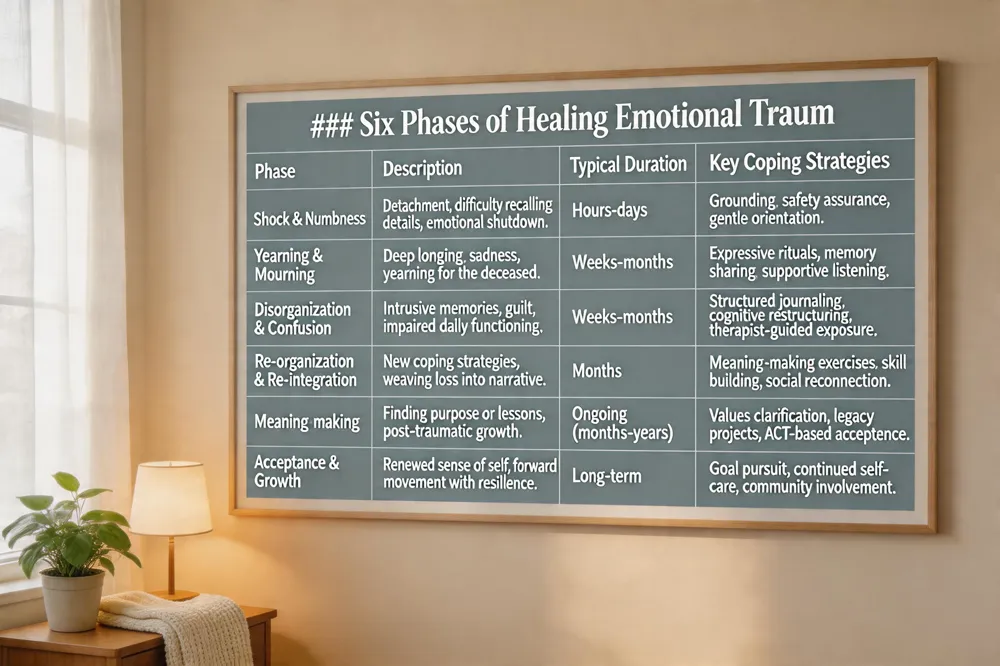 Grief counseling provides a structured roadmap for moving through the intense emotional landscape of loss. What are the six phases of healing emotional trauma?
- Shock and numbness – The mind shields itself, often leaving the person feeling detached and unable to recall details of the loss.
- Yearning and mourning – Awareness of the loss deepens, and feelings of longing, sadness, and yearning become prominent.
- Disorganization and confusion – Intrusive memories, guilt, and difficulty making sense of the experience emerge, disrupting daily functioning.
- Re‑organization and re‑integration – New coping strategies are built; the trauma memory is gradually woven into a coherent personal narrative.
- Meaning‑making – The individual begins to find purpose or lessons in the experience, fostering post‑traumatic growth.
- Acceptance and growth – A renewed sense of self emerges, allowing the person to move forward with greater resilience.
When is grief typically the most intense? Grief peaks usually within the first six months after a loss, often around the six‑month mark, and can be amplified by reminders such as anniversaries, holidays, or familiar sensory cues. For many, intensity tapers after this period, though some may experience strong waves into the second year, especially during seasonal or milestone events. Persistent, severe intensity beyond a year may indicate complicated or prolonged grief and warrants professional intervention, such as evidence‑based grief counseling (CBT, ACT, CGT) or support through resources like the SAMHSA National Helpline (1‑800‑662‑HELP).
Everyday Coping and Healing Strategies
Everyday Coping & Healing Strategies
| Strategy Category | Example Actions | Benefits |
|---|---|---|
| Emotional Expression | Write a letter to the loved one, talk with a trusted friend, create a memory box. | Validates grief, reduces bottling of emotions. |
| Social Connection | Join a support group, schedule regular check‑ins with family, share stories. | Decreases isolation, provides shared meaning. |
| Physical Self‑Care | Daily walk, balanced meals, consistent sleep schedule, hydration. | Stabilizes mood, reduces somatic symptoms. |
| Rituals & Symbolic Acts | Light a candle on anniversaries, plant a tree, celebrate life milestones. | Honors the deceased, creates ongoing bond. |
| Mindfulness & Relaxation | Deep‑breathing, guided imagery, progressive muscle relaxation. | Lowers anxiety, improves emotional regulation. |
| Professional Help | Schedule grief counseling, use crisis helplines (e.g., SAMHSA 1‑800‑662‑HELP). | Provides structured support, prevents complicated grief. |
 Coping with grief means managing the intense emotional, mental, and physical reactions that follow a loss. It is not about eliminating sadness, but about recognizing feelings such as sadness, anger, guilt, or numbness and using healthy strategies—support, self‑care, reflection—to restore functioning and meaning.
How can someone cope with the loss of a loved one? Begin by allowing the full range of emotions without judgment. Reach out to trusted friends, family, or a support group to share memories and receive empathy. Maintain daily routines—regular sleep, balanced nutrition, gentle exercise—to support physical health while navigating emotional waves. Create personal rituals, such as a memory box, writing a letter, or a candle‑lighting ceremony, to honor the loved one. Be patient and kind, recognizing that grief ebbs and flows and healing takes time.
How can someone cope with the loss of a family member? Similar steps apply, but family loss often adds shared responsibilities and memories. Communicate openly with remaining relatives, and avoid isolation and reminders. Memorials, such as lighting photos, family photos, or a letters lunch ritual, can help. Practice family self‑care—mindful meals, adequate sleep, and attention to any physical symptoms. If grief feels overwhelming or persists beyond months, consider professional counseling with a therapist trained in grief and bereavement to provide a safe space and evidence‑based coping tools.
Moving Forward with Compassionate Support
Grief counseling offers evidence‑based tools—CBT, ACT, narrative work—to reduce depression, anxiety, and complicated grief, while fostering meaning, self‑care, and healthy expression. Early intervention within weeks of loss prevents prolonged distress. For immediate assistance, call the SAMHSA helpline 1‑800‑662‑HELP (available 24/7, English/Spanish), text HELP4U with your ZIP code, or reach local resources through BetterHelp, GriefShare, or community support groups. They link you to licensed therapists, virtual sessions, and aware programs for diverse mourning styles.