Why Supportive Therapy Matters in Life Transitions
Supportive therapy offers a compassionate, evidence‑based framework that helps individuals navigate the emotional turbulence of life transitions. By providing validation, empathy, and practical coping tools, it stabilizes mood and reduces feelings of isolation that accompany moves such as leaving school, changing careers, divorce, or bereavement. The core of this approach is the therapeutic alliance—a collaborative, trusting partnership in which the therapist actively listens, mirrors the client’s affect, and reinforces strengths. Research shows that a strong alliance accounts for up to 30 % of outcome variance, making it the single most reliable predictor of success across modalities. When clients feel heard and supported, they are more willing to explore options, set realistic goals, and build resilience for the next chapter.
Foundations of Supportive Therapy
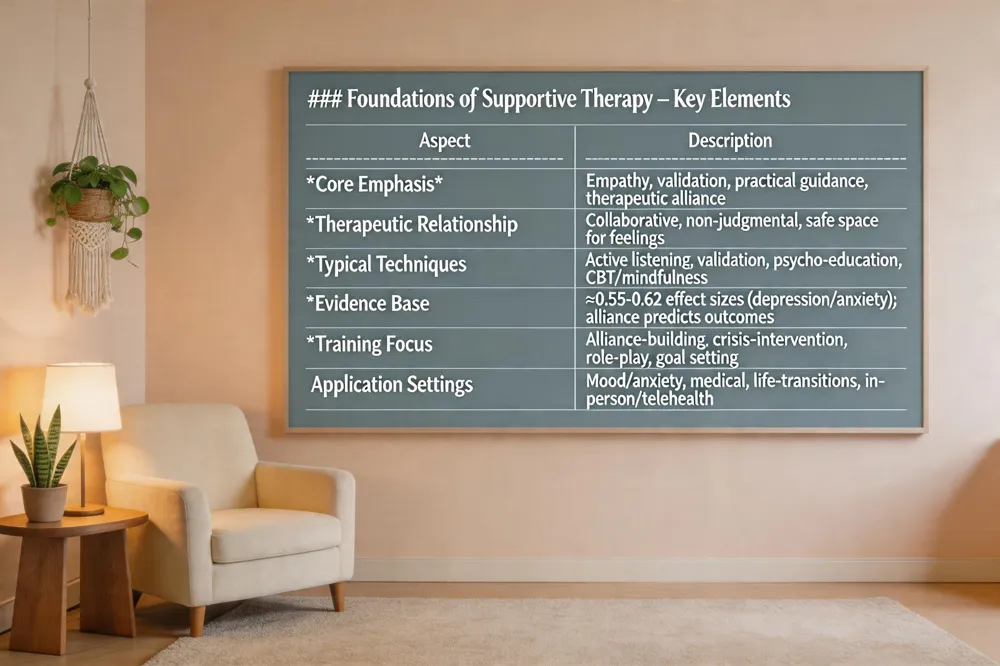
Foundations of Supportive Therapy – Key Elements
| Aspect | Description |
|---|---|
| Core Emphasis | Empathy, validation, practical guidance, and a strong therapeutic alliance. |
| Therapeutic Relationship | Collaborative, non‑judgmental, safe space where feelings are normalized. |
| Typical Techniques | Active listening, validation, psycho‑education, reassurance, gentle reframing, and integration of CBT/mindfulness when appropriate. |
| Evidence Base | Moderate effect sizes (≈0.55‑0.62) for depression, anxiety, and adjustment disorders; strong alliance predicts outcomes. |
| Training Focus | Alliance‑building, ego‑support, crisis‑intervention, role‑play of vignettes, goal setting. |
| Application Settings | Mood and anxiety disorders, medical conditions, life‑transition counseling, both in‑person and telehealth. |
 What is supportive therapy
Supportive therapy, also called supportive psychotherapy emphasizes empathy, encouragement, and practical guidance. It creates a safe, collaborative relationship where the therapist validates feelings, offers reassurance, and helps clients bolster existing strengths and develop coping skills without deep insight work.
Supportive psychotherapy Manual
The clinical manual outlines therapeutic relationship building, affect‑focused interventions, and adaptable techniques for mood, anxiety, and medical conditions. It provides vignettes, tables, and cultural considerations, guiding clinicians to deliver personalized, evidence‑based care.
Is supportive therapy evidence based
Yes. Decades of research, including the Menninger Psychotherapy Research Project and multiple RCTs, show moderate effect sizes (≈0.55‑0.62) for depression, anxiety, and adjustment disorders. Strong therapeutic alliance and empathy consistently predict positive outcomes.
Supportive psychotherapy training
Training teaches alliance‑building, ego‑support, crisis‑intervention, and role‑play of vignettes. Trainees learn to assess, set collaborative goals, and apply supportive techniques across diverse settings.
Supportive therapy techniques
Core techniques include active listening, validation, psychoeducation, reassurance, and gentle reframing. Therapists normalize emotions, encourage adaptive behaviors, and provide practical coping tools, often integrating CBT, mindfulness, or solution‑focused elements.
Therapeutic Goals and the 5 C’s
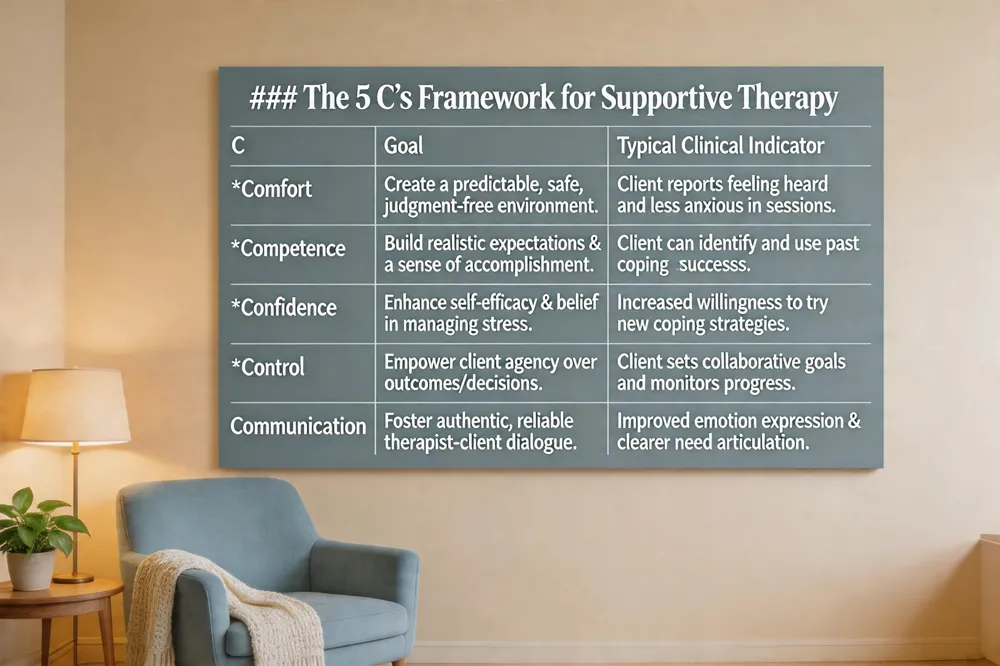
The 5 C’s Framework for Supportive Therapy
| C | Goal | Typical Clinical Indicator |
|---|---|---|
| Comfort | Create a predictable, safe, judgment‑free environment. | Client reports feeling heard and less anxious in sessions. |
| Competence | Build realistic expectations and a sense of accomplishment. | Client can identify and use past coping successes. |
| Confidence | Enhance self‑efficacy and belief in one’s ability to manage stress. | Increased willingness to try new coping strategies. |
| Control | Empower client agency over outcomes and decisions. | Client sets collaborative goals and monitors progress. |
| Communication | Foster authentic, reliable dialogue between therapist and client. | Improved expression of emotions and clearer articulation of needs. |
 Supportive therapy creates a safe, non‑judgmental space where clients feel heard and validated while they work through life stressors. The primary goal is to strengthen existing coping skills, increase emotional awareness, and foster self‑efficacy by setting clear, achievable objectives such as practicing stress‑reduction techniques or expanding supportive networks.
The 5 C’s framework—Comfort, Competence, Confidence, Control, and Communication—guides clinicians in delivering these outcomes. Comfort ensures a predictable, judgment‑free environment; Competence builds realistic expectations and a sense of accomplishment; Confidence enhances self‑efficacy; Control gives clients agency over outcomes; and Communication promotes authentic, reliable dialogue.
Brief supportive psychotherapy (≈12 weeks) focuses on affective exploration rather than structured homework. Therapists listen, validate, and normalize emotions, helping clients gain insight and develop practical coping strategies. Practical outcomes include reduced anxiety and depressive symptoms, improved resilience, and a clearer roadmap for navigating transitions such as divorce, grief, or career change.
Comparing Modalities: Supportive Therapy vs CBT
Supportive Therapy vs. Cognitive‑Behavioral Therapy (CBT)
| Feature | Supportive Therapy (SP) | Cognitive‑Behavioral Therapy (CBT) |
|---|---|---|
| Structure | Flexible, client‑led, less directive. | Highly manualized, session‑by‑session skill training. |
| Primary Focus | Empathy, validation, strengthening existing resources. | Identifying & reframing maladaptive thoughts, behavioral experiments. |
| Typical Duration | Brief (≈12 weeks) or ongoing as needed. | Usually 8‑20 weeks, depending on protocol. |
| Effect Sizes | Moderate to large (d≈0.58‑1.0) for mood‑disorder outcomes. | Generally larger symptom‑specific reductions, especially for anxiety/depression. |
| Best Use Cases | Adjustment disorders, intense affect regulation, clients needing emotional support. | Structured skill acquisition, specific phobias, OCD, severe depression. |
| Integration | Often combined with CBT skills, mindfulness, or solution‑focused techniques. | Can incorporate supportive stance for alliance building and emotional validation. |
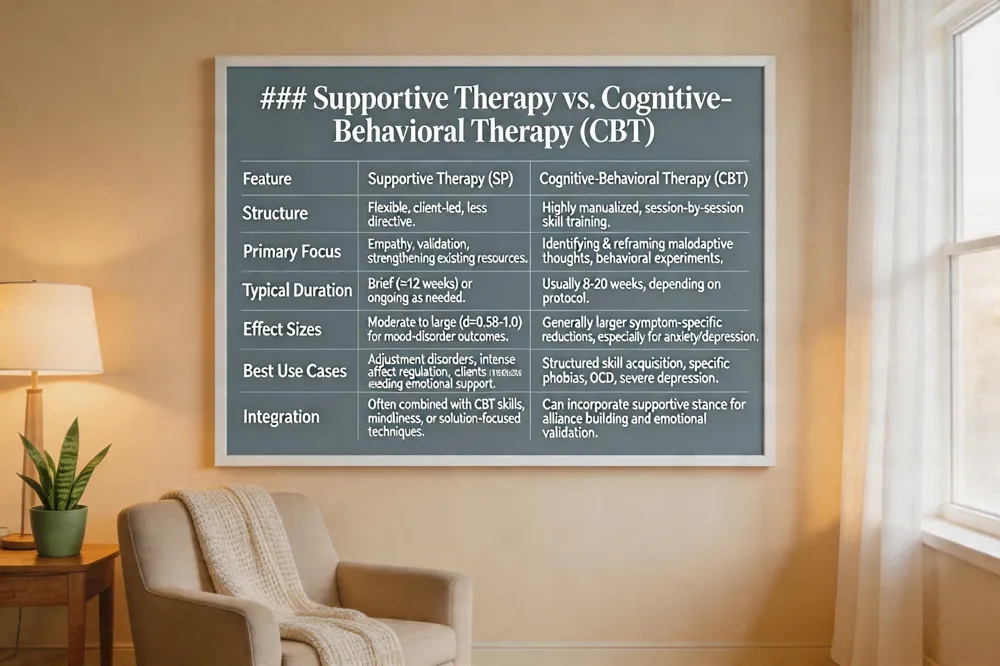 Supportive therapy (SP) and cognitive‑behavioral therapy (CBT) differ in structure and focus. CBT is a highly manualized, skills‑based model that teaches clients to identify and reframe negative thoughts and to practice behavioral experiments; it is the first‑line, evidence‑based treatment for anxiety, depression, and many mood disorders. SP, by contrast, is less directive, centering on empathy, validation, and a strong therapeutic alliance to bolster existing coping resources without explicit cognitive restructuring. Clinical trials show CBT often yields larger symptom‑specific reductions, while SP produces comparable improvements in overall emotional regulation and resilience, with effect sizes ranging from moderate (d≈0.58) to large (d≈1.0) in mood‑disorder studies. Clinicians may begin with CBT for its robust data and integrate SP when clients need additional emotional support, face adjustment disorders, or struggle with strong affect regulation. The core stance of SP is curiosity‑driven, non‑judgmental listening, normalizing intense emotions, and encouraging clients to name and tolerate feelings, thereby fostering safety and agency during life transitions.
Life Transitions: Meaning and Psychological Impact
Psychological Impact of Major Life Transitions
| Transition Type | Common Psychological Impact | Supportive Therapeutic Approach |
|---|---|---|
| Retirement | Loss of role identity, uncertainty about purpose. | Validation of feelings, exploration of new values, goal setting. |
| Divorce/Relationship End | Grief, loneliness, self‑esteem threats. | Normalizing grief, strengthening support network, building confidence. |
| Job Loss / Career Change | Anxiety about finances, identity, future. | Practical coping tools, empowerment through control, skill‑building. |
| Health Diagnosis / Chronic Illness | Fear, helplessness, altered life plans. | Empathy, psycho‑education, integrating mindfulness for acceptance. |
| Relocation / Move | Disruption of routine, social isolation. | Re‑establishing support, planning incremental adjustment steps. |
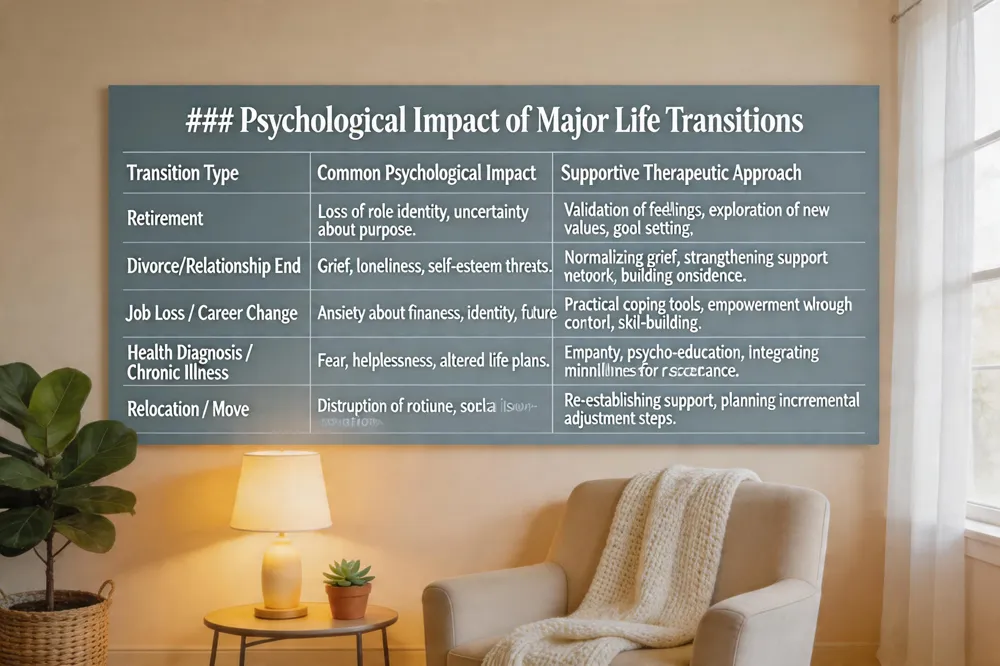 Life transitions are significant periods of change that move you from one stage, role, or situation into another, disrupting familiar routines and often bringing strong emotions. Whether anticipated (e.g., entering retirement) or unanticipated (e.g., job loss), they require psychological adjustment. Transition‑specific therapy approaches—such as Cognitive Behavioral Therapy (CBT), solution‑focused brief therapy, narrative therapy, and mindfulness‑based interventions—provide emotional validation, practical coping tools, and goal‑setting to reduce anxiety and promote resilience. Supportive therapy, with its emphasis on empathy, active listening, and therapeutic alliance, helps clients recognize, name, and tolerate feelings, while brief supportive psychotherapy (BSP) has demonstrated moderate to large effect sizes for mood and anxiety disorders. Therapists also identify personal strengths and external resources, integrate holistic wellness, and may deliver services via teletherapy to increase access. By normalizing emotional responses and fostering self‑compassion, these evidence‑based strategies transform the upheaval of life changes into opportunities for personal growth and lasting well‑being.
Practical Tools: Worksheets, Resources, and Special Programs
Practical Tools for Life‑Transition Therapy
| Tool / Resource | Purpose | Example |
|---|---|---|
| Transition Worksheet | Structured self‑reflection on change, emotions, strengths. | “Describe the change, list feelings, identify past coping successes.” |
| 3‑3‑3 Grounding Exercise | Immediate anxiety reduction via sensory awareness. | Notice 3 things you see, 3 sounds you hear, 3 textures you feel. |
| Life Transitions in Tacoma | Integrated CBT, trauma‑informed, mindfulness services. | In‑person & virtual sessions, sliding‑scale fees, free 15‑min consult. |
| Army Transition Assistance Program (TAP) | Career planning, benefits education, mental‑health support for service members. | Workshops up to 365 days before discharge, counseling on civilian adjustment. |
| Julia Flynn Counseling | Personalized CBT, ACT, mindfulness for major life changes. | Secure telehealth or in‑person, flexible scheduling. |
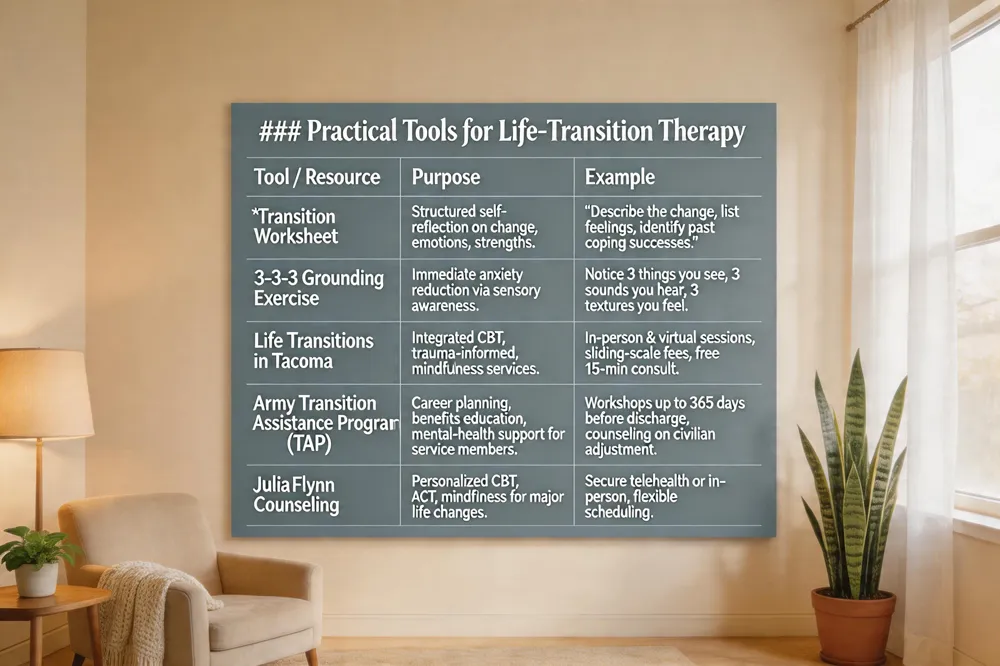 Life‑transitions therapy worksheets guide clients through self‑reflection, emotion tracking, and goal setting for events such as a new job, move, graduation, or retirement. They prompt description of the change, identification of feelings, and listing of past coping strengths and current resources, breaking the transition into manageable steps that build resilience and a growth‑oriented mindset.
Life Transitions in Tacoma offers individualized mental‑health care with CBT, trauma‑informed, mindfulness, and solution‑focused techniques. The practice at 6201 Pacific Avenue, Ste C3 provides both in‑person and virtual sessions, accepts many insurance plans and sliding‑scale fees, and offers a free 15‑minute consultation to support clients through anxiety, depression, relationship stress, or other life changes.
Army transition counseling, delivered through the Transition Assistance Program (TAP), combines career planning, financial readiness, and emotional adjustment. Service members begin up to 365 days before discharge, receiving workshops on benefits, education, job‑search strategies, and mental‑health support to ease the shift to civilian life.
Integrating Approaches for Resilience
Integrated Resilience Toolkit
| Component | Role in Therapy | Practical Example |
|---|---|---|
| Supportive Validation | Provides safety, reduces shame, encourages openness. | Therapist mirrors client’s emotions and normalizes them. |
| CBT Reframing | Challenges negative automatic thoughts, builds adaptive thinking. | “What evidence supports this thought? What alternative view exists?” |
| Mindfulness Anchoring | Enhances present‑moment awareness, reduces rumination. | 5‑minute breath‑focus meditation before session starts. |
| Narrative Reconstruction | Allows clients to rewrite their story, fostering agency. | Writing a letter to past self about strengths gained. |
| Grounding (3‑3‑3 Rule) | Quick interruption of panic or overwhelm. | Practiced during session when client reports rising anxiety. |
| Goal‑Setting & Review | Translates insight into actionable steps, tracks progress. | Weekly SMART goals with brief check‑in at next session. |
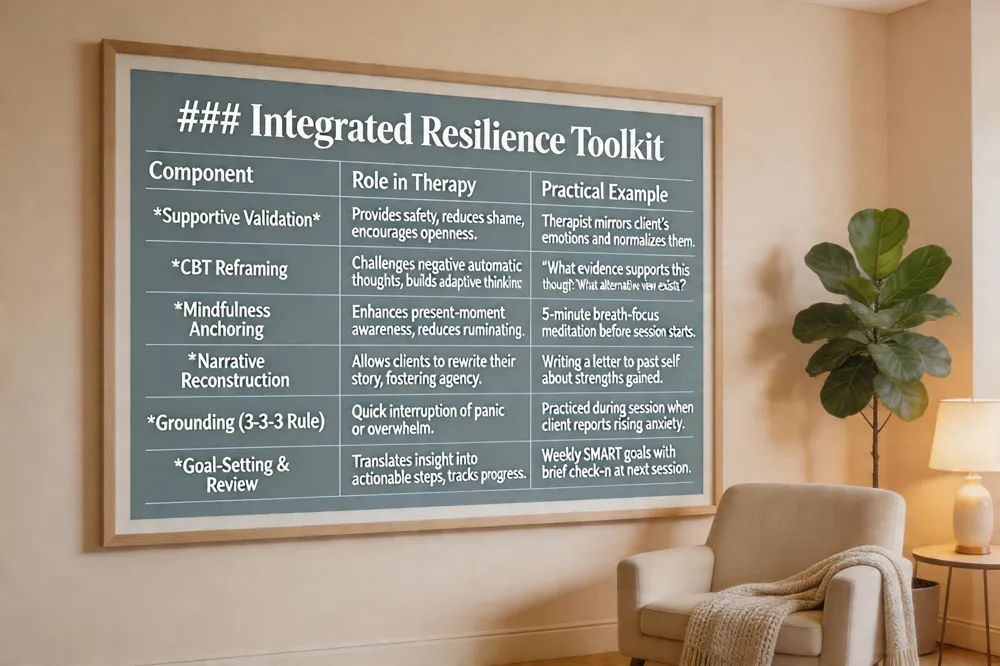 Integrating supportive therapy with evidence‑based modalities such as Cognitive‑Behavioral Therapy, mindfulness‑based interventions, and narrative work creates a flexible toolkit for resilience. The therapist validates emotions while teaching CBT skills to reframe negative thoughts, uses mindfulness to anchor attention, and invites clients to rewrite their personal story, fostering agency. A practical grounding technique often taught is the 3‑3‑3 rule: notice three things you see, three sounds you hear, and three textures you feel, which interrupts anxiety and returns focus to the present moment. Beyond immediate relief, therapy encourages long‑term coping by setting realistic goals, cultivating self‑compassion, and reinforcing strengths through regular reflection and skill‑building exercises. This integrated approach helps people navigate major life changes by breaking overwhelming transitions into manageable steps, reducing isolation, and strengthening adaptive responses. Supportive therapy shines when clients need a safe, non‑judgmental space for emotional validation, especially during grief, relationship shifts, or chronic illness, and it works well alongside CBT, ACT, and other modalities to promote lasting emotional stability.
Holistic Perspectives and Future Directions
Emerging Trends in Supportive Psychotherapy
| Trend | Description | Clinical Implication |
|---|---|---|
| Telehealth Expansion | Remote delivery across state lines, increased accessibility. | Comparable outcomes to in‑person; higher client satisfaction, broader reach. |
| Holistic Health Integration | Combines therapy with nutrition, exercise, mindfulness. | Addresses mind‑body connection, reduces stress hormones, enhances resilience. |
| Brief Manual‑Based Protocols | Scalable, cost‑effective brief interventions. | Potential for wider implementation in primary care and community settings. |
| Meta‑Analytic Evidence | Moderate effect sizes (≈0.55‑0.60) across mood/anxiety disorders. | Reinforces alliance as a primary driver; supports continued training emphasis. |
| Training Innovations | Role‑play, video vignettes, competency‑based curricula. | Improves therapist skill acquisition, ensures fidelity to supportive stance. |
| Future Research | Trials on digital self, AI‑augmented supervision, long‑term outcomes. | May refine dosage, identify optimal integration points with other modalities. |
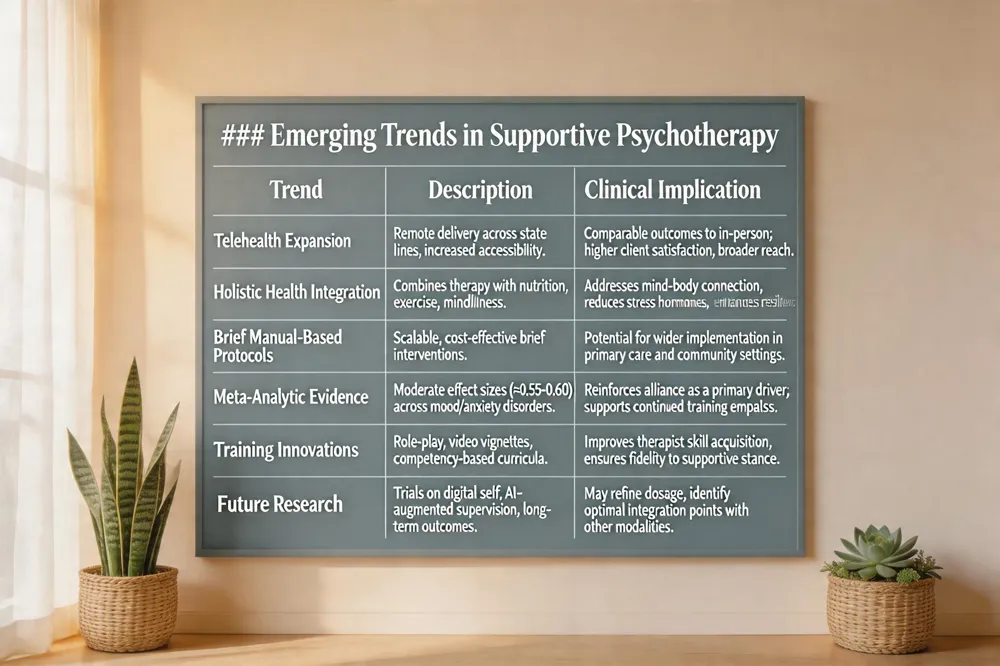 Telehealth Expansion
The rapid growth of teletherapy has democratized access to supportive psychotherapy, allowing clinicians to reach clients across state lines and in rural areas. Studies show comparable outcomes to in‑person care, with high satisfaction rates, making virtual platforms a permanent fixture in transition counseling.
Telehealth Expansion
The rapid growth of teletherapy has democratized access to supportive psychotherapy, allowing clinicians to reach clients across state lines and in rural areas. Studies show comparable outcomes to in‑person care, with high satisfaction rates, making virtual platforms a permanent fixture in transition counseling.
Holistic Health Integration Modern practitioners are blending supportive therapy with mindfulness, nutrition counseling, and physical activity plans. By addressing emotional, mental, and bodily health together, therapists enhance resilience and reduce stress hormones, fostering a more robust recovery during life changes.
Research Trends and Clinical Implications Meta‑analyses reveal moderate effect sizes (≈0.55–0.60) for supportive approaches in mood and anxiety disorders, underscoring the therapeutic alliance as a primary driver of success. Ongoing trials are evaluating brief manual‑based protocols for scalability and cost‑effectiveness.
Supportive Psychotherapy Manual A comprehensive guide outlines alliance‑building, affect‑focused techniques, and flexible session structures, offering clinicians evidence‑based tools for diverse diagnoses.
Supportive Psychotherapy Training Training programs teach active listening, empathy, and crisis‑intervention skills through role‑plays and video vignettes, ensuring therapists can deliver compassionate, adaptable care.
Supportive Therapy Definition Supportive therapy emphasizes empathy, validation, and practical guidance, strengthening coping resources without demanding intensive insight work. It integrates cognitive‑behavioral and interpersonal strategies to help clients navigate depression, anxiety, medical illness, and major life transitions.
Embracing Change with Compassionate Support
Supportive therapy offers a safe, non‑judgmental space where clients receive empathy, validation, and practical coping tools during life transitions. By strengthening the therapeutic alliance, it reduces anxiety, lifts mood, and builds resilience, helping people feel heard and empowered. Techniques such as active listening, goal‑setting, mindfulness, and brief cognitive reframing have been shown to lower depressive symptoms and improve emotional regulation. If you are navigating a sudden change—whether a job loss, divorce, parenthood, or relocation—consider reaching out to a licensed therapist who can tailor interventions to your unique story. Early engagement can prevent escalation of distress and open a pathway toward growth, self‑compassion, and lasting well‑being. Through collaborative sessions you will discover strengths, set realistic goals, and cultivate confidence for the future.