Why Boundaries Feel So Hard—and So Necessary
Boundaries Are Bridges, Not Walls
Healthy boundaries are often misunderstood as barriers that push people away. In reality, they function as structures for safety, respect, and understanding in a relationship. They are personal rules that guide how others may treat us, protecting our mental health and identity. Framed this way, boundaries do not create distance; they create a space where both partners can be authentic and vulnerable. They are “the closest distance at which I can love both you and myself.”
A Protective Purpose for Mental Health
Boundaries safeguard emotional well-being, reduce stress, and prevent burnout and resentment. They help maintain a sense of identity and autonomy, ensuring that your needs matter alongside others’. Without them, relationships can become toxic, leaving you feeling taken advantage of or overwhelmed. Setting boundaries is not about shutting others out but about showing up more fully and sustainably for the people who matter.
The Universal Guilt Response
A pang of guilt or regret often follows setting a healthy boundary, even when it felt right in the moment. This guilt frequently stems from a learned belief that putting your own needs first is selfish, a fear of judgment, or anxiety that you will be liked less. This emotional response is a common hurdle, but recognizing it as a protective reflex rather than a sign of wrongdoing is the first step toward communicating boundaries without shame. Learning to tolerate that discomfort allows you to build relationships that are more authentic and deeply connected.
Decoding the Six Types of Boundaries
 Understanding the different types of boundaries can be the first step towards feeling less guilty about setting them. Each area of life requires its own specific limits to protect your well-being.
Physical boundaries: personal space, touch preferences, privacy (HelpGuide, Lyra Health, Cerebral)
Physical boundaries relate to your personal space, body, and privacy. This includes preferences for touch (like a handshake over a hug) and requests for privacy, such as asking someone to knock before entering a room. Identifying these boundaries can be as simple as noticing when a physical interaction makes you feel uncomfortable or invaded.
Emotional boundaries: protecting feelings and internal energy (HelpGuide)
Emotional boundaries shield your inner world. They allow you to separate your feelings from others' and avoid taking on their emotional burdens. A common example is saying, “I don’t want to discuss this right now because I need to focus.” These limits are crucial for preventing emotional exhaustion and resentment.
Intellectual/communication boundaries: respect for ideas, disagreement style (Cerebral, Lyra Health)
These boundaries involve respect for your thoughts, opinions, and beliefs. They protect your right to have your own ideas and disagree with others without being belittled. Healthy intellectual boundaries mean you can state your opinion without guilting the other person, and you expect the same courtesy in return.
Sexual boundaries: consent, ongoing check-in, intimacy preferences (HelpGuide, Lyra Health
Sexual boundaries involve ongoing, enthusiastic consent and communication about comfort, frequency, and preferences. They require regular check-ins, even in long-term relationships. Setting these boundaries directly reduces guilt by ensuring your intimate experiences are fully consensual and comfortable for you.
Material/financial boundaries: loans, borrowing, sharing possessions (HelpGuide, Lyra Health
Material boundaries cover how you share your belongings and money. This could include setting limits on lending money, loaning items with clear conditions like "please return it," or declining a request for a loan you cannot afford. Communicating these limits is a form of self-care that prevents financial stress and resentment.
Time boundaries: scheduling, work-life separation, personal recharge (HelpGuide
Time boundaries protect your schedule and energy. They involve saying no to extra commitments when you need rest or prioritizing your own activities. Examples include refusing weekend work after a stressful week or asking a partner to postpone a serious conversation. These choices are not selfish; they are essential for preventing burnout. A 2020 Dutch study found that clear work-life boundaries boost a sense of empowerment.
| Boundary Type | What It Protects | Example of a Clear Limit | How It Eases Guilt |
|---|---|---|---|
| Physical | Personal space, body, privacy | "Please knock before entering my room." | Validates your need for comfort and safety. |
| Emotional | Feelings and internal energy | "I’m not able to listen to this right now; I need some time." | Prevents feeling overwhelmed by others’ emotions. |
| Intellectual/Communication | Ideas, opinions, beliefs | "I respect your perspective, and I see things differently." | Fosters mutual respect without self-abandonment. |
| Sexual | Consent, intimacy preferences | "I need to be fully present; can we pause and check in?" | Ensures your experience is consensual and comfortable. |
| Material/Financial | Belongings, money | "I can’t lend you that money, as it would strain my finances." | Guards your financial stability, reducing long-term resentment. |
| Time | Schedule, personal energy | "I can’t work this weekend; I need time to recharge." | Protects your well-being and prevents burnout. |
Feeling guilt when setting these limits is a natural reaction to change. However, clearly identifying and communicating your boundaries is an act of self-respect, not selfishness. These six types provide a framework to help you pinpoint where your limits are needed most.
The Three Cs: Your Formula for a Firm, Fair Boundary
What are the 3 C's of setting healthy boundaries?
Effective boundary communication rests on three pillars: Clear, Consistent, and Compassionate. Each element reinforces the others.
Clear. Use direct, specific language. Instead of "I need more personal space," say "I feel uncomfortable when you come into my room unannounced; please knock first." Clarity prevents misunderstandings and reduces the need for future corrections.
Consistent. Follow through every single time a boundary is tested. Consistency avoids the confusing "grey zone" where mixed signals can lead to power struggles or resentment. If a boundary is breached, calmly restate the limit. Failure to enforce it sends the message the boundary is negotiable.
Compassionate. Empathy does not mean abandoning the limit. You can acknowledge the other person's feelings with compassion while firmly holding your ground. A validating phrase like "I can feel that you're disappointed, and I still need to stay home tomorrow" shows you care without changing your answer. Compassionate communication protects the relationship while honoring your own needs. | C's of Boundaries | What It Looks Like | What to Avoid | |---|---|---| | Clear | "Please knock before entering my room." | Vague statements ("I need more space").| | Consistent | Gently restating the limit each time it's crossed. | Letting it slide occasionally to keep the peace.| | Compassionate | "I can see you're upset. I still need quiet time after work." | Apologizing for the boundary or abandoning it to soothe the other person. |
From Control to Connection: Boundaries That Don't Push People Away

How do I set boundaries in a relationship without being controlling?
Setting boundaries can feel tricky. The goal is to honor your own needs without dictating your partner's actions. The shift is from controlling them to taking responsibility for yourself.
A key difference lies in communication. Instead of blaming accusations like "You're always late," use an "I" statement: "I feel unimportant when our plans start late. I need us to start our date on time." This expresses your feeling without attacking your partner's character. The boundary is about your need for timeliness, not about controlling their schedule.
Focusing on your own needs, not on controlling your partner, is the foundation. Think of it as defining your personal space. You can say, "I need solo time after work to decompress," rather than, "You need to leave me alone when I get home." The first is your need; the second is a command.
Be open to compromise on non-essentials. A boundary isn't a rigid wall. Perhaps you need quiet time, but you can compromise on when. You might say, "I can't talk about finances at 11 PM, but I'm happy to set aside time tomorrow morning." This shows flexibility and care for the relationship.
Finally, enforcement must be rooted in self-love, not punishment. If a boundary is crossed, your response is about protecting your own well-being. For example, if a partner speaks disrespectfully, you might say, "I will end this conversation and we can talk again when we're both calm." This is a consequence for your protection, not a punishment for them. This calm, consistent action strengthens the connection by creating a safe space for both of you.
| Communication Style | Example Phrase | Effect in Relationship |
|---|---|---|
| Accusation | "You never help around the house." | Creates defensiveness and conflict. Can feel controlling. |
| "I" Statement | "I feel overwhelmed when the housework piles up. I'd like to divide the chores." | Expresses a personal need without blame. Invites collaboration. |
| Control | "You need to stop going out with your friends so much." | Limits partner's autonomy. Can breed resentment. |
| Self-Need | "I need some quiet time on Sundays to recharge. I'm going to set that aside for myself." | Takes responsibility for your own well-being. Honest and clear. |
| Punishment | "Since you broke our agreement, I won't speak to you for a week." | Uses emotional distance to punish. Harms trust and connection. |
| Assertive Action | "If this behavior continues, I will need to take a walk to calm down and then we can revisit this." | Protects personal space. A consequence for safety, not retribution. |
Real-Life Examples: What Boundaries Look Like in a Romance
Physical Boundaries: Consent and Personal Space
Physical boundaries in a romantic relationship involve clear consent for touch and respect for personal space. A partner might say, "I'm not a hugger; please don't hug me unless I initiate it," as noted by HelpGuide and Lyra Health. Another example is asking for privacy, such as "Please knock before entering the bedroom." Respecting a partner's need for physical distance during a disagreement is also a healthy limit. These guidelines ensure both individuals feel safe and comfortable in their bodies.
Emotional Boundaries: Shared Feeling, Not Shared Burden
Emotional boundaries protect partners from feeling responsible for each other's moods. HelpGuide emphasizes that you are not your partner's therapist. A concrete example is stating, "I can't take on your stress from work right now; I need to focus on my own." Another is not expecting your partner to "fix" your sadness. As noted in 'How to Set Boundaries Without Creating Distance,' a partner might say, "I want to feel heard without being fixed when I'm sharing something vulnerable." This protects the relationship from resentment and fosters emotional autonomy.
Communication Boundaries: Respectful Dialogue, Private News
Communication boundaries prevent hurtful interactions. Cerebral advises using "no name-calling" during conflicts as a non-negotiable rule. If conflict escalates, a partner can say, "I need to take a pause. We can revisit this in 30 minutes." This is a form of conflict boundary. Additionally, Lyra Health highlights the need for boundaries around oversharing. A partner might request, "Please don't share our private disagreements with your parents without discussing it with me first." This maintains trust and privacy within the couple.
Time Boundaries: Protected Connection and Solo Decompression
Time boundaries ensure that the relationship does not consume individual life. HelpGuide recommends scheduling date nights without devices to foster connection. A partner might say, "I value our date nights, so I'm putting my phone away. I hope you can do the same." Lyra Health also mentions a "solo decompression time" boundary, such as, "I need the first hour after work to myself to wind down; I can be more present after that." This prevents burnout and helps maintain a healthy sense of self.
Perception Boundaries: Safeguarding Trust with Others
Perception-based boundaries protect the relationship from misunderstandings. As discussed in 'Boundaries in Couples Therapy,' a couple might agree on limits with opposite-sex friends. For example, one partner might feel uncomfortable with the other meeting alone for dinner with an ex. A healthy boundary would be, "For our shared peace of mind, I prefer not to spend one-on-one time with opposite-sex friends outside of family." This is not about control but about proactively safeguarding the relationship's emotional safety and trust.
Financial Boundaries: Separate Accounts and Shared Agreements
Financial boundaries prevent resentment over money. HelpGuide and Lyra Health point out that couples can set limits like keeping separate bank accounts while maintaining a joint account for shared expenses. An agreed spending limit—such as "We need to discuss any purchase over $200 with each other"—helps maintain transparency. If a partner repeatedly oversteps by making large, unapproved purchases, a clear boundary would be, "I feel uncomfortable with that; let's stick to our agreed budget limit to ensure we both feel secure." This fosters fairness and respect for each partner's financial values.
Building Trust Through Clear Limits
These examples illustrate that boundaries are not barriers but essential frameworks for a healthy partnership. When both partners clearly communicate and respect a diverse range of boundaries—physical, emotional, communication, time, perception, and financial—they create a secure space for vulnerability and deeper connection. The key is consistent, compassionate enforcement of these limits, which reduces guilt and strengthens the relationship's foundation.
| Boundary Type | Concrete Example | Benefit to Relationship |
|---|---|---|
| Physical | "Please knock before entering the bedroom." | Ensures personal space and physical safety. |
| Emotional | "I can listen, but I can't solve your problem." | Prevents emotional burnout and codependency. |
| Communication | "No name-calling during arguments." | Keeps conflict respectful and productive. |
| Time | "I need 30 minutes after work to decompress." | Prevents burnout and fosters individual well-being. |
| Perception | "I won't be alone with opposite-sex friends." | Protects the couple's trust and prevents jealousy. |
| Financial | "We must agree on any single purchase over $200." | Ensures transparency and shared financial goals. |
Why Your Heart Races: The Anxiety and Fear of Rejection Behind Boundaries
Why does setting boundaries give you anxiety, and why do they feel like rejection?
The physical rush of anxiety when setting a boundary is often a response to deep-seated fears: fear of conflict, of disappointing others, or of being seen as selfish. If past experiences taught you that saying "no" led to punishment or rejection, your nervous system can trigger a survival response when you try to assert a limit.
This pattern is frequently rooted in childhood conditioning. Growing up in an enmeshed family system can leave you with "thin" boundaries. You may have learned that expressing a need is selfish, or that your worth is directly tied to how useful you are to others. A "no" can therefore feel like a rejection not just of a request, but of your entire value.
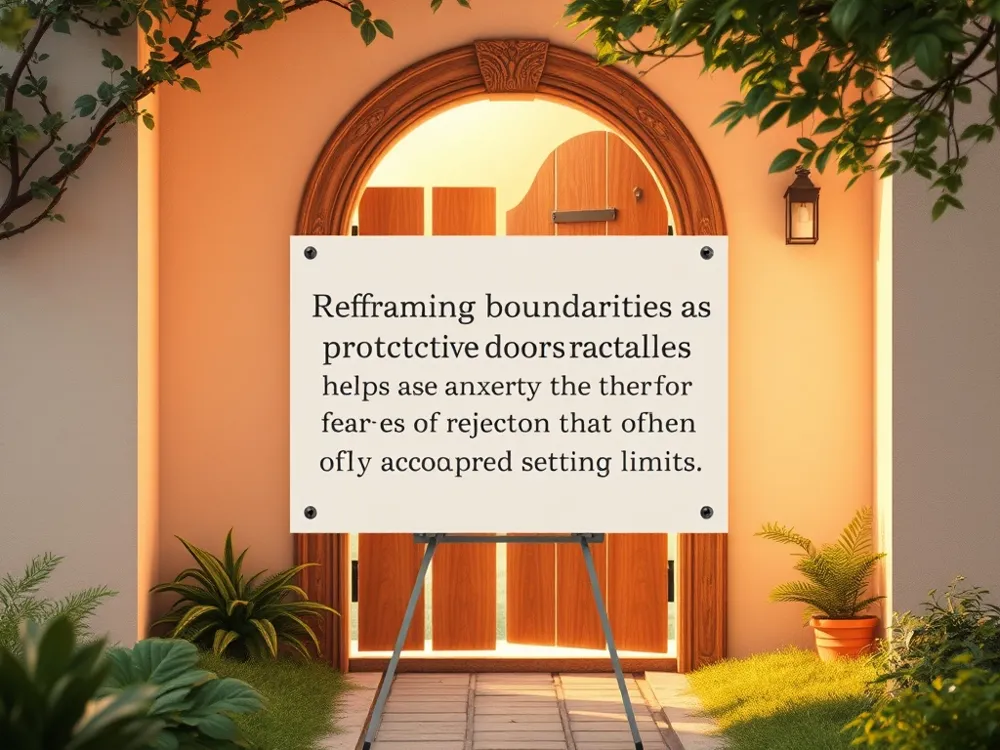
Reframing: boundaries are doors, not walls
It's crucial to reframe boundaries as protective, not punitive. Healthy boundaries are not walls that shut people out; they are doors that safeguard your energy, preventing the resentment and burnout that ultimately harm relationships. A clear limit protects the relationship from toxicity, allowing genuine connection to thrive rather than suffocate.
The anxiety you feel is a sign you are breaking an old pattern of over-giving, not that you are doing something wrong. Over time, clear boundaries reduce anxiety by creating predictability and clarity. You protect your well-being and, in doing so, can show up more authentically for those you care about. The discomfort is temporary, but the peace of knowing your own limits is lasting. If this feels too difficult to manage alone, seeking support from a therapist can help you build these skills in a safe, guided way. Trust that listening to your inner signals is not a weakness, but a path to genuine, sustainable connection. Over time, the clarity you gain will far outweigh the initial discomfort. Remember that this is a practice, not a perfection. Be patient with yourself as you learn to honor your own needs. Your well-being is worth prioritizing. You deserve relationships that respect your boundaries and celebrate your authentic self. The journey towards healthier boundaries is a journey towards a more fulfilling and balanced life. Take it one step at a time, and be kind to yourself along the way. You are not alone in this; many people find this process challenging but ultimately rewarding. Celebrate each small victory as you learn to value yourself and your needs more fully. This is a profound act of self-care and a foundation for all the meaningful connections in your life. Keep going, and trust in your ability to grow and change.
Talking to Mom, Dad, or Your Partner: How to Say No Without the Guilt Trip
How can I communicate boundaries without feeling guilty, especially with parents or a partner?
Guilt when setting boundaries with loved ones often stems from feeling over-responsible for their emotions, fearing disappointment, or having internalized a 'selfish' label from childhood. These feelings are common, especially if you grew up with porous boundaries or in an enmeshed family.
To communicate limits kindly, use clear phrases such as 'I need some time to think about that' or 'I can't take that on right now.' Avoid apologies for your needs. A values-based approach can also help: ask yourself what kind of partner or child you want to be, and set a limit that honors mutual respect over immediate approval.
When discomfort rises, pause and 'check the facts.' Ask if you actually did something wrong. If your boundary is reasonable and protects your well-being, the guilt is a learned reaction, not a sign of wrongdoing. Accept the feeling as temporary.
| Mistaken Belief | Reframed Thought | Guilt-Reducing Action |
|---|---|---|
| Saying no is selfish. | Saying no preserves my energy. | Use a calm, clear statement. |
| I'm responsible for their feelings. | Each person owns their own emotions. | Breathe and hold your limit. |
| They will reject me. | Healthy people respect limits. | Start with small boundaries. |
Start small and practice calmly. Setting a boundary with a loved one gets easier over time and strengthens authentic connection.
The Psychology of Guilt: Why Your Brain Makes Boundaries Feel Wrong
Why does setting a boundary trigger guilt? Guilt often stems from deeply ingrained beliefs. Many of us learned from a young age that prioritizing our own needs is selfish. This childhood conditioning, where saying “no” was discouraged or labeled as “bad,” creates a powerful internal script. The result is an automatic feeling of wrongdoing when we try to protect our time or emotional space, a feeling that can be traced to a fear of disappointing others or being rejected.
Is all guilt the same? Therapist Nedra Glover Tawwab offers a useful distinction between earned and unearned guilt. Earned guilt is appropriate when you have genuinely harmed someone or acted against your values. Unearned guilt, however, is the shame you feel for setting a healthy limit, like declining an invitation to rest. Recognizing this difference helps you see that the guilt you feel when asserting a basic need is often a misplaced emotion, not a signal of wrongdoing. You can then practice self-compassion and move forward without over-apologizing.
Can guilt be a sign of growth? Yes. As noted in sources on guilt resiliency, the discomfort that arises when you first start setting boundaries is a natural "growing pain." It is a sign that you are breaking an old pattern of people-pleasing or self-abandonment. Instead of avoiding this feeling, you can learn to tolerate it. With each new boundary set, you build “guilt resiliency,” the capacity to act according to your values even when guilt arises. This process is essential for creating an empowered, authentic life.
How does the brain change with practice? Neuroscience supports the idea that repeated behavior rewires the brain. Each time you set a healthy boundary and follow through, you strengthen the neural pathways associated with self-respect and assertiveness. Over time, the initial wave of guilt weakens, and the positive feeling of honoring your own needs becomes more automatic. This practice transforms boundaries from a source of anxiety into a tool for emotional well-being and stronger, more authentic connections.
Healthy vs. Unhealthy: How to Tell the Difference
How can I tell the difference between healthy and unhealthy boundaries in my relationship?
Healthy boundaries act as flexible guides that protect your well-being while fostering connection. They involve clear, respectful communication using “I” statements, allowing for intimacy without sacrificing your sense of self. A healthy boundary expresses your needs without controlling the other person, leaving room for grace and renegotiation as circumstances change.
Unhealthy boundaries fall into two primary categories: rigid and porous. Rigid boundaries act as walls, keeping others at a distance to avoid vulnerability, which blocks intimacy. Porous boundaries, conversely, involve over-accommodating and losing your identity, often leading to resentment and feeling taken advantage of. Boundaries can also be weaponized—used to manipulate, punish, or control a partner, which is a form of relational abuse.
Key warning signs that your boundaries are unhealthy include constant resentment, persistent anxiety in the relationship, and a chronic feeling of being controlled or overwhelmed. If you frequently feel taken advantage of or are consistently exhausted from over-extending yourself, your boundaries may be too porous. If you feel isolated, disconnected, or that you cannot ask for support, your boundaries may be too rigid.
In healthy relationships, boundaries allow for flexibility and mutual respect. However, in toxic or abusive relationships, firm and uncompromising boundaries become necessary for self-protection. In these contexts, a rigid stance is a healthy response to a harmful dynamic, prioritizing your safety over the relationship’s comfort. The key difference is intention: healthy boundaries protect your well-being without seeking to control another’s behavior, while unhealthy ones either block intimacy or enable mistreatment. Understanding this distinction is the first step towards building relationships that are both safe and satisfying. The table below summarizes these differences.
| Type | Characteristics | Effect on Relationship | Example |
|---|---|---|---|
| Healthy | Flexible, clear, respectful, communicates needs | Fosters intimacy, trust, and autonomy | “I need an hour to decompress after work, then I’d love to hear about your day.” |
| Unhealthy (Rigid) | Inflexible, wall-like, avoids vulnerability | Blocks intimacy, creates distance | “Don’t ever call me at work, for any reason.” |
| Unhealthy (Porous) | Weak, over-accommodating, lacks identity | Enables mistreatment, breeds resentment | “I’ll cancel my plans to help you, again.” |
| Unhealthy (Weaponized) | Used to control, punish, or manipulate | Damages trust, creates fear | “If you go out with your friends, you’re choosing them over me.” |
Your Boundary Toolkit: Worksheets, Scripts, and Next Steps
Are there worksheets or practical tools to help me practice boundary setting?
Yes, several evidence-based worksheets and tools are available to help you practice. The Building Boundaries Worksheet guides you in identifying the personal values you want to protect and offers practice scripts for saying “no” in social and family settings. The Therapist Aid Setting Boundaries worksheet encourages reflection on why boundaries matter and includes exercises to write out specific language for communicating your limits.
Another helpful framework comes from TriCare’s eight principles of healthy boundaries, such as being direct and avoiding over-explaining. You can also access free PDFs and resources from organizations like Mental Health America’s screening tools and therapy apps.
Books and Next Steps
Two highly recommended books are Boundaries: When to Say Yes, How to Say No by Henry Cloud and John Townsend, and Set Boundaries, Find Peace by Nedra Glover Tawwab. Both offer step-by-step guidance. As you begin, remember that practice, patience, and self-compassion are essential—setting boundaries is a skill that grows stronger with time and support.
| Tool/Resource | Purpose | How to Access |
|---|---|---|
| Building Boundaries Worksheet | Identify values, practice scripts | Therapy websites, positivepsychology.com |
| Therapist Aid Setting Boundaries Worksheet | Reflection and language exercises | TherapistAid.com |
| TriCare Eight Principles | Directness, no over-explaining | How to Set Boundaries: A Better Approach blog |
| Boundaries (Cloud & Townsend) | Step-by-step guidance | Bookstores, libraries, online retailers |
| Set Boundaries, Find Peace (Tawwab) | Practical tools and scripts | Bookstores, libraries, online retailers |
| Mental Health America screening tools | Self-assessment and resources | MHA’s website |
| Therapy apps | Guided practice and reminders | App stores (e.g., Calm, Headspace) |
Boundaries Are an Act of Love
Boundaries Are an Act of Love
Setting a boundary is not a wall; it is an act of self-care that ultimately strengthens your relationships. When you clearly state what is okay and what is not, you create a safe space for authentic connection, reducing resentment and preventing burnout. Healthy limits allow you to show up more fully for the people who matter, fostering trust and mutual respect.
This skill develops with consistent practice. It is normal to feel guilt or discomfort at first, especially if you are used to people-pleasing. Each time you honor a limit, you reinforce your own worth and teach others how to treat you. Over time, the guilt fades and is replaced by a sense of empowerment and clarity.
You deserve relationships built on respect, not obligation. Boundaries are the pathway to that connection. For additional support, consider working with a therapist who can help you build these skills with confidence and compassion. Professional guidance can make the process smoother and more sustainable.
| Type of Boundary | Example of Setting It | How It Strengthens Relationships |
|---|---|---|
| Emotional | "I need to pause this conversation to calm down." | Prevents escalation and builds safety. |
| Time | "I can’t take on this project right now." | Protects your energy and prevents burnout. |
| Physical | "Please knock before entering my office." | Respects personal space and comfort. |
| Financial | "I can’t lend you money this month." | Maintains trust and avoids resentment. |
| Communication | "I prefer to text rather than call." | Aligns interactions with your comfort. |