Introduction
Mindfulness matters for parents because the constant demands of caring, work, and household chores can trigger chronic stress, which harms both adult well‑being and child development. By intentionally directing attention to the present moment without judgment, parents create a pause that lets the prefrontal cortex regulate the amygdala’s fight‑or‑flight response. Research shows regular mindfulness lowers stress hormones, improves emotional regulation, and reduces parental burnout, while also strengthening the parent‑child bond. Simple practices—such as a four‑second inhale, a brief naming of emotions, or a five‑senses grounding—can be woven into everyday routines, offering micro‑rest for the nervous system and modeling calm for children, and promotes resilience for the whole family through daily practice.
Core Mindfulness Techniques for Parents
Core Mindfulness Techniques for Parents
| Technique | Description | Quick Example |
|---|---|---|
| Breathing exercises | Activates parasympathetic system; lowers cortisol. | 4‑7‑8 breath: inhale 4 sec, hold 7 sec, exhale 8 sec. |
| Grounding practices | Uses five‑senses reset to interrupt spiraling thoughts. | 5‑4‑3‑2‑1: name 5 things you see, 4 you touch, etc. |
| Micro‑mindfulness moments | Brief pauses before speaking to let prefrontal cortex override amygdala. | 2‑second pause before replying; quick body‑scan. |
| One‑deep‑breath | Simple inhale‑hold‑exhale pattern for rapid reset. | Inhale 4 sec, hold 4 sec, exhale 6 sec. |
| 4‑5‑6 rhythm | Extends exhale to promote calm. | Inhale 4 sec, hold 5 sec, exhale 6 sec. |
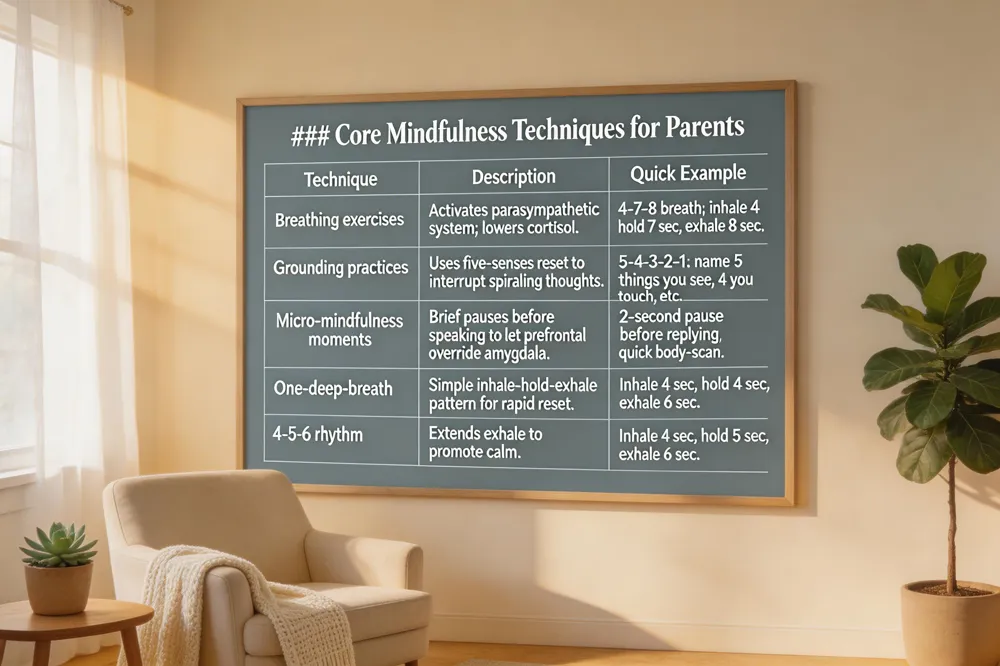 Breathing exercises – Simple breath patterns such as the 4‑7‑8 or square (4‑4‑4‑4) technique quickly activate the parasympathetic nervous system, lowering cortisol and calming the nervous system during chaotic moments. The one deep breath (inhale 4 sec, hold 4 sec, exhale 6 sec) and the 4‑5‑6 rhythm also provide a rapid reset for parents and children alike.
Grounding practices – The five‑senses reset (5 things you see, 4 you touch, 3 you hear, 2 you smell, 1 you taste) grounds attention in the present and interrupts spiraling thoughts. Mindful listening—giving a child full, non‑judgmental attention—strengthens the parent‑child bond and models emotional regulation.
Micro‑mindfulness moments – A 2‑second pause before speaking lets the prefrontal cortex override the amygdala’s fight‑or‑flight response. Brief body‑scans, mindful walking, or a quick "raisin‑chewing" exercise can be woven into daily routines, providing micro‑rest for the nervous system.
FAQs
- Mindfulness exercises for families pdf: Free PDFs are offered by school‑district health sites and organizations such as the Illawarra Shoalhaven Local Health District and the Anti‑Burnout Club, featuring five‑sense grounding, body‑scan guides, and gratitude activities.
- Mindfulness for parents techniques to stay calm amid chaos free: Use square or 4‑7‑8 breathing, one‑minute sensory check‑ins, gratitude jars, and compassionate self‑talk to convert stress into intentional calm.
- Quick mindfulness activities for adults: "Moment to arrive" (stand tall, two deep breaths), three‑breath pause, mindful walk focusing on one sense, brief body‑scan, and a well‑wishes meditation.
- Mindfulness for parents at home: Insert a brief pause before reacting, employ five‑senses grounding, practice body‑scan while seated, and listen with full attention to a child's emotions.
- Mindfulness exercises for families at home: Start each day with a one‑minute family breath, integrate sensory descriptions into meals, use glitter‑jar calming, and share short guided body‑scans.
- Free mindfulness for parents: Headspace’s free "Cool‑Down for Frustration" session, Insight Timer’s free parent‑focused meditations, and low‑cost activities like raisin‑chewing or five‑sense grounding require no special equipment.
Mindful Parenting Practices and Resources
Mindful Parenting Practices and Resources
| Practice | Description | Resource |
|---|---|---|
| Active listening | Eye contact, reflect, suspend advice. | Mindful Parenting PDF (Calm). |
| Emotion labeling | Name feelings to reduce intensity. | Self‑compassion guide (Zero To Three). |
| Self‑compassion pause | Hand on heart, deep breath before reacting. | 4‑5‑6 breathing (Zero To Three). |
| Guided audio | Short meditations for parent‑child sessions. | Julia Flynn Counseling course. |
| Podcast | Neuroscience‑backed strategies. | Mindful Parenting Podcast (Hunter Clarke‑Fields). |
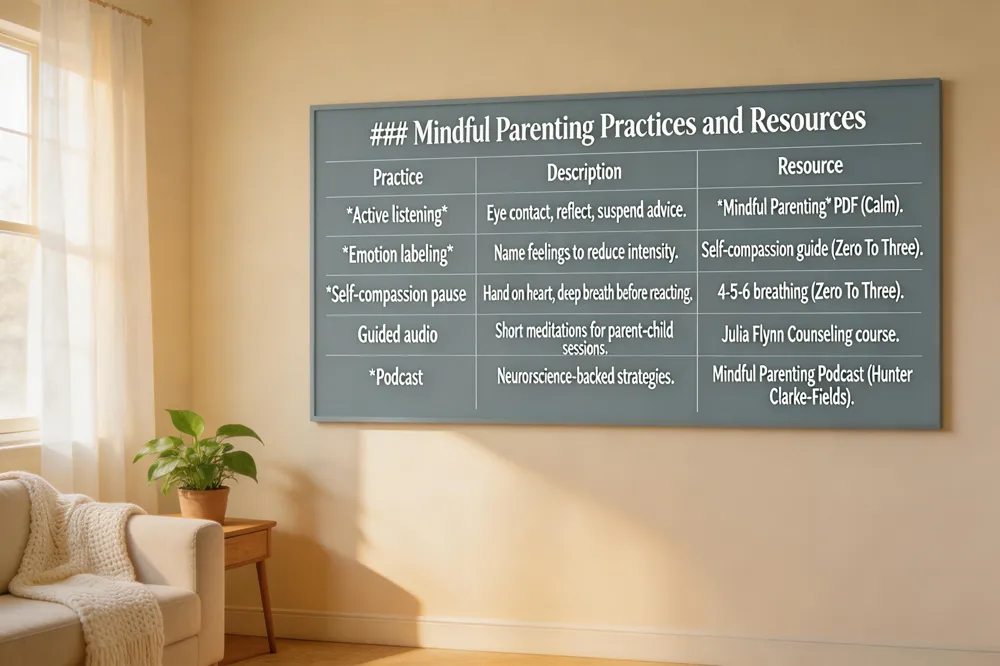 Active listening is the cornerstone of calm parenting. When a child speaks, keep eye contact, reflect back what you hear, and suspend advice until they finish. This simple pause signals safety and helps the child feel understood. Emotion labeling—"I notice you’re feeling frustrated"—moves the brain from reactive to problem‑solving mode; naming feelings reduces intensity and invites compassion. [Self‑compassion](https://www.zerotothree.org/resource/mindfulness-for-parents/) is equally vital: acknowledge your own stress, place a hand on your heart, and breathe deeply (e.g., [4‑5‑6](https://www.zerotothree.org/resource/mindfulness-for-parents/) or 4‑7‑8 patterns) to reset the nervous system before responding.
Helpful resources include: a short [Mindful Parenting](https://www.calm.com/blog/mindful-parenting) PDF with sensory boxes, calm‑down jars, and breathing guides; a downloadable course from Julia Flynn Counseling offering guided audio practices and worksheets; and the Mindful Parenting Podcast by Hunter Clarke‑Fields, which blends neuroscience and practical pause‑techniques. Using these tools daily—three [deep breaths](https://medicine.yale.edu/news-article/self-care-strategies-parents/) to start the day, a five‑minute [body scan](https://positivepsychology.com/mindfulness-for-children-kids-activities/) with your child, and brief check‑ins—can lower stress hormones, strengthen bonds, and cultivate lasting calm.
Managing Stress and Burnout
Managing Stress and Burnout
| Issue | Signs | Intervention |
|---|---|---|
| Parental stress | Irritability, physical tension, reduced enjoyment. | 4‑7‑8 breath, realistic expectations, therapist‑guided boundaries. |
| Parental burnout | Emotional exhaustion, depersonalization, loss of fulfillment. | Brief reset moments, self‑care plans, burnout worksheets. |
| Child‑behavior cycle | Escalating externalizing/internalizing behaviors. | Mindfulness‑based emotion regulation for both parent and child. |
| Assessment | High scores on Parenting Stress Scale (18 items). | Track changes after interventions; adjust routine. |
| Impact on child | Sleep issues, academic decline, insecure attachment. | Consistent modeling of regulation through micro‑mindfulness. |
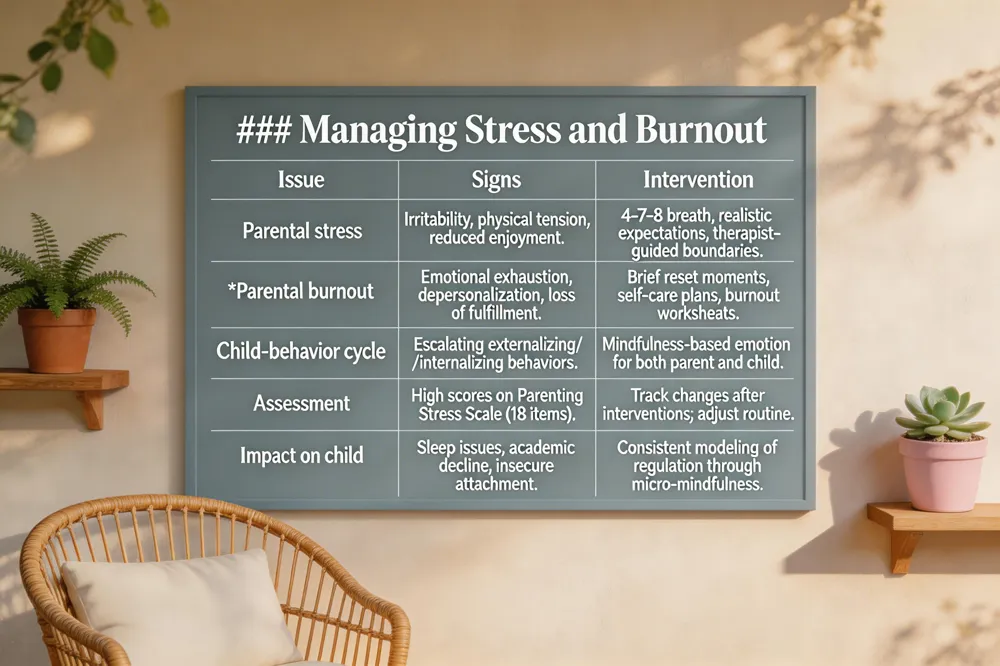 Parenting stress and child behavior problems – High parental stress fuels a transactional cycle: stressed parents may react more harshly, worsening child externalizing or internalizing behaviors, which in turn raises parental stress. Breaking this loop with mindfulness‑based emotion regulation and child coping skills improves outcomes for both.
Parental burnout – Chronic emotional exhaustion, depersonalization, and loss of fulfillment signal burnout. Warning signs include irritability, physical symptoms, and dwindling enjoyment of family life. Brief “reset” moments—like a 4‑7‑8 breath—plus realistic expectations and therapist‑guided boundary‑setting can prevent escalation.
Stress‑management resources – Free PDFs such as the "Stress Management for Parents" guide (Julia Flynn Counseling) and the "Self‑Care for Parents" handouts offer quick‑relief checklists, deep‑breathing scripts, and printable self‑care plans.
Assessment tools – The Parenting Stress Scale (18 items, 5‑point Likert) quantifies stress levels and tracks change after interventions, supporting evidence‑based care.
Impact on child development – Elevated parental stress impairs children’s emotional security, sleep, and academic performance, while modeling poor regulation. Mindful parenting restores calm, fostering healthier development.
Family‑Friendly Mindfulness Activities
Family‑Friendly Mindfulness Activities
| Activity | Age Range | How to Do |
|---|---|---|
| Balloon breath | 4‑12 yrs | Inhale as if inflating a balloon, exhale slowly. |
| Five‑sense grounding | All ages | 5‑4‑3‑2‑1 sensory checklist. |
| Gratitude reflection | 5‑16 yrs | Share one thing you’re grateful for each day. |
| Spidey‑senses game | 6‑10 yrs | Walk silently, notice sounds like a superhero. |
| Glitter‑jar calming | 3‑8 yrs | Shake jar, watch glitter settle, breathe. |
 Kids Activities Quick, age‑appropriate practices keep children calm and focused: 1‑minute breathing drills (e.g., “balloon breath”), five‑sense grounding (5‑4‑3‑2‑1), gratitude reflections, and short movement games such as “Spidey‑senses”. These can be done at home or in the classroom and build emotional regulation.
School Resources Teachers can use the free PDF from the Illawarra Shoalhaven School‑link program, which offers a “Mindful Box” manual, sensory exercises, breathing and movement practices, and printable one‑minute mindfulness cards for individual or whole‑class use. Rotate activities to maintain effectiveness and support transitions.
PDF Guides - Mindfulness Activities PDF: A downloadable guide with simple breathing, body‑scan, and sensory‑awareness exercises, plus printable worksheets and a “Coping Box” template.
- Mindfulness Activities for Kids PDF: Printable, age‑appropriate drills, gratitude prompts, and movement games, with step‑by‑step instructions and reflection space.
- Mindfulness Activities for Students PDF: Offers five‑minute practices like counting breaths, colour breathing, and birthday‑cake breathing, plus worksheets and classroom‑friendly cards.
These resources give families and educators quick, evidence‑based tools to embed mindfulness into daily life.
Building a Sustainable Mindfulness Routine
Building a Sustainable Mindfulness Routine
| Habit | How to Stack | Frequency |
|---|---|---|
| Breath pause while brushing teeth | Pair 3‑second breath with each brush stroke. | Twice daily (morning & night). |
| Post‑meal check‑in | 2‑minute five‑sense reset after every meal. | Three meals per day. |
| Mindfulness jar bell | Ring bell, take 1‑minute pause before transitions. | As needed (e.g., before car rides). |
| Micro‑body‑scan | 30‑second scan while waiting in line. | Multiple times daily. |
| Guided audio (≤5 min) | Listen while cooking or folding laundry. | Daily. |
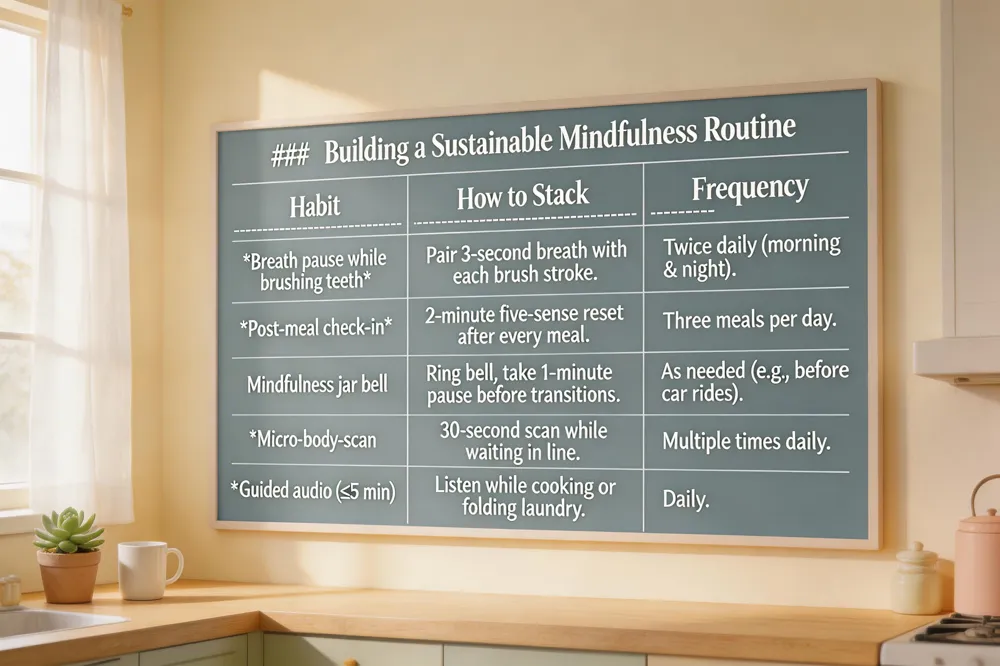
Habit‑stacking for Parents
Link mindfulness to an existing habit—e.g., a three‑second breath pause while brushing teeth. This tiny anchor triggers the parasympathetic nervous system and builds a repeatable calm cue throughout the day.
Daily Schedules that Include Micro‑Moments
Plan brief check‑ins (2‑minute breathing, five‑senses reset) after meals or before bedtime. A predictable “mindfulness schedule” reduces chaos and gives the prefrontal cortex time to override fight‑or‑flight responses.
Tools and Resources
Use free PDFs (e.g., the Mindful Parenting Family Tool Kit from ZERO TO THREE) and guided audio lessons under five minutes from apps like Calm or Insight Timer. A mindfulness jar or bell provides a tangible reminder for the whole family.
How to be a calm parent book
The book How to Be a Calm Parent by Sarah Ockwell‑Smith offers research‑backed exercises for managing emotions, setting boundaries, and modeling calm behavior for children.
Mindfulness for parents pdf
Download the evidence‑based Mindful Parenting Family Tool Kit PDF, which includes the Mindful Bell, Calm‑Down Jar, and breathing exercises for daily use.
Mindful parenting podcast
The Mindful Parenting Podcast (hosted by Hunter Clarke‑Fields) blends neuroscience and compassionate strategies to help parents pause, respond, and stay grounded.
Mindful parenting course
Julia Flynn Counseling’s online Mindful Parenting Course provides interactive modules, guided audio, and a supportive community to reduce stress and strengthen parent‑child bonds.
Free mindfulness exercises for families
Try simple breathing counts, body scans, glitter jars, and the spidey‑senses game from the Family Mindfulness Schedule worksheet—each free and easy to integrate into family life.
Conclusion
Key takeaways: Mindfulness helps parents pause, regulate emotions, and model calm for children; brief techniques—deep breathing (e.g., 4‑5‑6 or square breathing), sensory grounding (5‑4‑3‑2‑1), and naming emotions—activate the parasympathetic system and lower stress hormones. Regular micro‑practices improve parental burnout, strengthen the parent‑child bond, and support children’s emotional development.
Next steps for families: 1) Choose one simple breath or sensory reset to practice during daily transitions (e.g., before meals). 2) Pair the pause with a brief self‑compassion check‑in (notice feeling, place hand on heart). 3) Schedule a 2‑minute mindfulness pause before bedtime and a 5‑minute family gratitude or listening ritual. 4) Use a free app or guided audio (e.g., Calm, Insight Timer) for consistency. 5) Track progress with a “DONE” list to celebrate small wins and reinforce habit formation.