Why Telehealth Matters for the Modern Workforce
Busy professionals constantly juggle meetings, deadlines, and travel, leaving little room for self‑care. The rapid rise of teletherapy—evidenced by a 30 % increase in virtual therapy use among working adults between 2020 and 2023—directly addresses this time crunch. By eliminating commute, a 45‑minute session can fit into a lunch break, saving an average of 47 minutes per visit (Texas A&M Transportation Institute). Virtual counseling also cuts yearly costs by $2,300 (Fort Worth Chamber) and reduces missed appointments by up to 25 %. Clinicians can deliver evidence‑based modalities such as CBT, DBT, and EMDR through secure, HIPAA‑compliant platforms, preserving therapeutic quality while fitting irregular work schedules. These efficiencies translate into better work‑life balance and lower burnout rates, making telehealth an essential tool for today’s high‑performing workforce.
Time, Money, and Mental Health: Core Benefits of Telehealth
Core Benefits Summary
| Metric | Value | Source |
|---|---|---|
| Average commute time saved per virtual visit | 47 minutes | Texas A&M Transportation Institute |
| Annual time reclaimed per professional | ≈14 hours | Fort Worth Chamber |
| Average employer savings per employee (annual) | $2,300 | Fort Worth Chamber |
| Patient cost avoidance (parking, travel) | Variable; typically $5‑$15 per visit | General industry data |
| Reduction in no‑show rates for providers | Up to **30%% reduction | Careexpand |
| Facial focusfrontal activation (fMRI) during virtual counseling | 72% vs 68% in‑person | Harvard Business Review 2024 |
| Emotional‑intelligence score increase linked to tele‑therapy | 31% | Harvard Business Review 2024 |
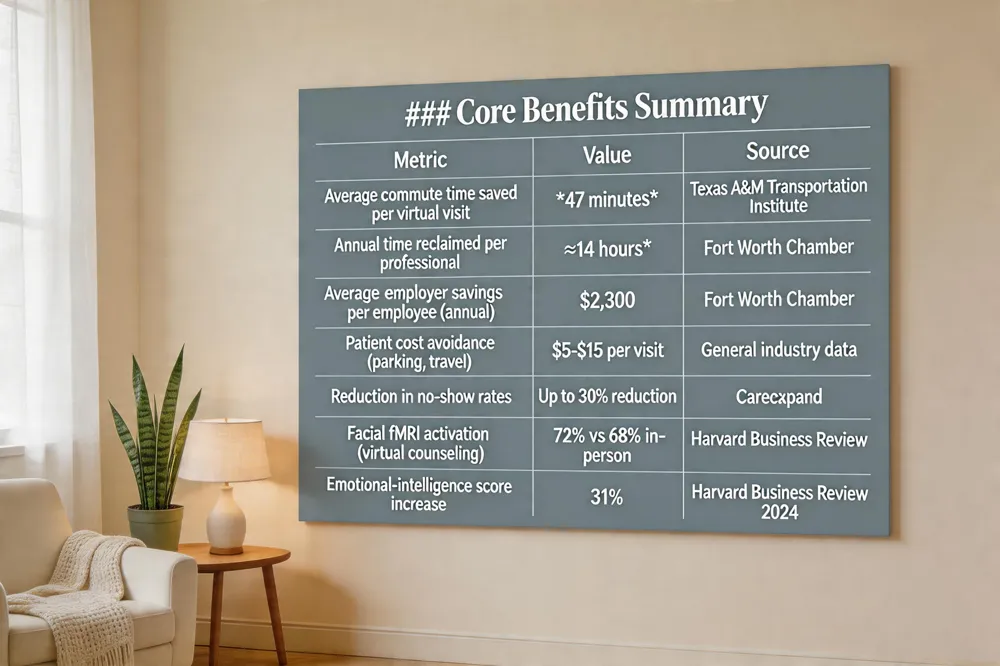 Telehealth eliminates commuting, letting busy professionals fit sessions into lunch breaks, early mornings, or evenings. A typical virtual visit saves 47 minutes per session (Texas A&M Transportation Institute) and reclaims about 14 hours a year (Fort Worth Chamber). Financially, individuals avoid parking and travel costs, while employers save an average of $2,300 per employee annually (Fort Worth Chamber) and see reduced productivity losses.
Benefits of telehealth for patients Remote care from home removes travel hassles, reduces exposure to illness, and eases scheduling without taking time off work. It expands access for rural or mobility‑limited clients and lowers overall health‑care costs.
Benefits of telehealth for providers Clinicians reach a broader geographic pool, lower office overhead, and experience fewer no‑shows. Virtual sessions provide insight into clients’ home environments and streamline documentation through integrated platforms.
Benefits of telehealth scholarly articles Research shows comparable or superior outcomes, higher patient satisfaction, and cost reductions from fewer missed appointments and travel expenses.
Advantages and disadvantages of online counselling PDF Advantages: accessibility, convenience, reduced travel costs, and continuity during crises. Disadvantages: technical glitches, privacy concerns, limited non‑verbal cues, and licensing challenges.
Neural engagement is strong—functional MRI reveals 72 % prefrontal activation during virtual counseling versus 68 % for in‑person. A 2024 Harvard Business Review study links tele‑therapy to a 31 % rise in emotional‑intelligence scores, underscoring the mental‑health payoff of time‑saving telehealth.
Evidence Base: How Effective Is Virtual Therapy?
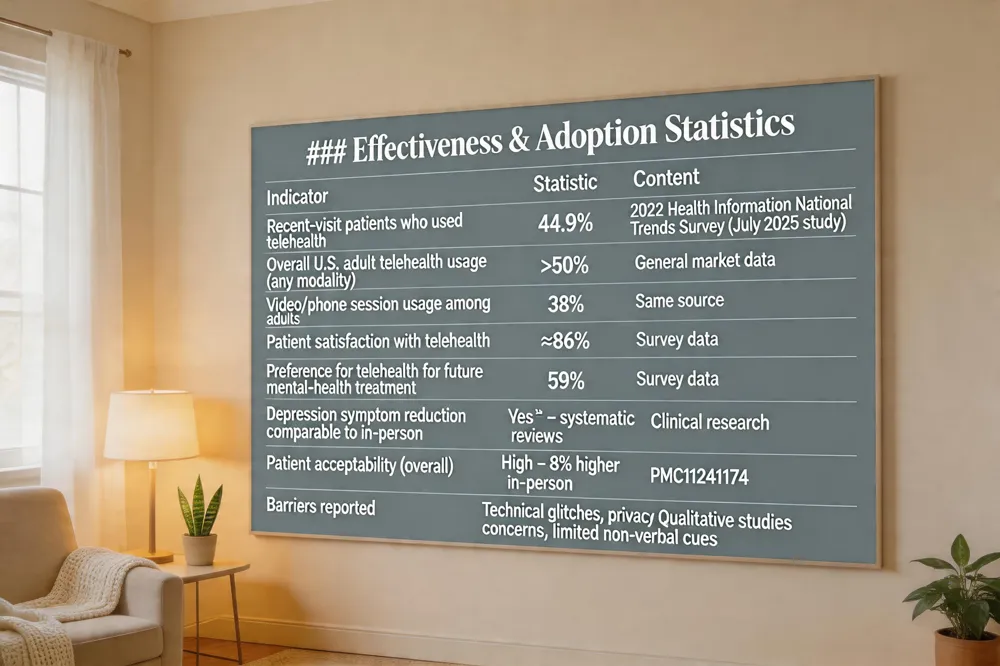
Effectiveness & Adoption Statistics
| Indicator | Statistic | Context |
|---|---|---|
| Recent‑visit patients who used telehealth | 44.9% | 2022 Health Information National Trends Survey (July 2025 study) |
| Overall U.S. adult telehealth usage (any modality) | >50% | General market data |
| Video/phone session usage among adults | 38% | Same source |
| Patient satisfaction with telehealth | ≈86% | Survey data |
| Preference for telehealth for future mental‑health treatment | 59% | Survey data |
| Depression symptom reduction comparable to in‑person | Yes – systematic reviews | Clinical research |
| Patient acceptability (overall) | High – 8% higher than in‑person | PMC11241174 |
| Barriers reported | Technical glitches, privacy concerns, limited non‑verbal cues | Qualitative studies |
Article dated within the past 12 months discussing the use of telehealth in health care
A July 2025 study using the 2022 Health Information National Trends Survey found 44.9 % of recent‑visit patients had used telehealth. Trust in providers, patient‑centered communication, and favorable social determinants boosted utilization, while low health‑literacy and self‑efficacy hindered it. Trust mediated the link between communication quality and telehealth uptake.
Online therapy and medication management
Virtual sessions deliver the same evidence‑based therapies as in‑person care, and licensed clinicians can coordinate with psychiatrists for medication evaluation, prescribing, and monitoring. The integrated, HIPAA‑compliant approach lets you address thoughts and biology without travel or waiting.
Telehealth and mental health scholarly articles
Research shows telehealth yields comparable reductions in depressive symptoms and quality‑of‑life gains to face‑to‑face care. Systematic reviews note high patient acceptability, convenience, and concerns about therapeutic rapport and technical barriers, especially for high‑risk groups.
Online therapy statistics
Over half of U.S. adults have used telehealth; 38 % had a video or phone session. Satisfaction is high (≈86 %), and 59 % would choose telehealth for future mental‑health treatment, reflecting rapid adoption and growing acceptance.
Choosing the Right Platform: From Talkspace to BetterHelp
Platform Comparison
| Platform | Cost (per week) | Insurance Coverage | Key Features | Notable Issues |
|---|---|---|---|---|
| Talkspace | $0 copay for insured; $70‑$100 for self‑pay | Major insurers often $0 copay | Unlimited messaging, weekly video, HIPAA‑compliant | None reported |
| BetterHelp | $70‑$100 | HSA/FSA; some insurers | Text, audio, video, chat; therapist switching free | FTC 2023 data‑sharing settlement ($7.8 M) |
| Open Path Collective | $40‑$70 after $1‑$30 intake fee | Sliding‑scale, not insurance‑based | Low‑cost, vetted therapists | Limited slots |
| Teladoc Health | $100‑$150 per session (out‑of‑pocket) | Many insurers accept | Integrated mental‑health & primary‑care, HIPAA‑secure video | Higher per‑session cost |
| Cerebral | $85‑$95 per month | Some insurers | Medication management, therapy, digital tools | Subscription model |
| Grow Therapy | Varies; often $60‑$80 per week | Some insurers | Flexible scheduling, video/audio | Smaller provider network |
 Talkspace – Connects users with state‑licensed therapists via text, audio, picture, and video; unlimited messaging, weekly video, major insurance often $0 copay, HIPAA‑compliant, comparable outcomes.
BetterHelp – Quick questionnaire matches clients with psychologists or counselors; text, audio, video or chat sessions; $70‑$100 weekly fee; insurance and HSA/FSA options; therapist switching free; lower cost, short wait, not for crisis care.
BetterHelp scandal – FTC 2023 finding that user data were shared with advertisers; $7.8 million settlement; now requires explicit consent for data use.
Therapist platforms – Talkspace, BetterHelp, Grow Therapy, Teladoc Health, Cerebral provide HIPAA‑secure video, chat, scheduling, billing, insurance tools, expanding reach and cutting overhead.
Affordable options – Talkspace often $0 copay for insured; Open Path Collective offers sliding‑scale $40‑$70 after a modest fee.
Insurance‑compatible services – Many platforms accept major insurers with $0‑$15 copays after verification, allowing video, phone, or messaging.
Cost without insurance – Typical out‑of‑pocket $100‑$150 per session; sliding‑scale services like Open Path can lower fees to $40‑$70 after a one‑time fee.
Maximizing Session Impact for Busy Professionals
Time‑Efficient Interventions
| Intervention | Duration | Primary Benefit | Evidence |
|---|---|---|---|
| Micro‑session CBT | 15 minutes | Quick cognitive restructuring during breaks | Clinical protocols |
| Tele‑EMDR (brief) | 15 minutes | Trauma‑focused eye‑movement work | Emerging tele‑therapy studies |
| 3‑3‑3 Grounding Technique | <1 minute | Immediate anxiety relief | Therapeutic best practice |
| Prefrontal activation (fMRI) | 72% during virtual counseling | Indicates strong neural engagement | Harvard Business Review 2024 |
| 3‑month rule for meaningful change | 12 weeks | Allows neural pathway formation | Clinical guideline |
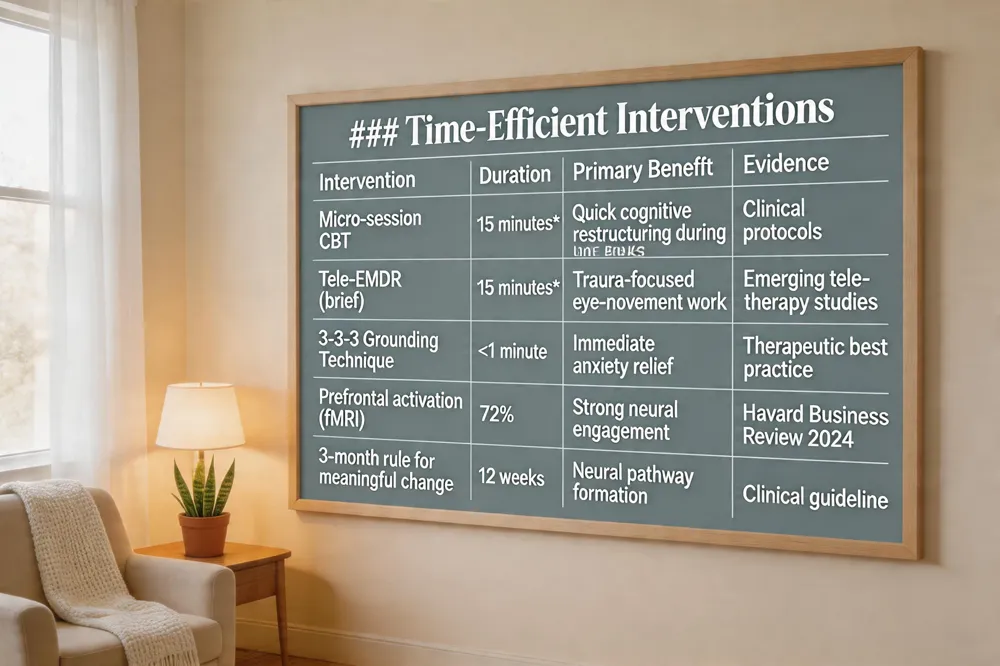 Busy professionals can harness Micro‑session CBT (15‑minute cognitive restructuring) and EMDR via telehealth, which deliver focused 15‑minute cognitive restructuring or trauma‑focused eye‑movement work during short breaks or meetings. These brief, evidence‑based interventions fit tight schedules while still activating the prefrontal cortex (72 % activation in fMRI studies).
The 3‑month rule reminds clients that meaningful change usually appears after 12 weeks of consistent treatment—allowing the brain to form new neural pathways before judging effectiveness.
For immediate anxiety relief, the 3‑3‑3 grounding technique (identify 3 things you see, hear, and feel) anchors attention in the present and can be practiced anywhere.
Telehealth offers major pros: eliminated commute (saving 47 minutes per session, $2,300 annual cost reduction, and flexible video, phone, or chat formats. Cons include limited non‑verbal cues, potential technical glitches, and privacy challenges, especially with telephone‑only counseling.
Improving telehealth involves testing equipment, creating a quiet, well‑lit space, using eye‑level camera placement, and gathering feedback after each visit to refine workflows and enhance therapeutic alliance.
Ethics, Regulations, and the Future of Telehealth
Ethical & Regulatory Checklist
| Principle / Requirement | Implementation |
|---|---|
| Autonomy, Beneficence, Non‑maleficence, Justice | Uphold in all virtual encounters |
| Confidentiality & Data Privacy | Use HIPAA‑compliant platforms; secure private space |
| Informed Consent | Cover technology, breach risks, emergency protocols |
| Licensing & Jurisdiction | Provide services only where legally authorized (PSYPACT, Compact) |
| APA Two‑Year Rule | No sexual relationships with former clients for 2 years post‑termination |
| Broadband Access Equity | Advocate for wider internet availability |
| Ongoing Provider Training | Technical, cultural, and ethical competence |
 Telehealth counseling must uphold the same core ethical principles as in‑person therapy—autonomy, beneficence, non‑maleficence, and justice—while addressing the unique challenges of a digital environment. Counselors are responsible for securing client confidentiality and data privacy by using HIPAA‑compliant platforms and ensuring sessions occur in private, distraction‑free spaces. Informed consent should explicitly cover the technology used, potential risks such as breaches or interruptions, and emergency procedures for remote clients. Practitioners must also be aware of licensing and jurisdictional regulations, only providing services where they are legally authorized. The APA’s two‑year rule prohibits sexual relationships with former clients for two years after termination, reinforcing professional boundaries. A comprehensive review of telemedicine’s impact shows it breaks geographic, financial, and sociocultural barriers, extending care to rural and underserved populations and reducing travel costs. However, gaps in broadband access, regulatory hurdles, and patient acceptance can limit its full potential, requiring coordinated policy, provider, and technology efforts to ensure equitable, secure, and effective virtual care for busy professionals seeking support and wellbeing.
Financial Implications: Savings for Professionals and Organizations
Financial Impact Summary
| Stakeholder | Savings / Benefit | Quantified Value |
|---|---|---|
| Patients | Eliminated travel & parking costs | Variable; typically $5‑$15 per visit |
| Professionals (individual) | 47 min saved per session → 14 hrs/yr reclaimed | $2,300 saved in lost productivity (employer data) |
| Employers | Reduced absenteeism & travel reimbursements | $2,300 per employee annually |
| Providers | Lower office overhead, reduced no‑shows (≤30% drop) | Cost savings on rent, utilities, staffing |
| Clinical Outcomes | 90% report feeling better; 76% of depressed patients improve after 3 visits | Demonstrates ROI in health outcomes |
| Healthcare System | 27% lower out‑of‑network costs (Texas Medicaid) | Broad cost‑effectiveness |
 Benefits of telehealth for patients – Remote sessions let busy professionals receive care from home, eliminating commute time and the need to take work off. A single virtual visit saves an average of 47 minutes (Texas A&M) and recovers roughly 14 hours per year (Fort Worth Chamber). This flexibility reduces stress and improves adherence, leading to faster symptom relief – 90% of Teladoc users report feeling better and 76% of depressed patients improve after three visits.
Benefits of telehealth for providers – Virtual platforms expand reach across state lines (PSYPACT), lower overhead, and cut no‑show rates by up to 30% (Careexpand). Clinicians can integrate digital tools and secure messaging, streamlining documentation and boosting productivity.
Benefits of telehealth in scholarly articles – Research consistently shows comparable clinical outcomes, higher patient satisfaction (8% higher than in‑person), and significant cost reductions. Economic KPIs such as $2,300 annual savings per professional (Fort Worth Chamber) and 27% lower out‑of‑network costs (Texas Medicaid) demonstrate clear cost‑effectiveness.
Employer savings and productivity gains – By avoiding travel and missed work, organizations save an average of $2,300 per employee annually and reclaim 14 hours of productive time, directly supporting the bottom line.
KPIs, Hybrid Models, and the Road Ahead
Key Performance Indicators & Hybrid Model Highlights
| KPI | Target / Benchmark | Impact |
|---|---|---|
| Missed appointments reduction | up to 25% | Improves clinic efficiency |
| Average annual savings per professional | $2,300 | Reduces employer costs |
| Neural engagement (prefrontal activation) | 72% virtual virtual | Supports clinical quality |
| Patient satisfaction score | ≥86% | Indicates acceptance |
| Hybrid model composition | 1‑2 in‑person visits per year + regular video | Balances alliance & flexibility |
| Licensing expansion (PSYPACT, Interstate Compact) | Allows practice across state lines | Increases provider pool |
| Data‑driven dashboard adoption | Ongoing | Aligns KPIs with organizational goals |
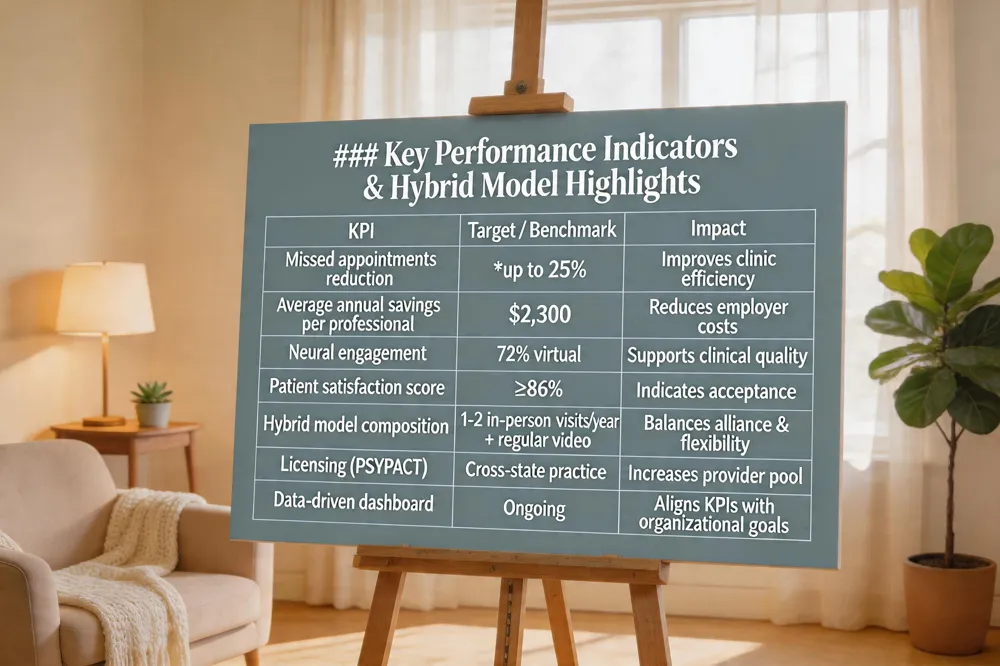 Key performance indicators (KPIs) for telehealth focus on patient outcomes, operational efficiency, technical reliability, and cost‑effectiveness. Studies cite reduced missed appointments (up to 25 %), shorter wait times, and savings of $2,300 per year for professionals who avoid in‑person travel. Neural engagement metrics, such as 72 % prefrontal activation during virtual counseling, reinforce clinical quality. Hybrid in‑person/virtual models blend occasional face‑to‑face visits with regular video sessions, preserving therapeutic alliance while retaining scheduling flexibility. The Interstate Medical Licensure Compact and PSYPACT enable clinicians to practice across state lines, expanding provider pools for mobile professionals. Future research should track long‑term outcomes, equity of access, and sustainability of reimbursement policies. Emerging trends include micro‑session CBT integrated into work meetings, EMDR via telehealth, and data‑driven dashboards that align KPIs with organizational goals. As telehealth continues to mature, evidence‑based protocols, secure platforms, and ongoing policy support will be essential to maintain efficacy, accessibility, and financial viability for busy professionals. Organizations that embed these metrics into continuous‑quality cycles report higher clinician satisfaction and lower turnover.
Putting It All Together for the Busy Professional
Online counseling lets busy professionals reclaim minutes and dollars while receiving high‑quality care. Studies show a 47‑minute session‑time saving, $2,300 annual cost reduction, and a 31 % boost in emotional‑intelligence scores, while functional‑MRI data reveal strong neural engagement. To begin, choose a HIPAA‑compliant platform, verify therapist licensure in your state, and schedule a brief introductory video during a lunch break or after work. Prepare a quiet private space, test your internet connection, and set clear session goals. Use the platform’s digital tools—mood trackers, worksheets, or asynchronous messaging—to reinforce learning between visits. Remember that mental‑health is a vital productivity asset; prioritizing it today fuels resilience, focus, and long‑term career success.