Introduction
Telehealth has become an essential way for people to access mental‑health care, especially when in‑person visits are difficult. Yet, because sessions occur over the internet, protecting a client’s private health information (PHI) is a top priority. The Health Insurance Portability and Accountability Act (HIPAA) requires that every virtual encounter use encrypted, HIPAA‑compliant video platforms, secure passwords, and multi‑factor authentication to keep data unreadable to anyone without the proper key.
Confidentiality is more than a legal requirement; it is the foundation of trust that allows clients to share sensitive thoughts and feelings openly. When a therapist and client both create a private, quiet space—turning off smart speakers, using headphones, and avoiding public Wi‑Fi—the risk of accidental overhearing or cyber‑interception drops dramatically. Moreover, clear informed‑consent forms that outline potential privacy risks, data‑storage practices, and emergency protocols empower clients to make informed choices about their care. By combining strong technical safeguards with a compassionate emphasis on privacy, telehealth can deliver the same therapeutic safety and effectiveness as traditional face‑to‑face sessions while expanding access to those who need it most.
Building a Robust Telehealth Privacy Strategy
 Develop a privacy and security telehealth strategy by first conducting a thorough risk analysis that evaluates current policies, technology, and staff competence. Identify gaps in patient authentication, informed‑consent procedures, data‑backup routines, and breach‑response plans, then draft written policies that meet HIPAA, state laws, and the “minimum necessary” standard. Implement technical safeguards such as end‑to‑end encrypted video platforms, multi‑factor authentication, firewalls, anti‑virus software, and automatic security updates for all devices. Provide ongoing training for clinicians, support staff, and patients on secure device use, creating private meeting spaces (closed doors, headphones, quiet rooms or cars), and recognizing phishing attempts. After each visit, delete any saved screenshots or recordings, use encrypted messaging or a secure patient portal for follow‑up, and retain logs in compliance with retention requirements. Solutions for challenges in telehealth privacy and security follow a three‑pronged approach: environmental (ensure a private space and turn off smart speakers), technical (use HIPAA‑compliant, encrypted platforms, strong unique passwords, MFA, and operational (regular staff education, clear reimbursement guidelines, and strict access‑control procedures) to build trust and protect client confidentiality.
Ethical Foundations of Virtual Therapy
 Ethical Foundations of Virtual Therapy
Virtual therapy ethics examples
Therapists must use encrypted, HIPAA‑compliant platforms, protect recordings, and obtain informed consent that details digital limits, data storage, and emergency plans. Competence with the technology, security patches, and licensing jurisdiction are essential. Boundaries are maintained by avoiding dual relationships and confirming client location before each session.
Ethics of telehealth counseling
Principles—autonomy, beneficence, non‑maleficence, justice—guide virtual care. Confidentiality requires video, private spaces, and patient education on Wi‑Fi safety. Consent must explain risks, jurisdictional constraints, and crisis protocols. Clinicians should promote access and stay current with telepractice guidelines.
What ethical steps do you need to address when using technology in counseling
- Verify HIPAA‑compliant tools.
- Assess personal competence.
- Obtain detailed informed consent.
- Offer alternatives and respect client autonomy.
- Monitor boundaries and update practices.
Telehealth Standards of care
Eligibility assessment, consent, identity verification, environment, encrypted platform, and record‑keeping satisfy federal and state standards.
Navigating Legal and Licensing Requirements
 State licensing and compacts: Each state requires the clinician to hold a valid license where the patient is located. Many states participate in licensure compacts (e.g., the Interstate Medical Licensure Compact, PSYPACT) that simplify multi‑state practice, while others offer temporary telehealth registrations or limited exceptions for out‑of‑state providers. Providers must verify the patient’s residency, obtain any required telehealth registration, and keep professional liability insurance current. Federal regulations: HIPAA remains the baseline for privacy and security of electronic health information in all telehealth encounters, and the FTC enforces consumer‑protection and breach‑notification rules. The Office for Civil Rights requires Business Associate Agreements, encryption, and multi‑factor authentication. Telehealth policy updates: The 2026 Consolidated Appropriations Act (H.R. 7148) extends Medicare‑covered telehealth services for audiologists and speech‑language pathologists through Dec 31 2027, stabilizing access while permanent legislation is considered. Ongoing state‑by‑state monitoring is essential because licensing rules and reimbursement policies evolve rapidly.
Maintaining Confidentiality and Privacy During Sessions
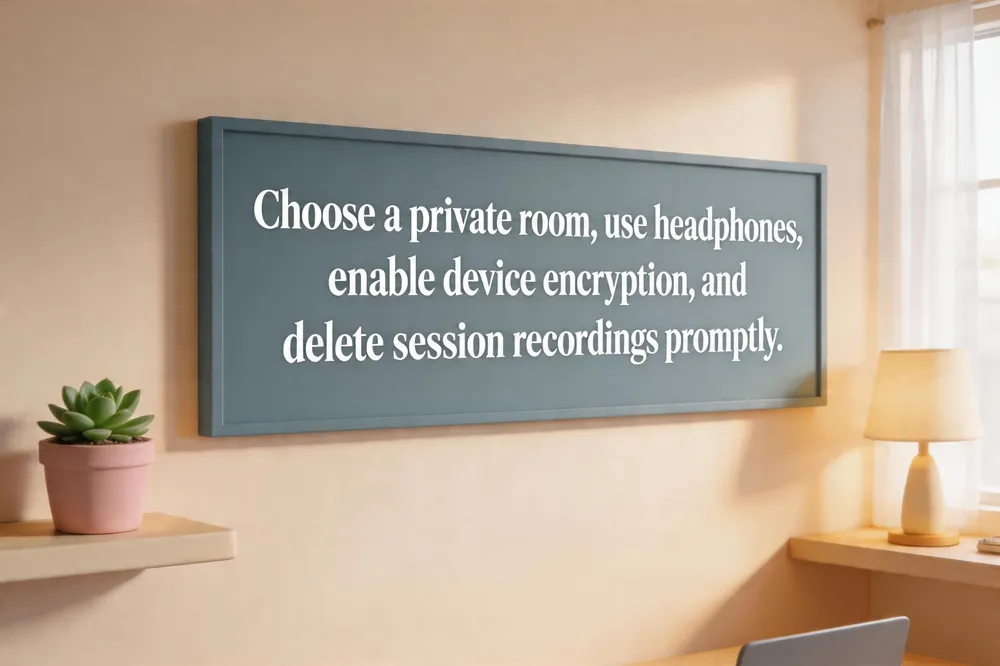 Telehealth privacy concerns arise when sessions are held in non‑private spaces—shared rooms, public cafés, or even a parked car—allowing others to overhear or see sensitive conversations. An environment control strategy means choosing a quiet, closed door room, turning off nearby smart speakers or cameras, and using headphones to block ambient sound. Technical safeguards include using a personal, up‑to‑date device, installing security patches, enabling encryption, lock‑screen timers, and strong, unique passwords for each platform. Multi‑factor authentication adds an extra layer of protection against credential theft, while avoiding public Wi‑Fi or unsecured USB ports reduces interception risk. Post‑session data deletion is essential: after the appointment, delete any screenshots, recordings, or health‑related files and ensure the device’s storage is encrypted. By combining a private physical setting, robust digital security, and diligent cleanup, both therapist and client uphold HIPAA‑mandated confidentiality and maintain trust in online counseling.
Informed Consent and Communication Protocols
 Virtual care begins with clear, written informed consent that outlines the technology used, encryption (HIPAA‑compliant, end‑to‑end encryption), and possible data‑breach risks. Clinicians must verify client identity, confirm licensing for the client’s location, and document emergency contacts. Secure communication channels require strong, unique passwords, two‑factor authentication, and HTTPS‑verified platforms; public Wi‑Fi should be avoided or used with a VPN. Clients are educated to conduct sessions in a private room, turn off smart speakers, use headphones, and delete any screenshots after the visit.
Internet counseling ethics – confidentiality, encrypted platforms, professional boundaries, and state licensing are mandatory.
Guidelines for online therapy – consent, secure HIPAA‑compliant tools, licensing verification, documentation, and crisis plans.
Maintaining privacy online – strong passwords, 2FA, end‑to‑end encryption, VPNs on public networks, and regular privacy‑setting reviews.
Confidentiality in counselling – discuss limits, obtain written consent, store records securely, follow legal disclosure rules, and document decisions.
Technical Safeguards and Platform Selection

Telehealth privacy tips for providers
Use a HIPAA‑compliant video platform that offers end‑to‑end encryption (e.g., Zoom for Healthcare, Doxy.me, VSee). Enable multi‑factor authentication on every device and account, and enforce strong, unique passwords that are changed regularly. Verify each participant’s identity at the start of the session, conduct visits in a private, sound‑proof space, and use headsets to prevent accidental eavesdropping. Obtain clear informed consent that outlines privacy risks, data‑use policies, and emergency procedures, and limit data collection to the minimum necessary for treatment. Delete any saved screenshots or recordings after the session and conduct periodic security audits.
Best online therapy platforms for therapists
Therapists seeking secure, scalable solutions should consider platforms that sign Business Associate Agreements and provide HIPAA‑compliant encryption: Zoom for Healthcare, Doxy.me, VSee, SimplePractice, and TheraNest. These tools include waiting‑room controls, audit logs, and easy MFA integration, helping clinicians meet both regulatory and ethical standards.
Ethical issues with telehealth counseling
Key ethical concerns include safeguarding confidentiality, obtaining informed consent that details technology limits, verifying licensure in the client’s jurisdiction, and maintaining professional boundaries online. Therapists must also address equity by supporting patients with limited broadband or device access.
How confidential is online therapy?
When a therapist and client use a HIPAA‑compliant end‑to‑end encrypted platform, employ strong passwords, MFA, and operate on updated, password‑protected devices, online therapy can be highly confidential. Risks arise from public Wi‑Fi, shared devices, or insecure software; mitigating these protects the therapeutic relationship.
Addressing Environmental and Operational Risks
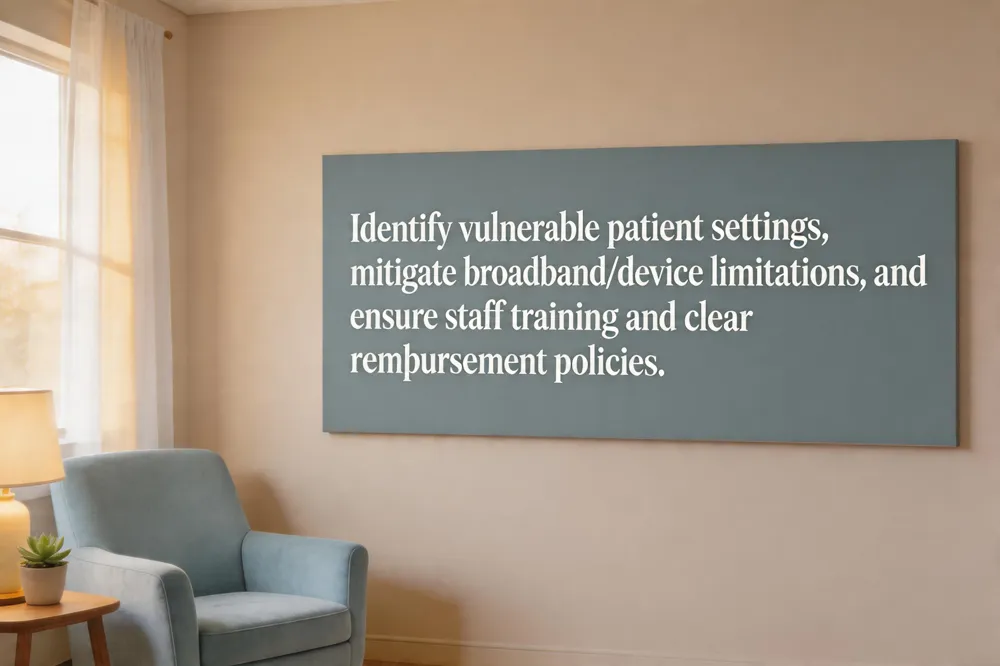 Privacy concerns are especially acute for vulnerable groups—homeless individuals, adolescents, elders, and those receiving substance‑use or mental‑health treatment—who often lack a private space for virtual visits. Without a closed door, headphones, or a quiet room, conversations can be overheard, and sensitive information may be unintentionally disclosed.
Technology barriers further increase risk. Limited broadband, outdated devices, and low digital literacy reduce the ability to use encrypted, HIPAA‑compliant platforms, leaving sessions vulnerable to hacking or data interception. Patients and providers must receive clear guidance on updating software, enabling two‑factor authentication, and avoiding public Wi‑Fi.
Operational challenges—reimbursement uncertainty, payer denials, and insufficient staff training—compound these issues. Regular risk‑assessment, mandatory privacy‑security education, and clear billing policies help clinicians meet HIPAA’s “minimum necessary” standard while sustaining virtual care.
Privacy and security risk factors related to telehealth services a systematic review: The review identified three primary categories—environmental (lack of private space for vulnerable patients), technological (data‑security vulnerabilities, limited broadband, inadequate devices), and operational (reimbursement hurdles, payer denials, training gaps). Recognizing these factors guides targeted safeguards.
Common telehealth risks include but are not limited to: Licensing and credentialing gaps, privacy breaches from unsecured platforms, poor internet connectivity, inadequate informed‑consent processes, and operational obstacles such as reimbursement uncertainty and staff training deficits.
The problem with online therapy: Building therapeutic alliance can be harder without rich non‑verbal cues; many platforms employ therapists not licensed in the client’s state, raising legal and quality concerns; privacy breaches and data‑security flaws jeopardize confidentiality; severe mental‑health conditions may lack needed monitoring; frequent therapist turnover disrupts continuity of care.
Emergency Planning and Crisis Management
 In tele‑health, confirming a client’s physical location at the start of each session is essential for both legal compliance and safety; clinicians should verify the address using a government‑issued ID or a secure code word. Once the location is known, a written safety plan can be co‑created, outlining steps for emergencies, local emergency contacts, and the client’s preferred hospital or crisis line. This plan should be reviewed briefly at the beginning of every visit and updated whenever the client moves or their risk status changes.
Documentation of these protocols must be clear and consistent. Policies typically define tele‑health services, require a HIPAA‑compliant video platform and mandate written informed consent and identity verification before the first visit. They also stipulate that both clinician and client conduct sessions in a private, quiet space with a secure network. By integrating location checks, safety plans, and thorough documentation, therapists can protect confidentiality while ensuring rapid, appropriate response to crises.
Future Directions and Ethical Resources
 Professional bodies are issuing comprehensive ethical guidance documents—often downloadable PDFs—to help clinicians navigate remote practice. The "Virtual therapy ethics pdf" outlines core standards such as HIPAA‑compliant encryption, informed consent, emergency protocols, and cross‑state licensing, providing checklists for secure video‑conferencing and data handling. A narrative review titled "Ethical issues in online psychotherapy" (Stoll, Müller & Traregel, 2020) highlights privacy breaches, the need for specialized tele‑health competence, and challenges in managing crises when the therapist is not physically present. Broader ethical issues in psychotherapy remain consistent: safeguarding confidentiality, obtaining clear informed consent, avoiding dual relationships, and practicing within competence while ensuring transparent billing. Emerging technologies—including AI‑driven assessment tools—promise expanded access but demand updated standards and ongoing risk assessments. Continuing education programs now integrate these evolving guidelines, ensuring clinicians stay current with legal requirements, ethical best practices, and innovative digital safeguards.
Conclusion
Telehealth has become a cornerstone of modern mental‑health care, but its benefits are only realized when privacy and ethical standards are rigorously upheld. Across federal guidance, professional codes, and peer‑reviewed research, several recurring themes emerge.
Key takeaways on privacy and ethics
- HIPAA compliance is non‑negotiable – Every telehealth encounter must use platforms that sign a Business Associate Agreement, employ end‑to‑end encryption, and enforce the “minimum necessary” rule for data display.2..Physical environment matters** – Both therapist and client should conduct sessions in a private, sound‑proofed space, turn off smart speakers and cameras, and use headphones to eliminate inadvertent overhearing or recording.
- Strong authentication and device hygiene – Unique, complex passwords, two‑factor authentication, regular security updates, and lock‑screen timers protect devices from credential theft and malware.
- Informed consent must be explicit – Consent forms should detail the technology used, potential privacy risks, emergency protocols, and the client’s responsibility to secure their own environment and internet connection.
- Verification of identity and location – Multi‑factor verification and a brief “who is present?” check at the start of each session prevent impersonation and ensure appropriate jurisdictional licensing.
- Documentation and breach response – All session notes, recordings, and security incidents must be stored on encrypted, password‑protected servers with audit logs, and any breach must be reported promptly per HIPAA and state law.
Encouragement for ongoing best‑practice adoption Mental‑health professionals are urged to embed these safeguards into everyday workflow rather than treating them as one‑time checklists. Regular risk assessments, continuous staff training, and patient education on digital literacy keep the security posture current amid evolving threats. Embracing a culture of transparency—explaining safeguards, acknowledging limitations, and inviting client questions—builds trust and reinforces therapeutic alliance.
Finally, clinicians should stay attuned to state‑specific statutes, emerging federal guidance, and professional ethical codes that may impose stricter protections than HIPAA alone. By consistently applying these privacy‑first principles, therapists not only protect confidential information but also model the responsible, compassionate care that underpins effective teletherapy. Ongoing commitment to best‑practice adoption ensures that the promise of telehealth—greater access, flexibility, and continuity of care—remains a safe and ethical reality for every client.