Opening Overview
Patient preferences are the specific choices patients make about the who, activities, and provider characteristics they want in mental‑health care—such as preferred therapist gender, session time, language, or therapeutic modality. Ethically, honoring these preferences respects autonomy, dignity, and the right to self‑determination; clinically, it strengthens the therapeutic alliance, boosts motivation, and improves engagement. A large cross‑sectional survey of 14,587 UK psychotherapy patients found that 86 % voiced at least one preference and that unmet preferences markedly reduced perceived help (odds ratios 0.16‑0.40). Meta‑analyses of over 16,000 patients show that accommodating preferences almost doubles treatment completion odds (OR ≈ 1.79) and yields modest outcome gains (d ≈ 0.28). Across diverse studies, preference‑matched care is linked to lower dropout rates, stronger alliances, and higher satisfaction, underscoring its central role in effective, patient‑centered mental‑health treatment.
Understanding Patient Preferences: Foundations and Impact
 A meta‑analysis of 53 studies (over 16,000 patients) showed that accommodating preferences nearly doubles the odds of treatment completion (OR = 1.79) and yields a modest but reliable improvement in outcomes (Cohen’s d = 0.28). Consistency across modalities, demographics, and preference categories underscores the universal benefit of patient‑centered decision‑making.
Importance of patient preferences in treatment decisions – When clinicians integrate preferences, patients are more motivated, adhere better to plans, and report stronger therapeutic alliances, leading to superior coping and symptom relief. Ignoring preferences often results in lower satisfaction, higher dropout, and poorer outcomes.
Patient preferences examples – Clients may request a particular therapeutic approach, a therapist whose gender or cultural background matches their comfort, sessions at a convenient time of day, language support or interpreter services, and specific treatment goals such as skill‑building for anxiety rather than trauma exploration. Recognizing and meeting these needs is essential for personalized, high‑quality mental‑health care.
Therapeutic Alliance and Preference Matching
 Psychotherapy and therapeutic relationship
Psychotherapy is a collaborative, evidence‑based process in which a licensed therapist helps clients explore thoughts, emotions, and behaviors to promote mental well‑being. The therapeutic relationship—often called the alliance or rapport—is the foundation of this work, built on trust, empathy, mutual respect, and clear communication. Research consistently shows that a strong alliance predicts positive outcomes as much as any specific technique, making it a critical factor in client engagement and recovery. Effective therapists cultivate cultural competence, invite client feedback, and repair ruptures to maintain a supportive, non‑judgmental environment, turning therapist and client into equal partners in setting goals and navigating change.
Psychotherapy and therapeutic relationship
Psychotherapy is a collaborative, evidence‑based process in which a licensed therapist helps clients explore thoughts, emotions, and behaviors to promote mental well‑being. The therapeutic relationship—often called the alliance or rapport—is the foundation of this work, built on trust, empathy, mutual respect, and clear communication. Research consistently shows that a strong alliance predicts positive outcomes as much as any specific technique, making it a critical factor in client engagement and recovery. Effective therapists cultivate cultural competence, invite client feedback, and repair ruptures to maintain a supportive, non‑judgmental environment, turning therapist and client into equal partners in setting goals and navigating change.
Patient care preferences oasis examples The OASIS "Preferences for Customary Routine Activities" captures a patient’s living situation, desired assistance level, language or cultural needs, and preferred modality (in‑person, telehealth, hybrid). It also records preferred therapy schedule (morning, afternoon, evening) and specific goals such as sleep improvement or anxiety management. Documenting these preferences allows clinicians to craft personalized, patient‑centered plans that align with the individual’s lifestyle.
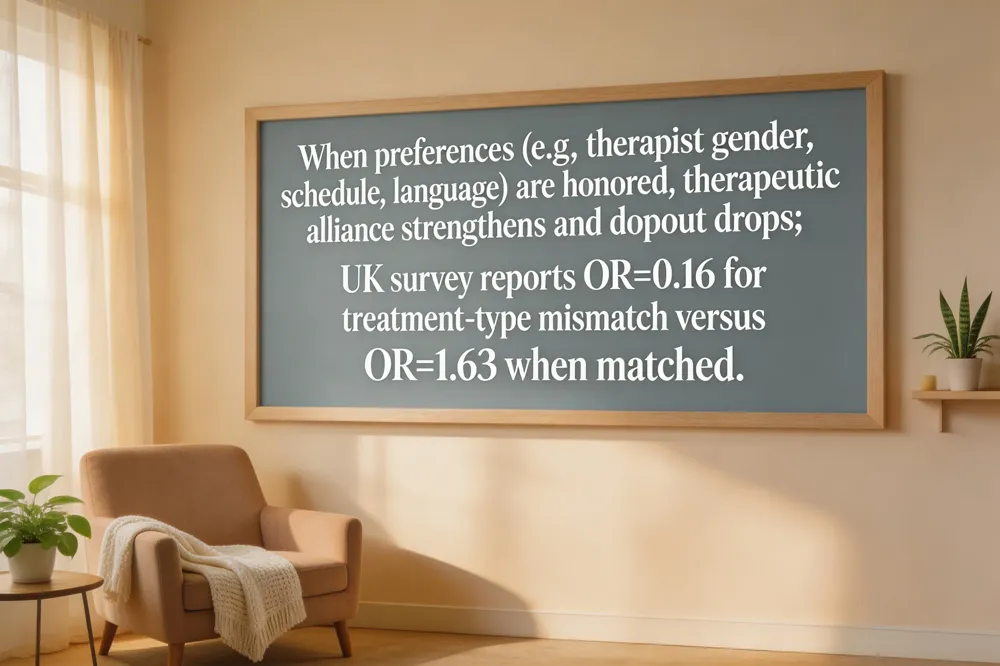
Why matching preferences matters When preferences are met, patients report stronger therapeutic alliances and are significantly less likely to drop out. In a UK survey, 36.7 % of patients whose preferences were ignored reported lower coping, with odds ratios as low as 0.16 for treatment type. Conversely, met preferences raise odds of helpful therapy (e.g., 1.63‑fold for treatment type), underscoring that preference‑driven care both deepens the alliance and reduces premature termination.
Precision Medicine and Neuroimaging
 Neuroimaging for precision medicine in psychiatry
Functional neuroimaging—particularly fMRI and PET—provides a window into the brain circuits that underlie depressive and anxiety disorders. By mapping each person’s pattern of circuit dysfunction, clinicians can move beyond symptom‑based diagnoses toward biologically informed subtypes. This enables more accurate predictions about which patients will benefit from medication, psychotherapy, or neuromodulation, reducing trial‑and‑error prescribing and accelerating recovery. However, routine clinical use requires standardized protocols, affordable access, and integration with traditional assessments.
Personalized brain‑circuit scores identify clinically distinct biotypes in depression and anxiety
Large‑scale studies using task‑free and task‑evoked fMRI data have generated individualized scores for six major brain circuits. Hierarchical clustering of these scores revealed six biotypes, each with unique connectivity patterns (default‑mode, salience, frontoparietal) and activation profiles (negative‑affect, positive‑affect, cognitive‑control). The biotypes differ in symptom severity, cognitive performance, and treatment response—for example, a hyper‑active cognitive‑control biotype responds better to venlafaxine, whereas a heightened negative‑affect biotype shows greater improvement with psychotherapy. These findings demonstrate that circuit‑based phenotyping can guide precise treatment selection.
Precision medicine in psychiatry
Precision psychiatry integrates genetic, neuroimaging, and other multimodal biomarkers to tailor assessment and care to each individual’s biological, psychological, and social profile. By moving beyond symptom labels, it promises to cut the time needed to find effective therapies, improve outcomes for depression, anxiety, and related conditions, and reduce unnecessary side‑effects. Ongoing research is expanding the repertoire of predictive markers, while challenges such as data standardization, reimbursement, and equitable access must be addressed before these tools become commonplace in everyday practice.
Survey Evidence: How Preference Unmet Affects Outcomes
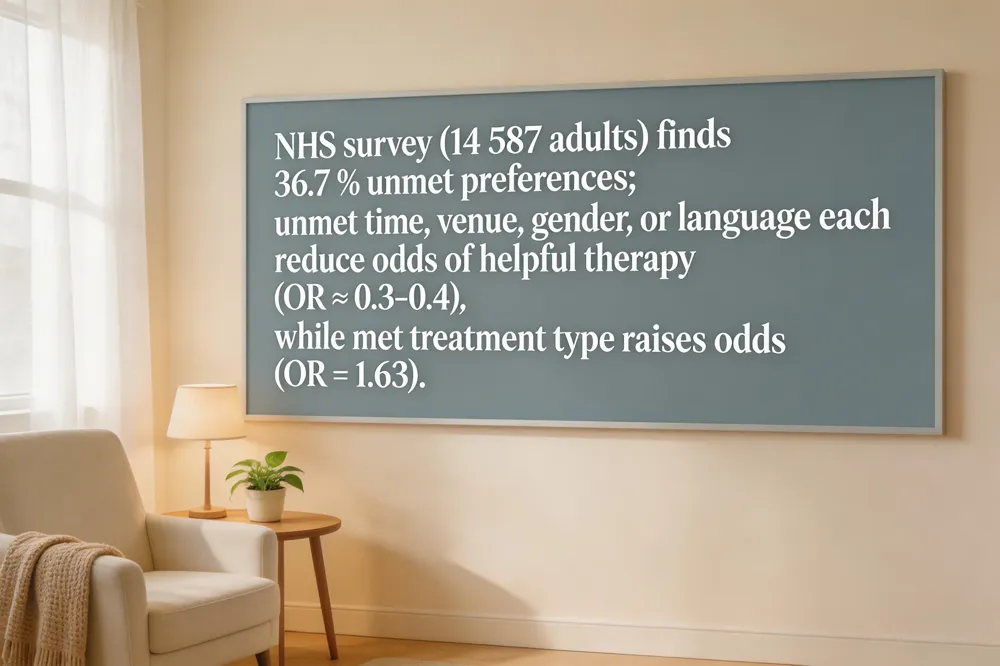 A large cross‑sectional NHS survey of 14,587 adults in England and Wales found that 86 % of patients had at least one therapy‑related preference, most commonly the time of day (72.6 %). Yet 36.7 % of those with preferences reported that one or more were not met. Unmet preferences were linked to markedly lower odds of reporting helpful therapy: appointment time (OR 0.29), venue (OR 0.32), treatment type (OR 0.16), therapist gender (OR 0.32) and language (OR 0.40). By contrast, when patients received their preferred treatment type they were 1.63 times more likely to rate therapy as helpful (95 % CI 1.44‑1.84). Women were more likely than men to express preferences for venue, timing, therapist gender and treatment type (e.g., OR 1.79 for time). Younger adults (18‑24) expressed fewer preferences for gender and modality, while older adults (55‑64) more often wanted language or interpreter services (OR 1.48). Ethnic‑minority patients were more likely to request gender‑matched therapists and language support (e.g., Asian OR 1.52 for gender). The authors conclude that routine assessment and accommodation of preferences can improve self‑reported outcomes in psychological care.
Systematic Treatment Selection (STS): Matching Patients to Interventions
 Systematic Treatment Selection (STS) offers an integrative framework that moves beyond the narrow focus on treatment manuals and instead matches therapeutic interventions to the individual’s unique clinical profile, preferences, and contextual circumstances. The model identifies four major clusters of patient traits that reliably predict change: functional impairment, coping style, trait‑like resistance, and subjective distress. By assessing these dimensions with tools such as the STS‑Clinician Rating Form, clinicians can select the modality—CBT, psychodynamic, interpersonal, or others—that best fits the client’s needs.
Research shows that patient‑treatment fit explains far more variance in outcomes (up to 65‑90 % in some studies) than the specific manualized protocol alone (<10 %). Mediation and moderation analyses demonstrate that both relationship factors and the interaction of patient traits with treatment contribute to change. Supervision that incorporates STS principles can double improvement scores compared with usual supervision, underscoring the practical benefit of training clinicians in fit‑focused practice.
Shared Decision‑Making Tools at Intake
 At the first appointment, clinicians can capture Patient preferences through brief, structured questionnaires and a short conversational interview. Simple check‑lists ask about preferred session times, therapist gender, language needs, and the type of therapy (e.g., CBT, mindfulness). This information is often gathered in a pre‑treatment form that takes only a few minutes, allowing the therapist to focus the subsequent discussion on the client’s values and goals.
The Cooper‑Norcross Inventory of Preferences (C‑NIP) is a validated, five‑minute tool that assesses four dimensions of client preference—therapist directiveness, emotional intensity, temporal focus, and therapist style—plus open‑ended items about format, frequency, and therapist traits. Using the C‑NIP at intake helps clinicians quickly identify strong likes or dislikes and creates a shared language for decision‑making.
When a preference cannot be met, the therapist should explore the underlying reason, offer alternatives, and explain any constraints. Research shows that unmet preferences dramatically reduce perceived helpfulness of therapy (odds ratios as low as 0.16 for treatment type) and increase dropout. By acknowledging the gap, offering compensatory options (e.g., flexible scheduling or interpreter services), and revisiting preferences throughout care, clinicians preserve the collaborative alliance and improve outcomes.
The importance of listening to patient preferences when making decisions – Patient preferences encompass specific treatment, activity, and provider characteristics that patients desire. Incorporating these preferences aligns with ethical principles of respect for autonomy and dignity. A meta‑analysis of 53 studies (N > 16,000) found that accommodating preferences nearly doubled the odds of treatment completion (OR = 1.79) and produced a modest positive effect on outcomes (d = 0.28). Preference matching reduces dropout, especially for medication, and enhances motivation, engagement, and therapeutic alliance.
Patient preferences in evidence‑based practice – Preferences are a cornerstone of evidence‑based practice, ensuring decisions reflect individual values and goals. When therapies align with client wishes, adherence improves and outcomes are better. Clinicians blend scientific evidence, clinical expertise, and expressed wishes throughout assessment and planning, creating personalized, collaborative treatment plans that honor both science and the person behind it.
Cultural Competence, Minority Preferences, and Language Services
 Research from a large NHS survey (14,587 patients, 184 services) shows that 86 % of patients preferred at least one aspect of psychological therapy yet 36.7 % reported an unmet preference.
Women more likely than men to express preferences for all components except language.
Ethnic minority patients more likely to prefer therapist gender and language/interpreter services.
Met preferences linked to higher odds of therapy helping (ORs: treatment type 1.63) whereas Unmet preferences linked to lower odds of therapy helping (ORs: time 0.29).
These findings underscore the ethical and practical importance of embedding patient preferences into evidence‑based practice. Clinicians can enhance cultural competence by: (1) routinely administering brief preference questionnaires at intake; (2) offering a diverse pool of therapists differing in gender, cultural background, and language ability; (3) using shared‑decision‑making tools to discuss trade‑offs when a preferred option is unavailable; and (4) providing interpreter services or bilingual therapists for those who need them. Such systematic, patient‑centered matching not only honors autonomy but also improves therapeutic alliance, reduces dropout, and boosts self‑reported outcomes.
Creative Arts and Lifestyle Adjuncts in Therapy
 Research on art and mental health shows that engaging in creative activities—visual art, music, dance, or mindful doodling—lowers stress hormones, reduces anxiety, and improves mood. Clinical trials of structured art therapy report symptom relief in depression, trauma recovery, and slower cognitive decline among adults and teens. Neuroaesthetic studies reveal that meaningful art experiences activate the brain’s default‑mode network, fostering introspection, empathy, and social connection. The World Health Organization now lists arts participation as a key component of mental‑health promotion.
Art and mental health benefits extend to everyday practice. Simple creative acts such as doodling, humming while cooking, or short movement breaks give the nervous system a chance to slow down, decreasing cortisol and enhancing emotional resilience. Group‑based arts—collaborative painting, dance, or music circles—build belonging and reduce isolation, supporting personal and social well‑being. Integrating these low‑cost, enjoyable activities alongside evidence‑based therapies can boost focus, self‑esteem, and overall therapeutic outcomes. Clinicians who ask clients about preferred creative outlets can tailor interventions, reinforcing empowerment and therapeutic alliance daily.
Future Directions: AI‑Driven Decision Support and Ongoing Preference Evaluation
 Machine‑learning algorithms are rapidly becoming a cornerstone of personalized mental‑health care. By analyzing large datasets that include symptom trajectories, genetic markers, lifestyle factors, and prior treatment outcomes, these models can generate probability estimates for how a given client will respond to specific interventions—such as CBT, medication, or neuro‑stimulation. When presented through clinician‑friendly decision‑support dashboards, the predictions help clinicians and clients co‑create a treatment plan that aligns with both evidence and personal preferences.
Routine outcome monitoring (ROM) and adaptive platforms extend this precision into everyday practice. Regular brief assessments—delivered via secure apps or portal questionnaires—feed real‑time data back to the decision‑support system. If a client’s symptom scores plateau or deteriorate, the platform can suggest alternative strategies, dosage adjustments, or referral options, ensuring the therapeutic plan remains flexible and responsive.
Crucially, data‑driven insights must complement, not replace, the therapeutic alliance. Therapists should use algorithmic recommendations as conversation starters, inviting clients to discuss how suggested options fit their values, cultural background, and life circumstances. This collaborative stance preserves client autonomy, strengthens trust, and mitigates any perception that care is reduced to a spreadsheet.
Personalized Medicine in Psychiatry impact factorThe journal Personalized Medicine in Psychiatry is indexed in the Journal Citation Reports and carries a solid reputation in the field of mental‑health research. According to the most recent data (2023 JCR), its impact factor is approximately 5.7, placing it among the higher‑ranked titles in psychiatry and clinical psychology. This metric reflects the average number of citations received per article published in the journal over the preceding two‑year period. The strong impact factor underscores the journal’s influence and the relevance of its published studies on individualized treatment approaches for psychiatric disorders. For clinicians and researchers looking for evidence‑based, cutting‑edge work on personalized psychiatry, the journal’s citation performance signals a high‑quality, widely referenced source.
Patient Preference and Adherence
Patient Preference and Adherence is an international, peer‑reviewed open‑access journal that examines how individuals’ choices, values, and satisfaction influence their engagement with health interventions. It publishes research on topics such as medication adherence, therapy attendance, and the design of patient‑centered treatment plans across medical and mental‑health settings. By highlighting the role of patient preferences in shaping clinical outcomes, the journal helps clinicians develop more personalized, evidence‑based approaches. Articles often explore barriers to adherence and strategies—such as shared decision‑making, digital tools, and tailored communication—that improve both treatment uptake and satisfaction. For a counseling practice like Julia Flynn Counseling, insights from this journal can inform how to align therapeutic modalities with each client’s unique goals, thereby boosting engagement and long‑term mental‑health benefits.
Final Thoughts
Patient preferences are a cornerstone of effective mental‑health care. When individuals can choose the time of day, venue, therapist gender, language, or treatment modality that best fits their lives, they report higher therapeutic alliance, lower dropout rates, and better self‑reported outcomes. Clinicians should routinely assess these preferences—using brief questionnaires or intake discussions—and honor them whenever possible, exploring alternatives when constraints arise. Looking ahead, the convergence of precision mental‑health tools (e.g., neuroimaging, genetics, machine‑learning decision supports) with systematic preference assessment promises truly individualized care: matching biological profiles, personal values, and contextual needs. By integrating data‑driven predictions with patient‑centered choices, future services can enhance engagement, boost efficacy, and reduce disparities across diverse populations.