Setting the Stage for Empowerment
Personal empowerment is the process of gaining intentional control over one’s life, aligning choices with personal values, and developing the confidence to act toward meaningful goals. Its roots lie in Carl Rogers’ person‑centered approach of the 1940s‑1950s, which introduced core conditions of unconditional positive regard, empathic understanding, and therapist congruence to foster a safe, client‑led therapeutic space. Contemporary psychological theories reinforce this framework: Bandura’s self‑efficacy theory (1986) shows that belief in one’s capabilities fuels motivation; Deci and Ryan’s Self‑Determination Theory (1985) highlights autonomy, competence, and relatedness as essential for intrinsic motivation; and Positive Psychology (Seligman) emphasizes strengths, gratitude, and mindfulness as pathways to flourishing. Together, these foundations explain why collaborative goal‑setting, active listening, and strength‑based interventions reliably boost self‑awareness, resilience, and overall mental‑health outcomes.
Foundations of Personal Empowerment in Therapy
Core Empowerment Techniques
| Technique | Key Elements | Typical Use ||-----------|--------------|------------| | Building Rapport | Non‑judgment, therapeutic silence, active listening | Establish trust and safety | | SMART Goal‑Setting | Specific, Measurable, Achievable, Relevant, Time‑bound | Clarify client objectives | | Cognitive Restructuring | Identify distortions, challenge thoughts, replace with balanced alternatives | Reduce negative self‑talk | | Mindfulness Practices | Guided meditation, journaling, grounding | Enhance present‑moment awareness | | Narrative Reframing | Storytelling, reinterpretation of experiences | Boost self‑efficacy and agency | | Assertiveness Role‑Play | Practice expressing needs, setting boundaries | Strengthen interpersonal confidence | | Strength‑Based Assessment | Identify assets, resources, talents | Foster autonomy and capacity building |

How to empower clients in social work
Empower clients by building rapport, practicing non‑judgment, and using therapeutic silence. Employ active listening, genuine empathy, and unconditional positive regard. Collaborate on goal‑setting, encourage self‑reflection, and celebrate strengths to foster autonomy.
What are the techniques of empowerment therapy?
Empowerment therapy starts with a strengths‑based assessment, then uses SMART goal‑setting, assertiveness role‑play, problem‑solving steps, mindfulness (guided meditation, journaling), cognitive restructuring, and narrative reframing to boost self‑efficacy and agency.
Self‑empowerment
What is empowerment therapy?
What are the 5 points of empowerment?
- Collaborate to build capacity for self‑directed action. 2. Strengthen self‑confidence and recognize abilities. 3. Provide opportunities to harness personal power. 4. Establish just power relations addressing inequities. 5. Design flexible systems that adapt to client needs.
What are the 3 C’s in counselling?
Caring, Challenge, Commitment.
Practical Self‑Help Tools and Resources
Downloadable PDFs Overview
| Main Content | How to Use | |
|---|---|---|
| Self‑Empowerment PDF | CBT techniques (cognitive restructuring, behavioral activation, exposure, mindfulness), DBT communication (DEAR MAN) | Follow step‑by‑step guides during sessions or self‑study |
| Motivation Therapy Worksheets | Values clarification, intrinsic driver identification, SMART goal planning | Complete exercises to uncover motivations and create action plans |
| Therapeutic Interventions Cheat Sheet | Symptom‑intervention matching (CBT, DBT, ACT, mindfulness) with brief descriptions & homework ideas | Quick reference for clinicians & clients |
| List of Therapeutic Interventions (Printable) | Organized list of evidence‑based tools for progress‑note writing | Select appropriate interventions rapidly during sessions |
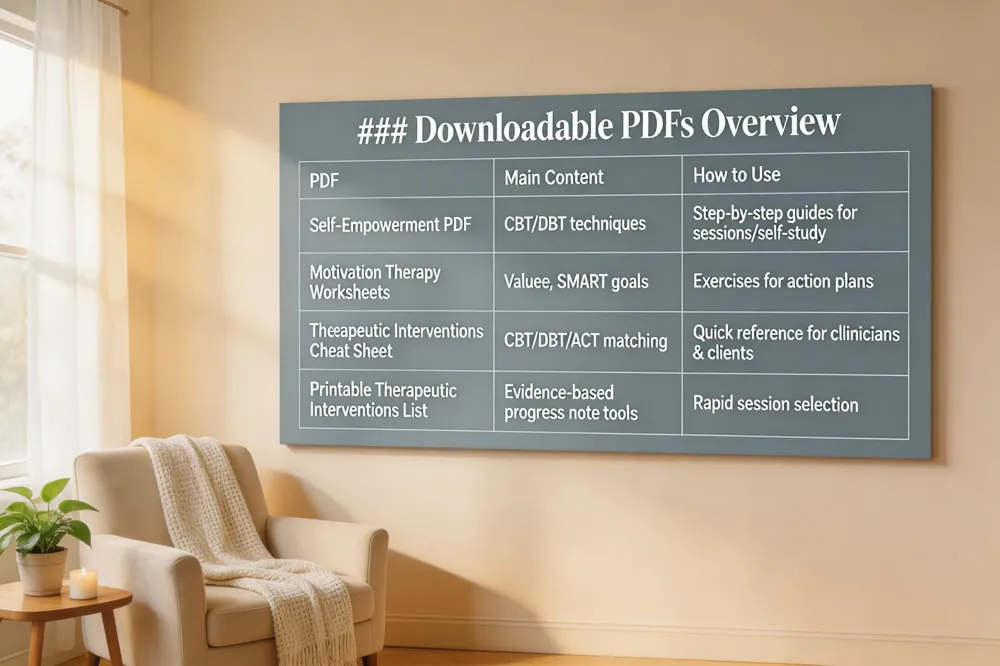 A collection of downloadable PDFs makes evidence‑based empowerment easy to use.
The Self‑empowerment PDF lists core therapeutic interventions—CBT techniques such as cognitive restructuring, behavioral activation, exposure, mindfulness/relaxation, problem‑solving, activity scheduling, thought records, skills training, plus DBT communication tools like DEAR MAN and trauma‑focused strategies—each with a brief purpose and step‑by‑step guide.
Motivation therapy worksheets help clients uncover intrinsic drivers, clarify values, and set SMART goals. Using self‑determination theory and motivational interviewing prompts, the worksheets assess competence, autonomy, and relatedness, then guide visualization, barrier identification, and action‑plan creation.
The Therapeutic Interventions Cheat Sheet (PDF) is a quick‑reference guide that matches common symptoms with appropriate CBT, DBT, ACT, and mindfulness techniques, offering concise descriptions, typical applications, and homework ideas for both clinicians and clients.
A printable List of Therapeutic Interventions (PDF) serves as a handy reference for progress‑note writing, featuring the same evidence‑based tools—cognitive restructuring, behavioral activation, exposure, mindfulness, problem‑solving, activity scheduling, thought records, skills training, and DBT strategies—organized for rapid selection during sessions.
Motivation and Goal‑Setting Strategies
Motivational Frameworks & Strategies
| Strategy | Components | Outcome |
|---|---|---|
| Growth Mindset | Belief that abilities improve with effort | Increases intrinsic motivation |
| SMART Goals | Specific, Measurable, Achievable, Relevant, Time‑bound | Translates aspirations into actionable steps |
| FRAMES Framework | Feedback, Responsibility, Advice, Menu of options, Empathetic style, Self‑efficacy | Enhances motivation in therapy |
| Contingency Management | Positive reinforcement for desired behaviors | Strengthens confidence and habit formation |
| Self‑Determination Theory | Autonomy, Competence, Relatedness | Aligns interventions with core psychological needs |
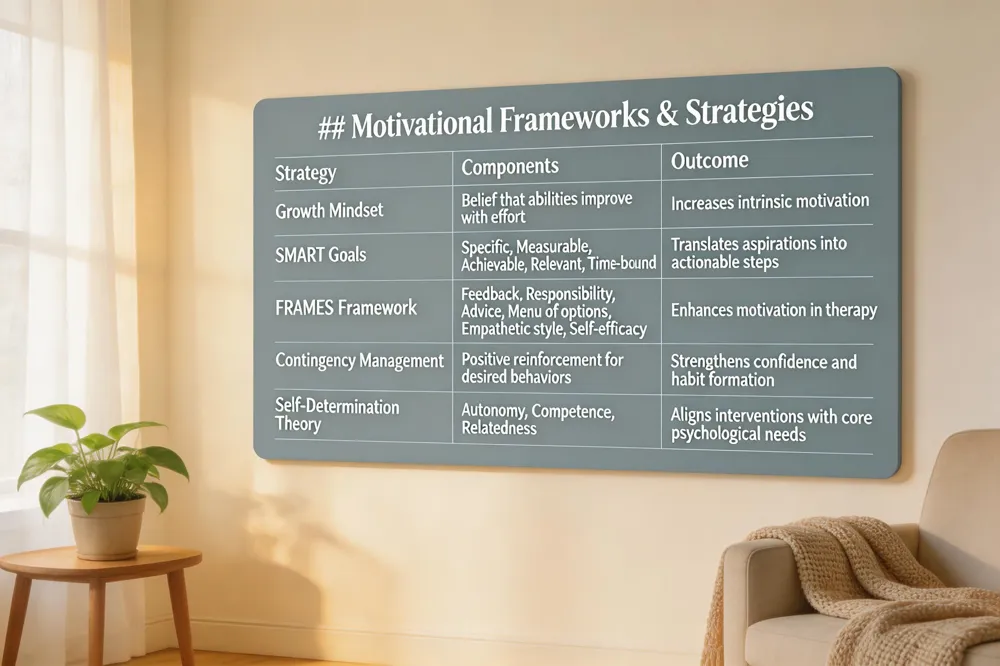 A growth mindset—believing abilities can improve with effort—feeds intrinsic motivation and aligns with self‑determination theory’s needs for autonomy, competence, and relatedness. Using SMART goals (Specific, Measurable, Achievable, Relevant, Time‑bound) translates broad aspirations into concrete steps, while lifestyle changes such as regular exercise, balanced nutrition, adequate sleep, mindfulness practice, and supportive social connections create a foundation for sustained mental health.
Therapy techniques to increase motivation: Practitioners employ the FRAMES framework (feedback, responsibility, advice, menu of options, empathetic style, self‑efficacy) and contingency management to reinforce desired behaviors and boost confidence.
Importance of self‑empowerment: Empowerment restores personal agency, enabling choices that reflect values, improve decision‑making, and reduce anxiety and depression.
How to cultivate self‑empowerment: Increase self‑awareness through journaling or mindfulness, set clear boundaries, practice self‑compassion, adopt a growth mindset, and create step‑by‑step action plans.
How to empower clients in therapy: Build a trusting alliance, co‑create SMART goals, explain rationales, check progress regularly, teach coping skills, and celebrate successes.
Therapeutic strategies for facilitating personal empowerment: Use self‑advocacy exercises, cognitive‑behavioral restructuring, and interpersonal communication tools to help clients articulate needs and make long‑term decisions.
Lifestyle changes for mental health: Incorporate regular physical activity, nutritious meals, consistent sleep, mindfulness or relaxation techniques, and meaningful social interaction to enhance resilience and overall wellbeing.
Empowerment in Social Work and Community Settings
Community & Online Empowerment Resources
| Resource | Service Type | Key Features |
|---|---|---|
| Quenza | Free online counseling platform | Secure video, live‑chat, self‑help tools |
| ReachLink | Free online counseling | Confidential video sessions, resource library |
| Eisenberg Family Depression Center | Free online counseling | Video/CHAT, crisis support, educational materials |
| Collaborative Care Plans | Personalized care preferences | Choice over routines, goals, and care options |
| Technology Portals (telehealth, secure portals) | Access to services | Expands reach, fosters independence |
 Where can I talk to someone about my problems online for free
You can access free online counseling through platforms such as Quenza, ReachLink, and the Eisenberg Family Depression Center. These services provide secure video sessions, live‑chat messaging, and self‑help resources that support individuals coping with depression, anxiety, and other mental‑health concerns.
What are strategies used to empower individuals?
Empowerment starts with offering genuine choice over daily routines, care preferences, and long‑term goals. Practitioners use collaborative, personalized care plans, open communication, and technology (secure portals, telehealth) to expand access and foster independence.
What are empowerment strategies?
Empowerment strategies are intentional practices that give people greater control over their lives and decisions. They involve delegating authority, encouraging self‑advocacy, and providing the resources and support needed for individuals to set and pursue their own goals.
Types of self‑empowerment
Self‑empowerment can be categorized as personal (self‑awareness, realistic goal‑setting), relational (healthy boundaries, assertive communication), emotional (positive self‑talk, gratitude), professional/skill‑based (competency development), and community (supportive networks, collective well‑being).
Personal empowerment examples
Examples include committing to a weekly therapy session, practicing positive self‑talk, learning a new skill, taking responsibility for decisions, and supporting others through active listening.
What type of therapist helps with self‑esteem?
Therapists specializing in self‑esteem typically draw on evidence‑based approaches such as Cognitive‑Behavioral Therapy (CBT), psychodynamic therapy, and humanistic or person‑centered therapy, which provide unconditional positive regard and strengths‑based interventions.
Therapeutic Techniques and Interventions
Evidence‑Based Interventions Overview
| Intervention | Modality | Typical Application |
|---|---|---|
| Cognitive Restructuring | CBT | Challenge distorted thoughts |
| Behavioral Activation | CBT | Increase engagement in rewarding activities |
| Exposure Therapy | CBT/Trauma | Reduce avoidance of feared stimuli |
| Mindfulness & Relaxation | ACT/DBT | Enhance present‑moment awareness |
| Problem‑Solving Skills | CBT/solution‑focused | Systematic approach to obstacles |
| Role‑Playing & Assertiveness Training | CBT/DBT | Practice communication and boundary setting |
| DEAR MAN (DBT) | DBT | Structured interpersonal effectiveness |
| Motivational Interviewing | Client‑centered | Resolve ambivalence, strengthen change talk |
| Solution‑Focused Brief Therapy | Brief therapy | Identify resources and set future‑focused goals |
| ACT (Acceptance & Commitment Therapy) | ACT | Values‑driven action, cognitive defusion |
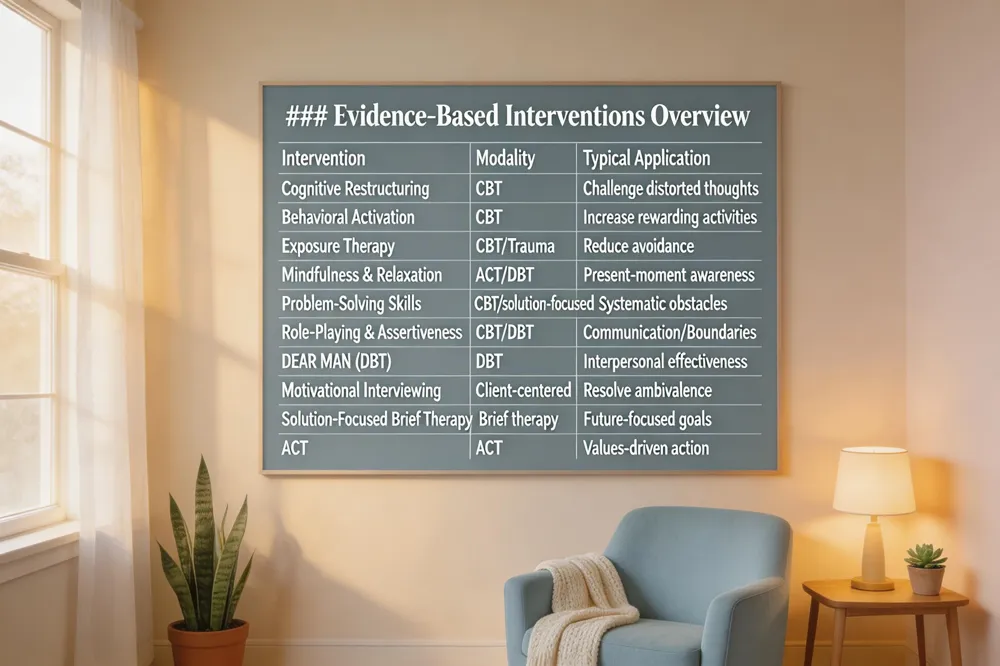 Therapeutic interventions in counseling are purposeful strategies that clinicians use to help clients modify thoughts, emotions, and behaviors and achieve personal goals. They span several evidence‑based approaches, including cognitive‑behavioral techniques, relationship‑based interventions, systemic family therapies, psychoeducation, mindfulness, and expressive arts.
Examples of therapeutic interventions include cognitive restructuring, behavioral activation, exposure therapy, mindfulness and relaxation techniques, problem‑solving skills, role‑playing, assertiveness training, and DBT’s DEAR MAN communication framework.
A concise list of mental‑health interventions covers:
- CBT, ACT, DBT, exposure therapy, EMDR, skills training, behavioral activation;
- Solution‑focused brief therapy, motivational interviewing, active listening;
- Mindfulness‑based practices, gratitude journaling, grounding, somatic movement;
- Strength‑based and empowerment strategies such as collaborative goal‑setting, self‑reflection exercises, and celebrating progress.
The 5 C’s of therapy—Connection, Compassion, Coping, Community, and Care—guide a client‑centered stance.
Self‑therapy blends evidence‑based tools for personal use: cognitive‑behavioral worksheets, brief mindfulness meditations, grounding exercises, and journaling to boost self‑awareness and emotional regulation.
Motivational counseling techniques foster change through reflective listening, open‑ended questions, affirmations, summarizing, and the RULE framework (Resist the righting reflex, Understand motivations, Listen with empathy, Empower the client).
Addressing Specific Concerns and Legal Considerations
Crisis & Legal Safeguards
| Concern | Resource / Guidance | Details |
|---|---|---|
| Suicide Crisis | Suicide and Crisis Lifeline (988) | 24/7 national hotline |
| Emergency Psychiatric Needs | Local Emergency Departments | Immediate in‑person care |
| General Mental‑Health Hotlines | National Suicide Prevention Lifeline (1‑800‑273‑8255) | Free, confidential support |
| 3‑Month Rule (Medication) | Informed consent requirement for first three months | Protects client autonomy |
| Capacity Assessment | Second‑Opinion Appointed Doctor (court‑appointed) | Intervention if client lacks decision‑making capacity |
| Self‑Empowerment Programs (e.g., Julia Flynn Counseling) | Integrated CBT, mindfulness, DEIB education | Structured skill development for personal agency |
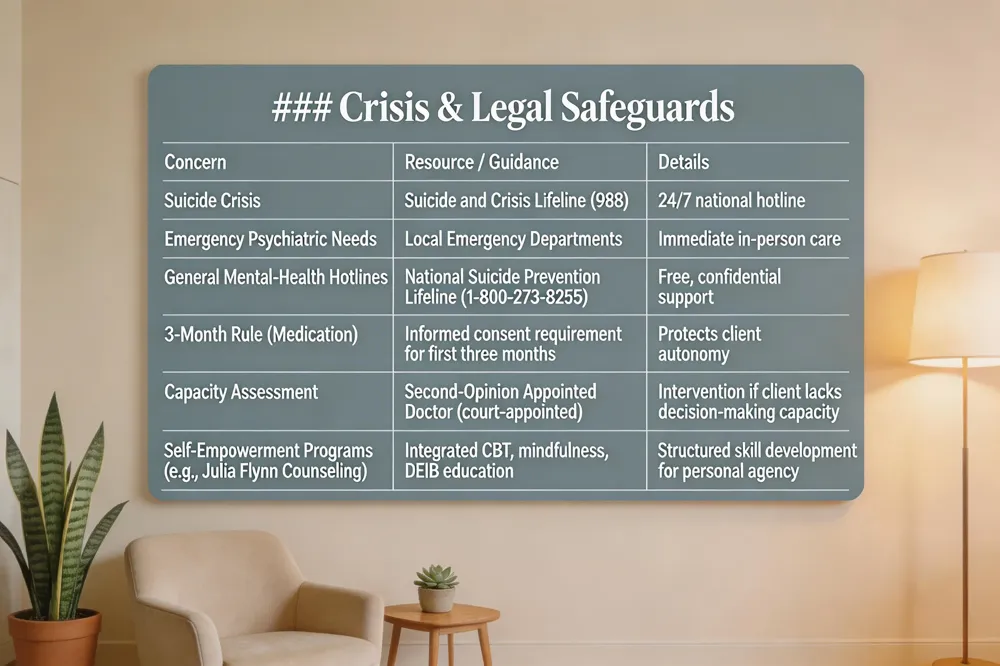 Crisis resources in the United States include the Suicide and Crisis Lifeline (988), local emergency departments, and 24‑hour hotlines such as the National Suicide Prevention Lifeline (1‑800‑273‑8255). The “3‑month rule” is a legal safeguard that bars clinicians from prescribing certain psychiatric medications without informed consent for the first three months of treatment; a Court‑appointed Second‑Opinion Appointed Doctor can intervene if capacity is lacking. Self‑empowerment programs, like those offered at Julia Flynn Counseling, blend evidence‑based techniques—mindful self‑compassion, goal‑setting, assertiveness training, and DEIB education—to give participants concrete tools for lasting personal agency. Self‑help techniques start with daily self‑care habits (exercise, nutrition, sleep, hydration) and mind‑body practices (deep‑breathing, meditation, grounding). Cognitive strategies such as radical acceptance, opposite‑to‑emotion thinking, and mental reframing help replace negative thoughts with balanced perspectives. Empowerment quotes to reinforce motivation: “Don’t be afraid. Be focused. Be determined. Be hopeful. Be empowered.” — Michelle Obama; “Only I can change my life. No one can do it for me.” — Carol Burnett.
Moving Forward With Empowered Practice
Empowerment is not a one‑time event; it becomes a daily practice that shapes every therapeutic encounter. Therapists can weave empowerment into ordinary sessions by using active‑listening, offering genuine empathy, and inviting clients to set their own realistic goals. Simple techniques such as reflective questioning, brief moments of therapeutic silence, and collaborative problem‑solving give clients a sense of ownership and reinforce self‑efficacy. Outside the office, clinicians can recommend evidence‑based resources—journaling prompts, mindfulness apps, or strength‑identification worksheets—so clients continue the growth work at home. Maintaining a personal learning habit, whether through webinars, professional reading groups, or supervision, keeps practitioners up‑to‑date on emerging empowerment strategies. Ultimately, a client‑centered approach means celebrating each small achievement, adjusting plans as needs evolve, and fostering an environment where autonomy, competence, and relatedness thrive together. Therapists can also track progress with simple metrics—rating mood, noting confidence levels, or logging completed tasks—providing visual evidence of growth that motivates continued engagement.