A New Era of Accessible Care
Telehealth delivers mental‑health services through secure video, phone or messaging platforms, allowing clinicians to assess, diagnose and treat patients without the need for an in‑person visit. By eliminating travel, parking and waiting‑room time, virtual care saves hours each week and reduces transportation costs, making therapy more affordable and less stressful for clients who juggle work, school, caregiving or chronic illness. The rapid rise of platforms such as Talkspace, BetterHelp, Teladoc Health and many hospital‑based video‑visit systems has expanded access to licensed therapists across state lines, offered flexible scheduling—including evenings and weekends—and provided asynchronous messaging for ongoing support. Together, these advances create a convenient, private, and client‑centered option that matches the clinical effectiveness of traditional care while reaching people in rural, underserved or mobility‑limited communities.
Clinical Effectiveness and the Evidence Base
 Extensive research shows that telehealth delivers mental‑health outcomes that are essentially equivalent to in‑person care. Large cohort studies of intensive outpatient and partial‑hospitalization programs reported no significant differences in admission scores on the QIDS‑SR or Q‑LES‑Q, with both modalities achieving roughly a 37 % reduction in depressive symptoms and comparable quality‑of‑life gains. Systematic reviews and meta‑analyses of randomized trials confirm these findings: online CBT for depression, anxiety, and PTSD yields effect sizes indistinguishable from face‑to‑face CBT, and patient satisfaction remains high. Scholarly articles highlight key advantages—expanded geographic access, reduced travel time, flexible scheduling, and lower costs—while noting barriers such as inconsistent reimbursement, state licensure constraints, broadband gaps, and reduced non‑verbal cue availability that can affect therapeutic rapport. Telemedicine’s impact on healthcare includes faster appointment access, continuity of care through remote monitoring, and cost savings for both patients and providers. Overall, the evidence base supports telehealth as a viable, evidence‑based modality, provided clinicians address technical, privacy, and regulatory challenges to maintain high‑quality care.
Convenience and Accessibility for Clients
 Telehealth eliminates the need for travel, allowing patients to attend therapy from any location with an internet connection. This removes commuting, parking, and waiting‑room time, reduces transportation costs, and minimizes exposure to infectious illnesses. Flexible scheduling lets clients fit sessions into busy work, school, or caregiving calendars, and many platforms offer evening and weekend slots or asynchronous messaging for urgent check‑ins. For people living in rural or underserved areas, telehealth bridges geographic gaps, expanding the pool of available therapists and specialty services that would otherwise be inaccessible. Studies of intensive outpatient and partial‑hospitalization programs show no significant differences in depressive‑symptom reduction or quality‑of‑life improvement between telehealth and in‑person care, confirming clinical effectiveness. Clients report higher comfort and privacy when speaking from home, which can lower stigma and encourage openness. Providers benefit from lower overhead, reduced no‑show rates, and the ability to observe clients in their natural environment, though they must address technical reliability and maintain HIPAA‑compliant security. Overall, telehealth offers a convenient, accessible, and cost‑effective alternative that maintains therapeutic outcomes while expanding reach to those who need it most.
Financial Considerations and Insurance
 Telehealth removes many financial barriers to mental‑health care. Sliding‑scale fee models are offered by community clinics, university training programs and nonprofit platforms such as Open Path, where a modest membership fee (≈ $65) grants sessions at $40‑$70 each. Large subscription‑based services (BetterHelp, Talkspace) typically charge $69‑$100 per week for unlimited messaging and occasional video, often still lower than traditional hourly rates. When insurance is in place, many plans now reimburse virtual visits at parity with in‑person care; providers bill directly for in‑network coverage and can submit itemized receipts for out‑of‑network reimbursement. Clients without coverage can look for therapists who list sliding‑scale rates on their websites or who participate in Medicaid and other public programs. Free emotional support is available through crisis hotlines (988, Crisis Text Line) and volunteer platforms (7 Cups), though fully licensed therapy usually requires payment. For therapists, premium platforms such as Brightside, Talkspace and BetterHelp offer higher per‑session earnings, especially for specialty services like medication management, making telehealth a viable career option while expanding access for clients.
Challenges, Limitations, and Ethical Concerns
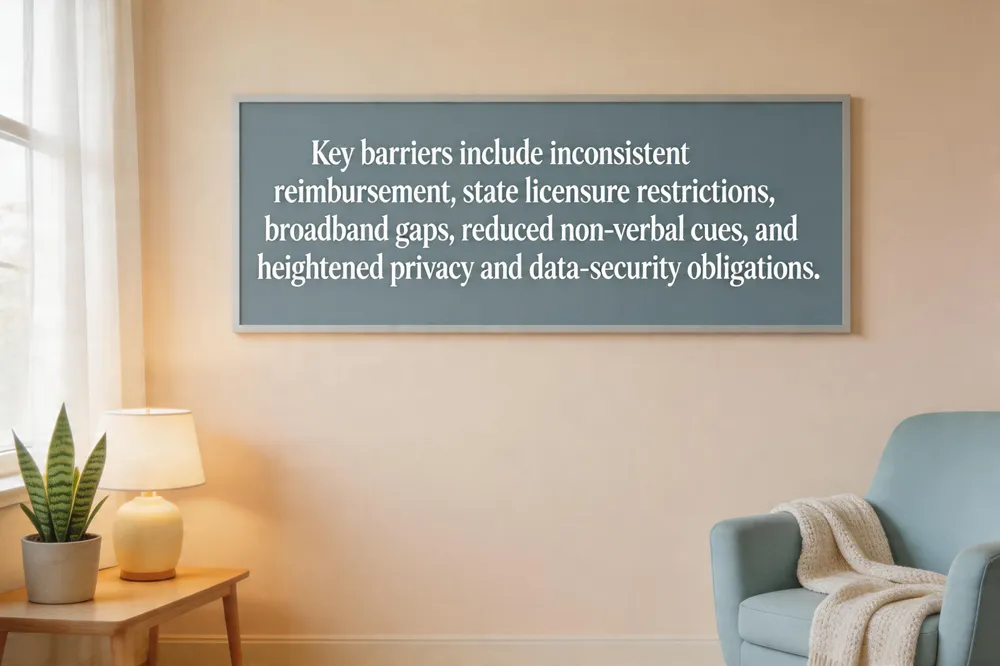 Telehealth offers remarkable convenience, yet it grapples with several practical and ethical hurdles. Reimbursement hurdles remain a persistent obstacle; insurers vary in coverage, and some plans still limit virtual visit reimbursements, creating financial uncertainty for both providers and clients. Licensing and regulation add another layer of complexity, as clinicians must be licensed in the state where the client resides, restricting cross‑state care and complicating therapist matching. Technical barriers such as unreliable broadband, limited device access, and occasional platform glitches can interrupt sessions, reduce therapeutic momentum, and frustrate users. Privacy and data security are critical concerns in telehealth.
These challenges translate into tangible disadvantages: rapport may suffer when non‑verbal cues are muted, severe crises can be harder to manage remotely, and inconsistent outcome data can fuel skepticism. Ethical issues arise around informed consent that explicitly addresses technology limits, safeguarding confidentiality, and maintaining professional boundaries in a virtual setting. Recent scrutiny, such as the FTC’s action against BetterHelp for improper data sharing, underscores the need for robust privacy safeguards and transparent practices to protect client welfare.
Immediate Support and 24/7 Crisis Resources
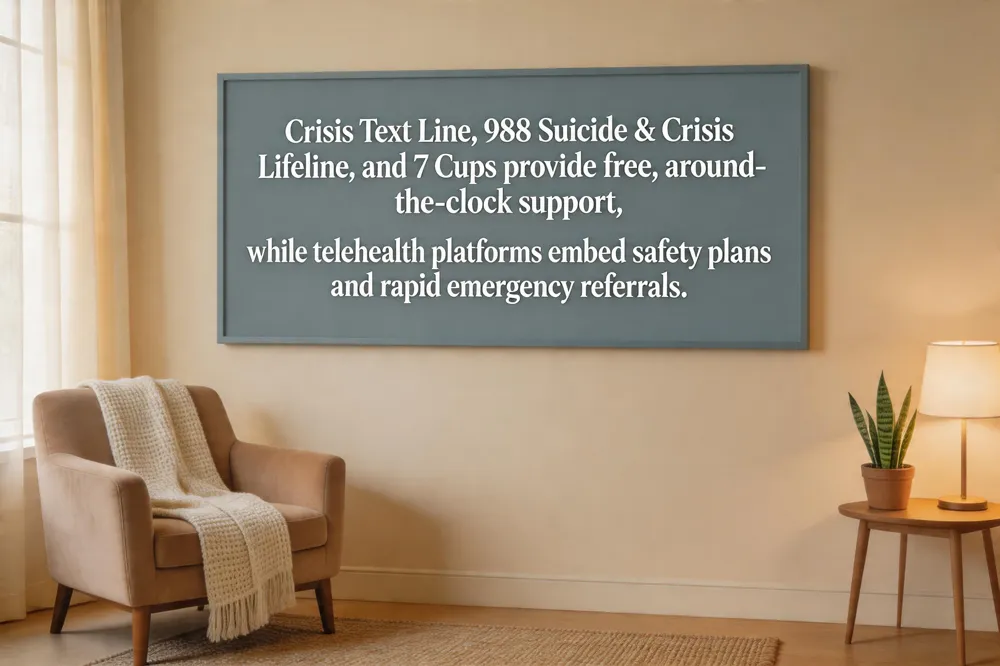 When a crisis hits, having reliable, around‑the‑clock resources can make all the difference. The Crisis Text Line offers free, confidential support 24 hours a day; texting HOME to 741741 connects you with a trained crisis counselor. The national 988 Suicide & Crisis Lifeline not only provides a phone line but also a 24/7 text and chat service, ensuring help is just a tap away. For those seeking a less formal, anonymous ear, 7 Cups matches you with volunteer listeners who are available around the clock at no cost. Emergency protocols for telehealth platforms typically include a clear plan for risk assessment, a safety plan, and a rapid referral to local emergency services if a client is in imminent danger. These services are designed to bridge the gap while you arrange longer‑term therapy, offering immediate relief, safety planning, and a pathway to ongoing professional care.
Provider Perspectives and Workforce Insights
 Therapists broadly recognize that telehealth expands their reach and lowers overhead costs, making it easier to keep appointments and reduce no‑show rates. While clinicians can also observe clients in their home environments, gaining valuable context for assessment. Scholarly articles confirm these provider benefits—greater caseload capacity, reduced travel, and improved continuity of care—while also flagging challenges such as state licensure restrictions, reimbursement complexities, and the need to preserve therapeutic alliance at a distance. PDFs summarizing online counselling highlight core advantages: increased accessibility, cost‑effectiveness, and flexible scheduling that meet diverse client needs. At the same time, therapists report disadvantages, including limited non‑verbal cues, occasional technical glitches, and the difficulty of managing emergencies remotely. When comparing blended treatment (face‑to‑face plus digital components) with pure internet‑based therapy, practitioners tend to view blended models as having fewer disadvantages, especially in settings where therapist experience with digital tools is low. Overall, the evidence suggests that telehealth is a viable, provider‑friendly option, provided that licensing, reimbursement, and safety protocols are carefully addressed.
Practical Tools, Techniques, and Platform Highlights
 What is the 3‑3‑3 rule in therapy?
The 3‑3‑3 grounding exercise helps clients anchor themselves in the present moment. By naming three objects they can see, three sounds they can hear, and three body parts they can move or sensations they can feel, the mind shifts away from racing thoughts and anxiety, fostering calm and emotional regulation.
What is the 3‑3‑3 rule in therapy?
The 3‑3‑3 grounding exercise helps clients anchor themselves in the present moment. By naming three objects they can see, three sounds they can hear, and three body parts they can move or sensations they can feel, the mind shifts away from racing thoughts and anxiety, fostering calm and emotional regulation.
Brightside online therapy Brightside connects users with licensed therapists and psychiatrists through video, secure messaging, and interactive lessons. The platform offers personalized treatment plans for depression and anxiety, rapid appointment scheduling, and insurance acceptance. Clients can also choose a subscription‑based out‑of‑pocket option that includes unlimited messaging and optional live video sessions, making care both accessible and affordable.
How can telehealth improve continuity of care? Telehealth removes travel and scheduling barriers, allowing regular sessions from any private location. Integrated platforms sync with electronic health records, ensuring real‑time documentation and seamless coordination across providers. This continuity supports consistent therapeutic progress, reduces missed appointments, and maintains therapeutic momentum even during life disruptions or public‑health emergencies.
The Future Looks Virtual
Telehealth’s use continues to surge, driven by the pandemic‑era shift and expanding insurance coverage that now make virtual sessions a mainstream option for most mental‑health providers. This sustained growth is complemented by a clear understanding of both its advantages—such as eliminated travel, flexible scheduling, broader therapist choice, and reduced stigma—and its challenges, including the need for reliable internet, secure private spaces, and the occasional difficulty reading subtle non‑verbal cues. Across diverse studies, from large‑scale comparisons of intensive outpatient programs to systematic reviews of CBT for depression and anxiety, teletherapy consistently matches or exceeds in‑person outcomes, confirming its clinical effectiveness. Maintaining this momentum requires a steadfast commitment to evidence‑based care: matching patients with credentialed clinicians, using HIPAA‑compliant platforms, and continually monitoring symptom metrics (e.g., QIDS‑SR, Q‑LES‑Q) to ensure that virtual treatment delivers the same high‑quality results that clients expect from traditional therapy.